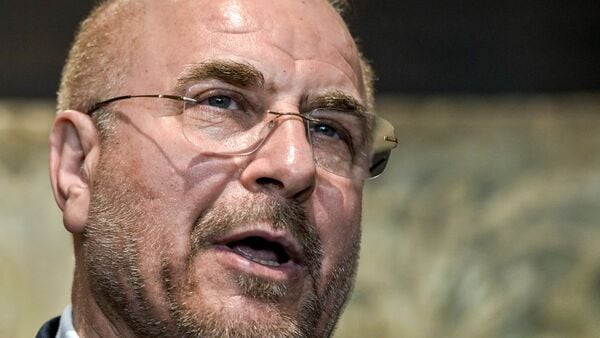
Iranian Parliament Speaker Mohammad Bagher on Monday (Iranian time) mocked US President Donald Trump after he threatened to block the Strait of Hormuz, hours after it was reported that US-Iran peace talks held in Islamabad, Pakistan, failed after 21 hours.
Ghalibaf reminded Washington about the rising . In a post on X, he shared an image depicting the current oil prices near the White House, warning Americans that they ‘will miss them’ soon. He wrote, “Enjoy the current pump figures. With the so-called ‘blockade’, soon you’ll be nostalgic for $4–$5 gas.”
Along with his post, Ghalibaf also shared an equation, “ΔO_BSOH>0 ⇒ f(f(O))>f(O)” to make his point.
What does the formula mean?
Soon after Ghalibaf posted the formula, X users began decoding its meaning. Simply put, the formula explained that if the Strait of Hormuz is blocked, oil or gas prices won’t just undergo a linear price hike; instead, they will enter an explosive, uncontrollable, compounding spiral. This would make the prospect of five-dollar-a-gallon gas seem cheap by comparison.
According to Ghalibaf’s formula, O refers to oil prices, and BSOH refers to the Strait of Hormuz blockade.
The first part of his equation means that as the blockade intensifies, oil prices increase.
The second part shows that the effect doesn’t stop at the initial rise; it continues to amplify over time. An initial price increase is followed by an even larger one, driven by panic, supply disruptions, rising shipping costs, and broader market reactions.
What did Trump say on blocking the Strait of Hormuz?
In a Truth Social post today, wrote, “The United States to Blockade Ships Entering or Exiting Iranian Ports on April 13 at 10:00 AM ET. sic” This would mean the blockade would start at 5:30 pm in Iran and around 7:30 pm (IST).
According to The Guardian, the blocking of the Strait of Hormuz was an attempt by Tehran to seize control of the strategic waterway in the aftermath of the failed peace talks between the two countries over the weekend.
Additionally, he also threatened to bomb the Islamic Republic’s water treatment facilities, power plants, and bridges if it did not agree to abandon its nuclear weapons programme, the key sticking point between the two sides.
The also noted that US warships would “seek and interdict every vessel” that had paid Tehran since the beginning of the conflict, adding that it is beginning the de-mining of the central section of the strait. This was previously declared a “hazardous area” by the ; however, it is unclear how many mines have been laid.
Announcing the blockade on its X account, the US Central Command said the blockade will be “enforced impartially against vessels of all nations entering or departing Iranian ports and coastal areas, including all Iranian ports on the Arabian Gulf and Gulf of Oman.”
It further said, “Additional information will be provided to commercial mariners through a formal notice prior to the start of the blockade. All mariners are advised to monitor Notice to Mariners broadcasts and contact US naval forces on bridge-to-bridge channel 16 when operating in the Gulf of Oman and Strait of Hormuz approaches.”
Iran’s response to Trump’s threat to block the Hormuz Strait
Responding to the warning issued by the US President, Tehran’s Islamic Revolutionary Guard Corps (IRGC) noted that if any warships approached the strait to implement a blockade, which is usually considered an act of war, it would be considered a breach of the current ceasefire and would be dealt with strongly. IRGC also insisted that the remained under Iranian control.
US-Iran peace talks fail
The developments come a day after the US and Iran to reach a deal following meetings between the delegations in Pakistan’s capital, Islamabad, on 10 April. Media reports suggested that both sides blamed each other for failing to reach a deal during the two-week ceasefire, which ends on 21 April. While the US said that Tehran did not accept Washington’s terms and did not agree to relinquish control over the Strait of Hormuz and its nuclear program, the Islamic Republic noted that the US delegation was unable to gain its trust, given the experience of the previous two wars.