Our love affair with the movies, with the very idea of Hollywood, has been hot and heavy for more than a century. We laugh, we cry, sometimes we fight, but we make up in the end.
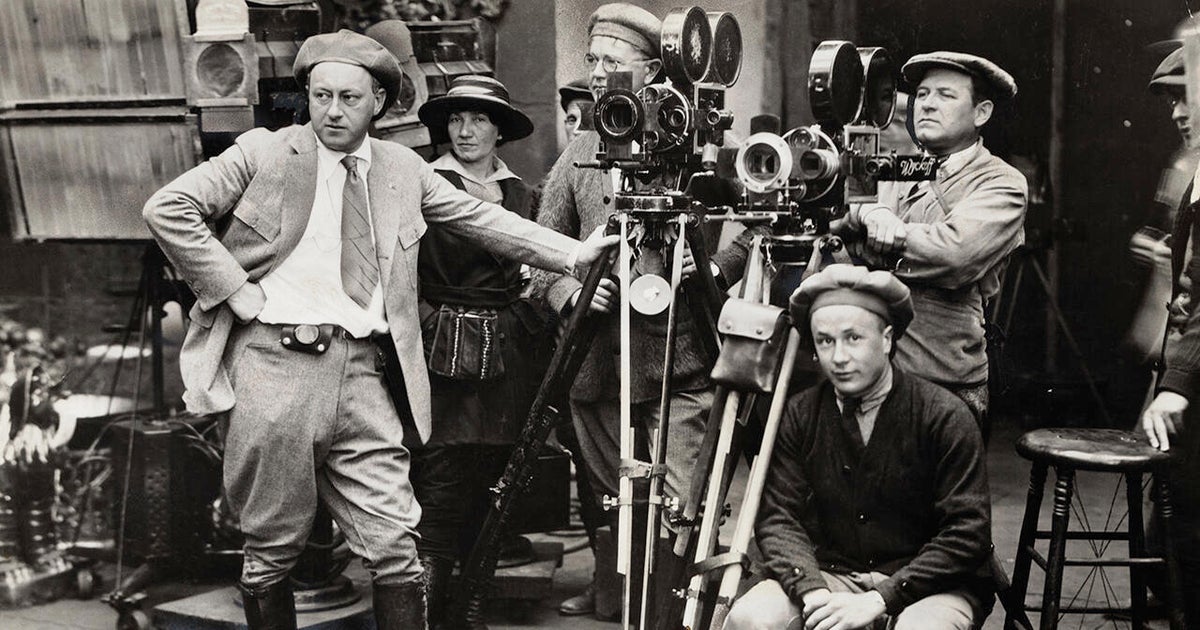
That love affair with the movies started … in a barn. “It’s the oldest structure still standing in Hollywood, built in 1901,” said Angie Schneider. Twelve years later, it became the birthplace of Hollywood’s first feature film, directed by Cecil B. DeMille. The barn then became the site of the first major motion picture studio. It is now home to the Hollywood Heritage Museum. Schneider is its director.
In the 1910s, a lot of filmmakers were beginning on the East Coast, including such pioneers as DeMille, producer Jesse L. Lasky, and Lasky’s brother-in-law, Samuel Gelbfisz (who would later become Samuel Goldwyn, a founding father of Metro-Goldwyn-Mayer). They got the rights to what was the top play at the time, called “The Squaw Man” – a western.
So, DeMille took his small crew west, to Flagstaff, Arizona. But it didn’t look right, or feel right, certainly not in the dead of winter. “So, they went to Los Angeles,” said Schneider. Not only could you have a temperate climate, “you can have an ocean one day, mountains the next,” she said.
DeMille then sent Lasky a telegram to remember: “Want authority to rent barn in a place called Hollywood for $75 a month.”
Schneider’s museum has a copy of that original lease, which was $250 a month. “The Squaw Man” represents not only the first feature film shot in Hollywood; it also appears to be the first lie told by a Hollywood director to a producer.
That studio eventually became Paramount (CBS’ parent company) … one of the five big movie studios of classic Hollywood.
According to actor, producer and director Tony Goldwyn (Samuel Goldwyn’s grandson), many of the founders of Hollywood were poor Eastern European Jews who had come here with a vision of what America was: “These guys were so patriotic, and were trying to impart to America and to the world a vision of what it meant, of what this country was all about,” he said.
It started with the silents, giving way to sound, then the Golden Age, and the bold innovation of the New Hollywood of the 1970s. Then, the blockbusters, and all those superheroes.
Hollywood is an industry, but it is also a metaphor. “Hollywood obviously is a place in Southern California where it all started, and has been the foundation, physically, of the movie industry,” Goldwyn said. “But there is a more lasting version of Hollywood, which is a metaphor for the visual expression of our dreams in motion.”
Charlie Rivkin, the chairman and CEO of the Motion Picture Association, says the immigrants who founded Hollywood were brilliant entrepreneurs: “They built an industry out of whole cloth. It’s the freedom, I think, that’s particularly unique. We are free to tell stories that other countries would hesitate doing. For example, we told a story about the Vietnam War when the wounds were raw (“Platoon,” “The Deer Hunter”). We told the story of America’s role in the financial crisis (“The Big Short”). The fact that we’re free to make those stories – that freedom is what gives us our ability to project Hollywood around the world.”
Patty Jenkins knows something about having a movie projected around the world. She directed “Wonder Woman,” with a box office of more than $800 million.
We spoke on a legendary sound stage, where Alfred Hitchcock shot 1954’s “Rear Window.” “The history of Hollywood is such a delightful, interesting thing,” she said. “So much great history, like the stage we’re on right now, and so many great artists have worked in it.”
But could “Rear Window” be made today? “It could be made, mainly because of Hitchcock, because there was a famous director who already had a track record,” Jenkins said. “Would it be seen? Very little. It would probably end up straight to streaming. It would be a very different world. The great thing about Old Hollywood, in a way, was that they were taking a lot of radical gambles. And those movies were going to the theatre, and that’s what you were seeing.
“So, I think there was a sort of beautiful heyday then – some real art house directors and people doing incredible things got their movies on the big screen, and were very seriously watched,” Jenkins said.
Ever since that first feature film, Hollywood has beaten back a host of challengers: TV in the early 1950s, VHS tapes and DVDs in the ’80s and ’90s. But this latest obstacle, streaming and AI, feels like their biggest threat yet.
Charlie Rivkin disagrees: “In the early days when there were silent movies going to sound, it terrified everybody. Then came color, and people thought, ‘Color? It’ll hurt the entire industry.’ Every single time, Hollywood not only embraced change, but thrived.”
Jenkins said, “The thing that I dislike the most about Hollywood at this moment is the cocky smugness that the story has ended and we know what movies people watch. And so, like, we’ve lost – had lost for the last many years, ‘Oh, this kind of picture works.’ I mean, when I first got here to Hollywood, somebody actually said to me, ‘Well, drama’s dead.’ And I was like, ‘Thousands of years, but now? Wow!’ Storytelling has never changed, you know? It’s an intrinsic need of mankind to tell each other these stories.”
And as long as we need stories, says Tony Goldwyn, storytellers in Hollywood will be up to the task. “I think you’re gonna be seeing a lot of great art come out of the years that we’re living through right now,” he said.
So, would that qualify him as anxious, but not discouraged? “Anxiety breeds action, in my experience,” Goldwyn said. “I mean, I feel very agitated by what’s happening in our world. But I feel, as a result, compelled to get in there, you know, and react to it, and tell stories about it.”
Story produced by Gabriel Falcon. Editor: George Pozderec.