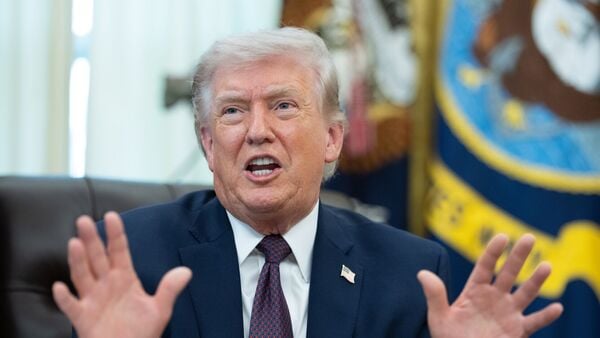
US President Donald Trump has said the US could end its military attacks on Iran within two to three weeks. Tehran, the said, did not have to make a deal as a prerequisite for the war to end.
“We’ll be leaving very soon,” was quoted by news agency Reuters as telling reporters at the White House on 31 March (Local Time).
Trump added the exit could take place “within two weeks, maybe two weeks, maybe three.”
It’s been over a month since the West Asia war began with joint US-Israeli attacks on Iran. Tensions escalated following the killing of 86-year-old Iran’s Supreme Leader, , in the military strikes on 28 February.
In retaliation, Iran targeted Israeli and US assets across several , causing further disruptions to the waterway and impacting international energy markets as well as global economic stability, disrupting trade routes through the Strait of Hormuz.
Deal not a prerequisite, says Trump
Trump also clarified on Tuesday that a deal was not a prerequisite for the US to end “Operation Epic Fury” – the term used for the military strikes on Iran.
“Iran doesn’t have to make a deal, no,” he said. “No, they don’t have to make a deal with me.”
The fresh remarks are clearly a shift from the earlier stand by the US President. On Monday, in the near term and the Strait of Hormuz was not reopened, the US could escalate its response. He said, in a Truth Social post, this could include strikes on Iran’s key infrastructure, including power facilities, oil fields, Kharg Island, and possibly desalination plants, targets he claimed had so far been deliberately avoided.
On Tuesday, in another strong-worded , President Donald Trump publicly attacked two of America’s closest allies — the United Kingdom and France — for refusing to join US military action against Iran.
President Trump accused France of blocking US supply planes and called the UK “cowardly” for not helping reopen the. He also warned both nations they can no longer count on American support, telling them to “build up some delayed courage” and “go get your own oil.”
France and Italy have pushed back against some U.S.-Israeli military operations, sources said, highlighting how divisions between NATO allies have been exposed by the war.
US prepared to continue the war if, says Hegseth
Earlier in the day, US Defence Secretary Pete Hegseth said Trump was willing to make a deal with Iran to end the war that has killed thousands, spread across the region, disrupted energy supplies and threatened to send the global economy into a tailspin.
Talks were ongoing and gaining strength, Hegseth said, but the US was prepared to continue the war if Iran did not comply. “We have more and more options, and they have less … in only one month we set the terms, the upcoming days will be decisive,” Hegseth said in Washington.
Iran’s Revolutionary Guards on Tuesday hit back with a new threat against US companies in the region starting on Wednesday. It listed 18 businesses, including , that would be targeted from 8 PM Tehran time.
On these threats to the companies, President Trump said, “They don’t have much left to threaten,” he said of Iran.
Getting direct messages from Steve Witkoff: Abbas Araqchi
Iranian Foreign Minister said on Tuesday he has been receiving direct messages from US special envoy Steve Witkoff, but they do not constitute “negotiations”, according to Al Jazeera TV.
The messages include threats or exchanged views delivered through “friends,” the Iranian leader said.
, chairman of the Joint Chiefs of Staff, told reporters in Washington on Tuesday that the US military was continuing to strike key manufacturing and research sites and had taken out over 150 Iranian naval vessels.
Iran has remained defiant despite heavy for the past month, as neighbours have been pulled into the conflict. Heavy strikes were reported in the Lebanese capital of Beirut on Tuesday evening, Reuters said, quoting sources.
(With inputs from agencies, Reuters)