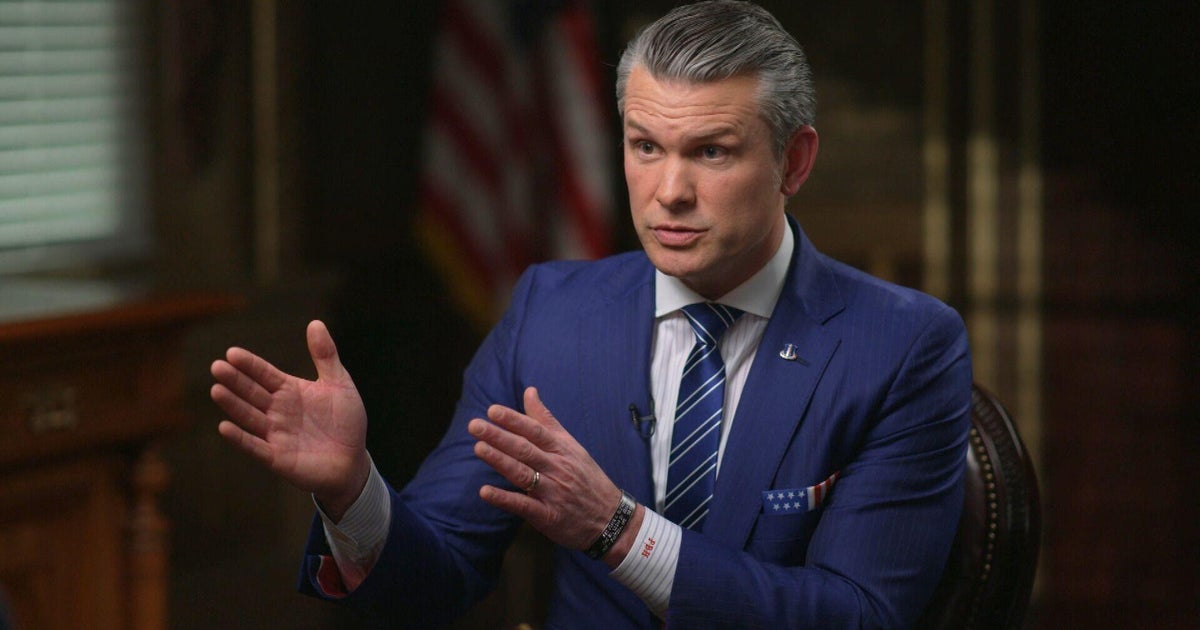
Defense Secretary Pete Hegseth said President Trump’s demand for Iran’s “unconditional surrender” will happen whether Iran wants “to admit it or not, whether their pride lets them say it out loud or not.”
The U.S. said it had already struck 3,000 targets inside Iran when CBS News’ Major Garrett spoke with Hegseth on Friday. Hegseth said there will come a point when Iran will be incapable of fighting.
“This is war. This is conflict. This is bringing your enemy to their knees. Now, whether they will have a ceremony in Tehran Square and surrender, that’s up to them,” Hegseth said.
Iranian President Masoud Pezeshkian called the U.S. demand for surrender “a dream that they should take to their grave.”
But Hegseth says the U.S. is going to step up its attacks on Iran. “What I want your viewers to understand is this is only just the beginning,” he told 60 Minutes.
Last June, during Operation Midnight Hammer, the U.S. launched airstrikes that targeted Iran’s nuclear capabilities.
“They should’ve come to the table and said, ‘OK, we get it. You mean business. We’re not going to have nukes.’ And they haven’t,” Hegseth said. “And as a result, when the president looks at it, generationally, he sees a threat that would continue to gather.”
There are varying versions of how and why the war started when it did. Some normally enthusiastic supporters of the president have criticized him, saying Israeli Prime Minister Benjamin Netanyahu pulled the U.S. into a war that, to their minds, did not put American interests first.
Hegseth argued that is not the case. “We were always controlling the throttle about whether or not we go or not go – and ultimately to advance American interests, and protect American lives,” he said.
The U.S. announced the death of Iran’s hardline supreme leader, Ali Khamenei, on March 1. Hegseth said the roots of the conflict began much earlier.
“They’ve been killing us for 48 years, 47 years,” he said. “They have unabated nuclear ambitions.”
Speaker of the House Mike Johnson last week said the mission in Iran is “nearly accomplished by all estimates.” Hegseth agreed that the plan is on track, but said that the U.S. is “not flying a mission accomplished banner.”
“But we can be clear with the American people that this is not a fair fight. And that’s on purpose,” Hegseth said. “Our capabilities are overwhelming compared to what Iran’s are. And frankly, when you combine our Air Force with the air force of the Israeli Defense Forces, it’s the two most powerful air forces in the world.”
The U.S. has not deployed ground forces in Iran, Hegseth said, but he hasn’t ruled out the possibility.
“President Trump knows, I know, you don’t tell the enemy, you don’t tell the press, you don’t tell anybody what your limits would be on an operation. We’re willing to go as far as we need to in order to be successful,” Hegseth said.
Since the war began, oil shipments through the Strait of Hormuz, through which 20% of the world’s oil flows, have stalled. U.S. gas prices are up an average of almost 50 cents a gallon according to data from GasBuddy. Mr. Trump has said the Strait of Hormuz will be taken care of. Hegseth said that will be accomplished through “American firepower.”
“What was the Iranian Navy is largely no more. There’ll be more boats to be sunk, for sure,” Hegseth said. “So their ability to project any power in that area in a naval sense is…diminishing and will be increasingly diminished. Again, what I want your viewers to understand is this is only just the beginning.”
Six U.S. Army reservists were killed in an Iranian drone attack in Kuwait on March 1. Mr. Trump and Hegseth attended the dignified transfer on Saturday at Dover Air Force Base. One more U.S. service member’s death was announced Sunday afternoon.
“The president’s been right to say there will be casualties. Things like this don’t happen without casualties. There will be more casualties,” Hegseth said. “I mean, especially our generation knows what it’s like to see Americans come home in caskets. But that doesn’t weaken us one bit. It stiffens our spine and our resolve to say this is a fight we will finish.”
So far, more than 1,600 Iranians have been killed, according to a group called Human Rights Activists in Iran. The death toll includes 168 people, mostly children, killed at a school in the southern part of the country, an area the U.S. was attacking at the time.
Neither the U.S. nor Israel has claimed responsibility for the strike. Hegseth said the U.S. is still investigating, noting that’s the “only answer I’m prepared to give.”
“But what I will emphasize to you and to the world is that, unlike our adversaries, the Iranians, we never target civilians,” he told 60 Minutes.
Other countries have been dragged into the war. Iran has launched missiles and drones in nearly a dozen Middle Eastern countries, including American allies Qatar, Bahrain and Saudi Arabia. CBS News has reported that American allies in the region are running low on missile interceptors. Hegseth said the U.S. is prepared to step in and aid its allies.
“Our projections of munitions are well beyond what we would need,” Hegseth said.
“We can crossload for allies if need be, always ensuring that our forces and our troops and our bases are taken care of first,” he said. “But where we can help allies, we will.”
Russia is also playing a role in the war. Multiple sources told CBS News that Russia provided intelligence to Iran on U.S. positions and movements.
Hegseth said the U.S. is “tracking everything” and factoring it into battle plans.
“The American people can rest assured their commander-in-chief is well aware of who’s talking to who,” he said. “And anything that shouldn’t be happening, whether it’s in public or back-channeled, is being confronted and confronted strongly.”
Hegseth was asked whether Russia’s involvement puts U.S. personnel in danger.
“No one’s putting us in danger. We’re putting the other guys in danger, and that’s our job. So we’re not concerned about that. We mitigate it as we need to. Our commanders factor all of this,” he said. “But the only ones that need to be worried right now are Iranians that think they’re gonna live.”
After the U.S strikes on Iran in June 2025, Mr. Trump said that “Iran’s nuclear enrichment facilities have been completely and totally obliterated.”
Despite the administration’s claim, international monitors estimate that Iran still has more than 970 pounds of nearly bomb-grade uranium.
It’s not clear how the U.S. would secure any of that nuclear material that still exists inside Iran.
“I would never tell you or anybody else what our options are,” Hegseth said.
More than a week after dozens of Iran’s top officials were killed, Iran announced Sunday night that a son of its slain leader would replace him. Earlier in the day, Mr. Trump said that any leader Iran picks without his approva l”is not going to last long.”
“This is not a remaking of the Iranian society from an American perspective,” Hegseth said. “We tried that. The American people have rejected that. President Trump called those wars dumb. And we’re not fighting that way.”