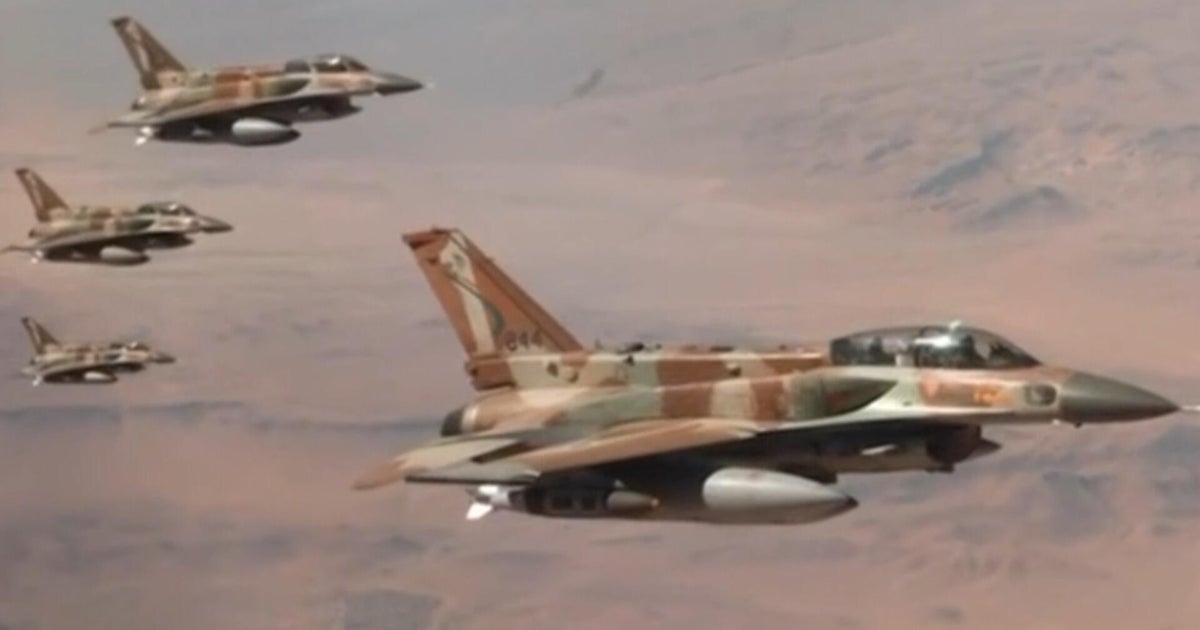
When Iranian state media reported on Friday that an American military UH-60 Black Hawk helicopter had been struck during a search-and-rescue mission over Iranian-Iraqi overlapping airspace, conflict analysts were not the only ones who took notice.
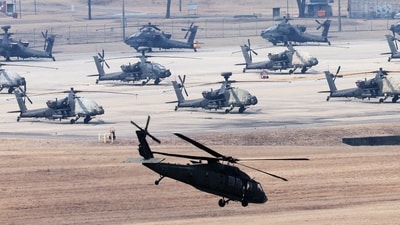
It also served as an instant recall of a popular-culture reference, spanning a 1999 book, a 2001 blockbuster movie, and that night when Osama Bin Laden was killed in 2011. All of this takes the Black Hawk beyond just being .
What happened: Latest in US-Iran war
The chopper was in action for a search-and-rescue operation after a . Social media footage, geolocated by CNN to Khuzestan province in south-western Iran, appeared to show a C-130 transport aircraft and two Black Hawk helicopters flying low as part of that rescue effort.
Iran’s semi-official news agency Tasnim, associated with the regime’s elite military wing Islamic Revolutionary Guard Corps (IRGC), said one of the Black Hawks was “attacked by air defence near the border and fled the scene”. Reports in Iraqi media channels said the helicopter had been shot and fell in Iraq. Neither the Pentagon nor US Central Command officially commented on the chopper, which has been at the forefront of major American military ops.
Know UH-60, importance of Black Hawk name
The UH-60 Black Hawk is built by Sikorsky, a subsidiary of the American defence company Lockheed Martin.
It is named after the Native American war chief Makataimeshekiakiak, also known as Black Hawk, who was a leader of the Sauk tribe in what is now the state of Illinois. He led his people in the Black Hawk War of 1832, which became one of the last armed resistances by a Native American nation against the US government’s efforts to forcibly remove them from their ancestral lands.
He was defeated, captured, and later died in 1838, but his name endured in American culture as a symbol of defiance and bravery.
The US Army has since had a convention of naming its choppers after indigenous or Native Americans people.
Black Hawks have served in combat in Grenada, Panama, , Somalia, the Balkans, Afghanistan, and across the Middle East/West Asia, according to the US Department of War. Over five decades, the helicopter has evacuated the wounded from battlefields, which is what it was reportedly trying on Friday.
It has also inserted special forces troops into hostile territory, hence been in the firing line.
Mogadishu 1993: Where the phrase was born
The phrase “Black Hawk down” entered pop culture in one such moment of enemy fire. On October 3, 1993, when the helicopter was carrying out a raid in Mogadishu, the capital of Somalia, it was struck by a rocket-propelled grenade. The three words were spoken over a radio call by the pilots.
In fact, two Black Hawks went down. About 90 US elite soldiers rushed to the rescue, but they were trapped amid gunfire in an 18-hour battle that left 18 Americans and around 300 Somalis dead. Television networks broadcast footage of mobs dragging the bodies of dead American servicemen through the streets of Mogadishu.
The US had deployed forces to Somalia in 1992 as part of a United Nations humanitarian mission to ensure food aid reached a population ravaged by famine and civil war. Part of the mission later became capturing warlord Mohamed Farrah Aidid, and that set the stage for the Battle of Mogadishu in 1993. Aidid was never captured.
The Battle of Mogadishu triggered an American withdrawal as President Bill Clinton ordered all US forces out of Somalia by March 1994. Aidid later declared himself president of Somalia in 1995, and died a year later in a clash with a rival Somali faction.
After Mogadishu, the United States became deeply cautious about deploying ground forces anywhere, until 2001 when the US went into Afghanistan following the 9/11 attack by Osama Bin Laden-led Al Qaeda. Iraq followed in 2003.
Both those on-ground interventions are now cited as cautionary tales amid plans to deploy ground troops in Iran —
The book and the film
As for Mogadhishu and the two Black Hawks downed, journalist Mark Bowden covered the battle for the publication Philadelphia Inquirer, and later turned his reporting into a book in 1999.
From the book ‘Black Hawk Down: A Story of Modern War’, director made a film in 2001, with a cast that included Josh Hartnett, Eric Bana, Tom Hardy and Orlando Bloom. The was number one at the US box office for at least three weeks.
The timing was significant, as the film had a limited release on December 28, 2001, just as the US was returning to direct military interventions abroad with Afghanistan to avenge 9/11. The premiere was attended by Vice President Dick Cheney, Secretary of Defence Donald Rumsfeld, and several military veterans.
The Pentagon provided active support to the production with equipment, locations, and logistical assistance. This is a long-held convention with Hollywood films in exchange for some influence over how the story is told.
Black Hawk down again: The Bin Laden raid
The Black Hawk’s next defining moment came on May 2, 2011, when US Navy SEALs at a compound in Abbottabad, Pakistan.
The mission was conducted using Black Hawk helicopters that had been secretly modified to reduce their radar signature and acoustic footprint. One of the helicopters crashed during the operation; the team destroyed it before departing, but a section of the tail remained and was photographed.
Analysis of the tail revealed extra blades on the tail rotor and other noise-reduction measures, making the craft considerably quieter than a standard Black Hawk, news agency AP reported. The stealth was designed to fool not Laden, who didn’t have radars, but the Pakistanis.
This moment also later became a movie. The 2012 film ‘, directed by Kathryn Bigelow, depicted the decade-long American spy hunt for Laden.
Iran 2026: Phrase returns?
The downed F-15E on Friday would be the fourth US plane lost in Operation Epic Fury, the military campaign against Iran, but the first acknowledged to have been shot down by the Iranians. Of its two-member crew, one was reported to have been rescued while the other was reported missing, at the time of writing this report. The exact fate of a Black Hawk was also shrouded in mystery after a number of choppers were engaged in the rescue mission.