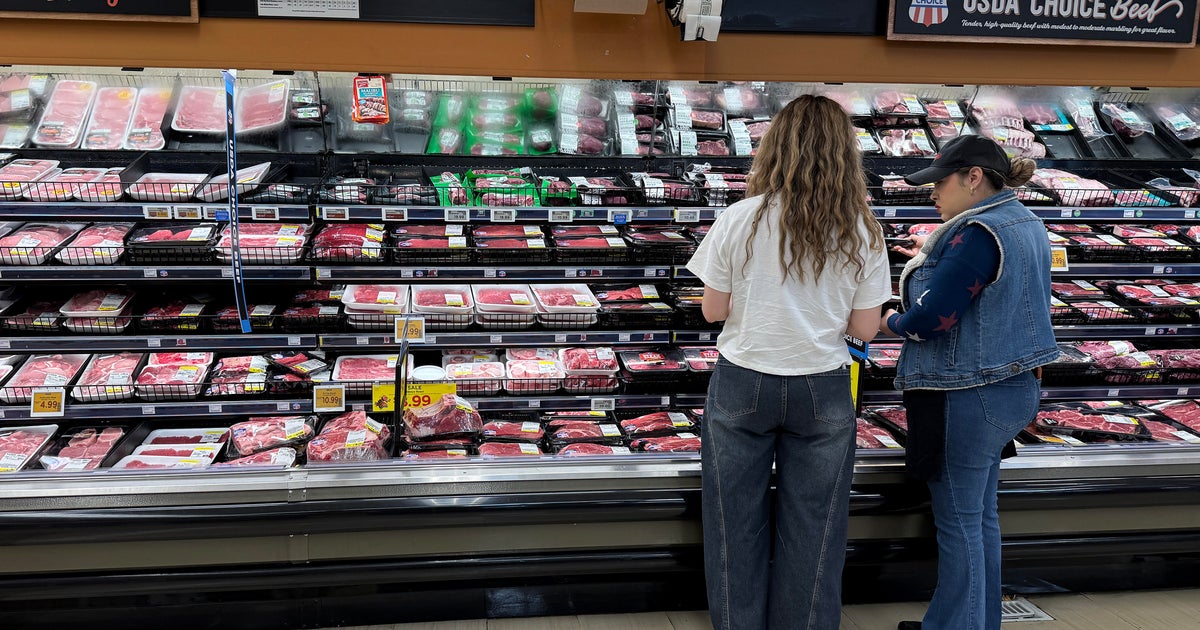
While the cost of other food staples, like eggs, has sunk in the last year, ground beef prices remain searingly high. Data from the Federal Reserve Bank of St. Louis shows that ground beef prices were $6.70 a pound in March, up nearly 16% from a year ago. Beef steaks, which were $12.73 per pound in March, are also up 16% from a year ago.
In 2021, by comparison, ground beef cost as little as $3.96 a pound, while a decade ago it averaged $3.75.
Unfortunately for beef lovers, those prices aren’t likely to recede anytime soon.
“There is nothing to suggest any relief from high beef prices,” said Derrell Peel, a professor of agricultural economics at Oklahoma State University.
In fact, beef prices could even rise in the short-term, offering Americans little relief at the grocery store as summer barbecue season heats up.
In its latest forecast, the U.S. Department of Agriculture estimated that beef prices will climb more than 10% in 2026, and perhaps by as much as 18%.
“I would expect beef prices to remain high for the remainder of this year and potentially into next year as well,” said David Ortega, a food economist at Michigan State University.
Beef costs are continuing to surge amid a recent burst in inflation caused by the Iran war, which is driving up global oil and fuel prices. The Consumer Price Index last week showed that inflation in March jumped 3.3% from a year ago, almost a full percentage point higher than the previous month’s reading.
The conflict in the Middle East could also push food prices higher in the coming months as a spike in diesel prices lifts transportation costs. The increase wouldn’t be immediate, but could potentially flow through to perishables like beef in the coming months, Ortega said.
“Higher diesel prices are going to affect costs all along the agri-food supply chain, from my running a combine, to transporting the grain that livestock producers need, to then transporting the actual processed beef products to the store,” he added.
As of March, U.S. food prices overall had risen nearly 20% from January 2022, according to the CBS News Price Tracker.
Although inflation stemming from the Iran war isn’t helping, it’s not the main factor driving up beef prices. The main culprit, according to economists: U.S. cattle herds have shrunk, but Americans’ appetite for beef has not. And a basic rule of economics is that prices tend to climb when demand outstrips supply.
The number of beef cows in the U.S. fell to less than 28 million in January, down 1% from the year prior and the lowest levels since the 1960s, according to data from the Department of Agriculture. The agency attributes the drop to worsening drought conditions in the U.S., which it said is reducing the amount of pasture for cattle to graze, forcing ranchers to turn to more costly feed, and in some cases to cull their herds.
That came to a head in 2022, when a drought hit the western U.S., a key region for beef production. The same year, Russia invaded Ukraine, pushing up feed costs and making it more expensive to maintain cattle, Ortega said.
“It became costly to hold on to livestock. So [ranchers] sold a lot of those animals,” shrinking herds and making it harder to expand future beef supplies, he explained, noting that cattle take longer to reproduce because they have a long gestation period.
So far, higher beef prices haven’t done much to deter U.S. shoppers. Data from NielsenIQ shared with CBS News shows that, as of late March, unit sales for beef are down only 4% year-over-year, while dollar sales (the revenue companies take in from beef purchases) were up 8%. The global marketing research firm aggregates sales data from U.S. grocery stores, dollar stores and other retailers across the country.
Demand for “beef has not diminished,” Andrew Coppin, CEO of Ranchbot, a Fort Worth, Texas-based company that sells water-monitoring technology to ranchers, recently told CBS News. “It’s actually taken more wallet off pork and chicken, so it’s been faring better even in a moderate inflation environment,” he said.
If there’s a sliver of hope for consumers, it’s that cattle herds have room to rebound. Ortega pointed to USDA data showing that ranchers are slaughtering fewer cattle and increasing the number of female beef cows — a sign they could be prioritizing breeding and replenishing herds.
“High prices are what signal producers to rebuild the herd and expand supply,” he told CBS News. “Because of these high prices, we may start to see additional supply in future months and years that will then sort of help moderate these high prices.”