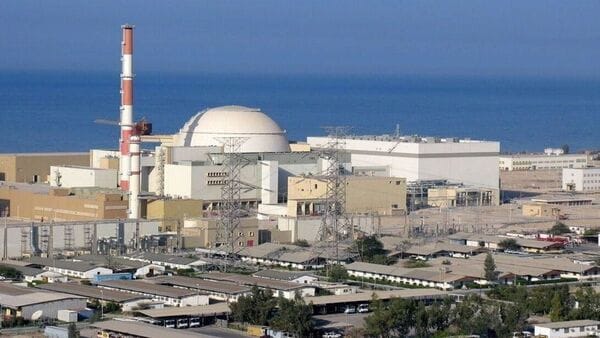
Iranian Foreign Minister Abbas Araghchi said on social media that any further strikes on the Bushehr nuclear power plant could trigger radioactive fallout with severe consequences for capitals across the Gulf Cooperation Council (GCC), not Tehran.
He also slammed Western governments for what he described as their silence over repeated attacks on the facility, located about 750 kilometers south of the Iranian capital.
The plant, which generates around 1,000 megawatts of electricity, operates using low-enriched uranium supplied by Russia and is supported by Russian technicians, according to AP.
Aragchchi asked, “Remember the Western outrage about hostilities near Zaporizhzhia Nuclear Power Plant in Ukraine?”
“-U.S. have bombed our Bushehr plant four times now. Radioactive fallout will end life in GCC capitals, not . Attacks on our petrochemicals also convey real objectives,” he said.
A projectile from a US-Israeli strike landed near Iran’s Bushehr nuclear power plant on Saturday, killing one person, state media reported, as the country’s foreign minister cautioned against further attacks on the facility.
According to the official IRNA news agency, this was the fourth strike on the area since the conflict with the United States and Israel began on February 28.
The plant, located on Iran’s southern Gulf coast, was not damaged in the incident, though a security guard at the site was killed.
“Following the US-Zionist criminal attacks, this Saturday morning, around 8:30 am, a projectile hit the area near the Bushehr nuclear power plant in the southwest,” IRNA mentioned.
The International Atomic Energy Agency (IAEA) said there had been no rise in radiation levels following the attack.
As per a post by the agency on X, the agency’s chief Rafael Grossi urged for “maximum military restraint to avoid risk of a nuclear accident”.
UN Security Council to vote on draft resolution calling for Hormuz reopening
The secretary-general of the GCC on Thursday urged the UN Security Council to approve the use of force to safeguard the from Iranian attacks.
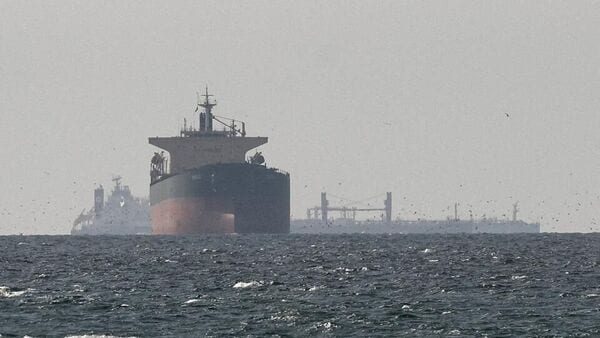
Iran has tightened control over the vital shipping route in response to US-Israeli strikes that sparked the month-long conflict, raising concerns over fuel supplies and putting pressure on the global economy.
Jassem al-Budaiwi, head of the , stated, “Iran has closed the Strait of Hormuz, prevented commercial vessels and oil tankers from transiting, and imposed conditions on some to pass through the Strait.”
He made the remarks in New York during the first Security Council meeting focused on cooperation with the GCC, which includes Saudi Arabia, the United Arab Emirates, Bahrain, Qatar, Kuwait, and Oman.
“We call upon the Security Council to assume its full responsibility and take all necessary measures to protect maritime routes and ensure the safe continuation of international navigation,” al-Budaiwi further said.
Meanwhile, the UN Security Council is set to vote on a draft resolution proposed by Bahrain on Saturday calling for the reopening of the Strait of Hormuz, despite opposition from permanent members China and Russia to earlier versions that included provisions for the use of force, as per a PTI report.
The revised draft affirms that the Strait of Hormuz must remain open to all transit and states that no country has the authority to block or control it.
It also authorises nations to take “strictly defensive measures” to ensure safe passage and prevent any actions that could disrupt international shipping through the waterway.