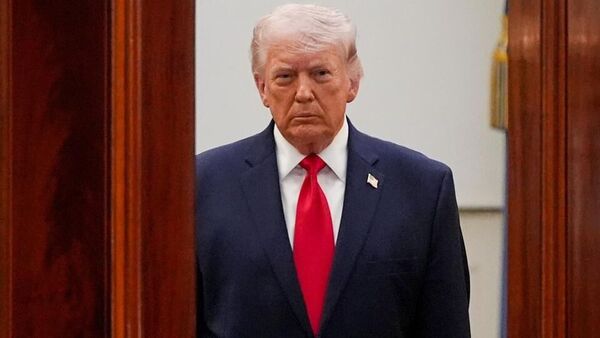
US-Iran War Fallout: The transatlantic alliance that rebuilt the West after the Second World War and held the line through the Cold War is, by several accounts, closer to collapse than at any point in its history. According to a report in the Wall Street Journal, Donald Trump has privately floated the idea of withdrawing the United States from NATO.
What Triggered the Latest Crisis: The Iran War Europe Didn’t Sign Up For
The immediate fault line is the US-Israeli military campaign against Iran, a war that European governments were not consulted on, do not recognise as legal, and have refused to join.
Trump, according WSJ report citing people familiar with his private conversations, has reacted with fury. The US President has reportedly expressed “disgust” towards European allies for staying on the sidelines, and has discussed with aides and journalists the possibility of the US walking away from the North Atlantic Treaty Organisation altogether.
The sentiment broke into the open this week when Trump told Britain’s The Telegraph: “We would always have been there for them. They weren’t there for us.” European assistance with the Strait of Hormuz, he said, should have been “automatic,” in the same way the US had automatically supported Ukraine, which “wasn’t our problem.”
Europe’s Response: We Were Never Obligated to Join Your War
European governments have not been passive. Several, including France, the United Kingdom, Italy and especially Spain, have placed explicit restrictions on how the US can use their air bases and airspace in the prosecution of the Iran campaign. Requests to deploy European naval forces into the Strait of Hormuz while active hostilities continue have been flatly rejected.
The legal basis for that refusal is straightforward, European officials argue. NATO’s founding charter is a mutual-defence pact covering Europe and North America. It carries no obligation for member states to participate in US military campaigns of choice in the Persian Gulf or anywhere else beyond that geographic scope.
What makes the European position particularly pointed is the reminder of what the alliance has already given. Since NATO was founded in 1949, its collective-defence clause has been triggered exactly once, after the September 11 attacks in 2001. European nations answered that call, committed troops to Afghanistan, and bore several thousand casualties fighting alongside American forces. Trump’s suggestion, made in January, that those allies had hung back from frontline combat was, European diplomats noted, factually incorrect.
“The offense taken to those comments in Europe was palpable and deep, in a way that many in the US didn’t register,” WSJ quoted Philippe Dickinson, a former British diplomat and deputy director of the Transatlantic Security Initiative at the Atlantic Council.
Formal Withdrawal Would Face Legal and Political Obstacles in Washington
Pulling the US out of NATO is not, in practice, something a president can do by executive order. Congress passed legislation in 2023 stating that the president cannot withdraw from the NATO treaty without either Senate approval by a two-thirds majority or a new act of Congress. That provision was co-sponsored by Marco Rubio, now Trump’s secretary of state.
In the Senate this week, Mitch McConnell and Chris Coons issued a rare joint statement across party lines affirming that NATO serves American national security. The legislative pushback is real, if not yet decisive.
Military historian Phillips O’Brien of the University of St Andrews pointed to additional constraints: “Congress would balk, the US still wants to sell weapons to European allies and pulling out would reduce US leverage in world affairs.”
Some European officials are reading Trump’s threats as a pressure campaign rather than genuine intent, an attempt to extract greater European support for the Iran operation through the threat of abandonment. Polish Foreign Minister Radoslaw Sikorski was less sanguine, posting on X that allies must take the breakup scenario seriously: “Of course, we want to be a good, loyal ally of the United States, but we cannot pretend that the US President isn’t saying what he is saying.”
Britain Pivots Toward Europe. The Signal Is Unmistakable.
The clearest sign of the alliance’s shifting centre of gravity may be coming from London. UK Prime Minister Keir Starmer, who has been publicly belittled by Trump on multiple occasions, announced this week that Britain is reorienting its economic and security posture towards Europe.
After a year that included sweeping US tariffs on European goods, the near-abandonment of Ukraine, mockery of European leaders, and threats to seize Greenland from Denmark, European public opinion has hardened considerably. Governments that might otherwise have sought compromise find themselves constrained by electorates that have run short of patience.
“The US is going to be a more lonely superpower, at a higher cost to itself,” said Fabrice Pothier, chief executive of geopolitical consulting firm Rasmussen Global to Wall Street Journal. “Trump is kicking and screaming because he made a unilateral move with only Israel and now he’s realising it’s pretty heavy lifting.”
What Happens Next: An Alliance That Could Dissolve Without Anyone Formally Ending It
No decision has been made, US officials say, and NATO has survived crises before. But the scenario its architects most feared, not a dramatic rupture but a slow hollowing out of credibility and commitment, is now a live possibility. The US could remain a treaty signatory whilst slashing its military presence in Europe and making clear, through word and deed, that Article 5 guarantees are conditional.
European defence budgets are rising, but the continent remains years away from being able to guarantee its own security without American backing. The urgency of that transition has never felt more pressing, nor the timeline more uncertain.