Artemis II will launch from on April 1, with a two-hour launch window starting 6:24 pm EDT (3:54 am IST). It’s the United States’ first crewed lunar mission in nearly 50 years — after the historic Apollo program.
Four astronauts — three American and one Canadian — will fly around the Moon during the 10-day mission. NASA said that the four members will fly by the far side of the Moon at altitudes of approximately 3,000 to 9,000 miles.
Artemis II flight will carry astronauts farther from Earth and closer to the Moon than any human has been in over half a century, while also testing the Orion capsule and venturing further into deep space than anyone has gone before.
Here, we explain how NASA will send and bring back Artemis II astronauts and compare the Artemis II flight path to that the
How NASA will send and bring back Artemis II astronauts
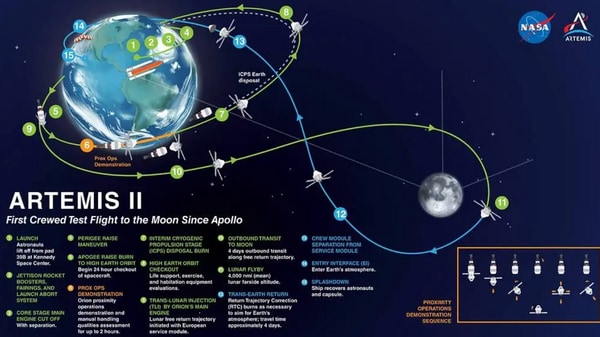
The Artemis II mission will unfold over 10 days — from launch on April 1 to splashdown on April 10. During the mission, the Orion spacecraft, carrying the four astronauts, will fly two orbits of Earth and then venture around the Moon in a figure-eight pattern before returning to Earth.
After the launch on April 1, SLS (Space Launch System) rocket’s main engines will cutoff, and sometime later, the interim cryogenic propulsion stage (ICPS) will fire again, raising the spacecraft into a high-Earth orbit. The crew will have about 23 hours to do a thorough checkout of Orion’s systems. About three hours into the mission, NASA will test how Orion handles.
After astronauts spend three to four days checking and making scientific observations, the Orion spacecraft is expected to enter the lunar sphere of influence on flight day 5, “marking the point at which the pull of the Moon’s gravity will become stronger than the pull of the Earth’s gravity.” The crew will then test their spacesuits.
The orange suits, officially called the Orion crew survival system, protect the crew during launch and reentry, but also could be used in an emergency to provide the crew member wearing it with a breathable atmosphere for up to six days if Orion depressurised.
The Artemis II crew will then come their closest to the Moon on flight day 6, while traveling the farthest from Earth, NASA explained. Here, Artemis II could set a record for the farthest anyone has travelled from Earth, depending on launch day. The crew will swing around the far side of the Moon.
Orion will exit the lunar sphere of influence the morning of flight day 7. In the following days, the crew and the ground team will note some observations. The crew will assess their ability to protect themselves from high radiation events like solar flares.
They will also try out Orion’s manual piloting capability by steering the spacecraft through a variety of tasks.
Orion will exit the lunar sphere of influence the morning of flight day 7.
On Flight Day 9, the crew will prepare to return to Earth. On Day 10, the crew will return their cabin to its original set-up – with equipment stowed and seats in place – and get back into their spacesuits.
All eyes will then be on the reentry — one of the most crucial moments for any spaceflight. It will be a key test for the crew module’s Orion heat shield.
How will Artemis II crew re-enter the Earth?
“A final return trajectory correction burn will ensure Orion is on the right path for splashdown,” NASA said.
On the last day, the crew module will separate from the service module, whose engines have steered them around the Moon and back to Earth.
This will expose the crew module’s heat shield, which will protect the spacecraft and crew as they make their way back through Earth’s atmosphere.
Once safely through the heat of reentry, the cover that protected the spacecraft’s forward bay will be jettisoned to make way for a series of parachutes to deploy.
There are two “drogue parachutes” that will slow the capsule down to about 307 miles per hour, followed by three pilot parachutes that will pull out the final three main parachutes.
“These will slow Orion down to approximately 17 mph for a splashdown in the Pacific Ocean, where NASA and U.S. Navy personnel will be waiting for them, concluding the Artemis II mission,” NASA explained.
Key test for Orion’s spacecraft
The Orion spacecraft heat shield had experienced an “unexpected loss of charred material during re-entry of the Artemis I uncrewed test flight.” Since the, NASA and its engineers have worked around the clock to fix the issue.
Once safely through the heat of reentry, a few moments later, parachutes will open and Orion will slow down for a splashdown in the Pacific Ocean, where NASA and US Navy personnel will be waiting for them, concluding the Artemis II mission.
Watch | How Artemis II spacecraft will will make the figure 8
After completing checkout procedures, Orion will perform the next propulsion move, called the translunar injection (TLI) burn. The service module will then provide the last push needed to put Orion on a path toward the Moon.
The TLI burn will send crew on an outbound trip of about four days and around the backside of the Moon where they will ultimately create a figure eight extending over 230,000 miles from Earth before Orion returns home.
How is Artemis II’s path different from that of Apollo’s?
NASA explained that the astronauts will be looking at the Moon from a “unique perspective” during Artemis II, as they will be passing by at a much higher altitude (between 4,000 and 6,000 miles from the surface) compared to the Apollo missions (~70 miles from the surface).
View full Image
How Artemis II astronauts will see the Moon | Visual Representation
They will see the entire disk of the Moon, including areas near the north and south poles. At closest approach, the Moon will appear to the Artemis II cr
ew to be about the size of a basketball held at arm’s length.
View full Image
What is Lunar far side?
The lunar far side is the area of the Moon that is not visible from Earth. Some people call the far side – the hemisphere we never see from Earth – the “dark side”, but that’s misleading.
This is because the Moon is rotating at the same rate that it revolves around Earth (called synchronous rotation), so the same hemisphere faces Earth all the time.
NASA explained that from Earth, one can watch the Moon’s phases play out across its familiar near side. Because half of the Moon is always illuminated, the far side also goes through phases beyond our line of sight.
During a full Moon, the near side is in full sunlight while the far side is in full shadow. Meanwhile, a “new moon” occurs when the far side of the Moon has full sunlight, and the side facing us is having its night.
“Depending on their launch date, the crew of NASA’s Artemis II mission may become the first humans to see regions of the lunar far side…in sunlight,” it said.