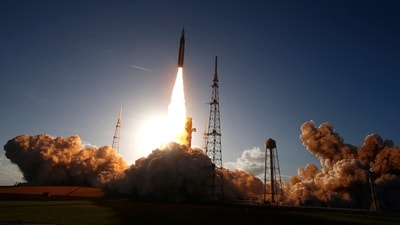
NASA launched its mission on Wednesday, the first crewed lunar flyby in more than 50 years. Four astronauts, three Americans and one Canadian, were lifted off from Florida’s Kennedy Space Center at approximately 6:35 pm local time.
Who are the 4 NASA astronauts on the Artemis II mission?
The team, clad in bright orange suits with blue trim at the time of the launch, includes Americans Reid Wiseman, Victor Glover and Christina Koch along with Canadian Hansen.
During final checks before Artemis 2 was deemed a go for launch, astronauts gave brief words: “We are going for all humanity,” said the Canadian aboard, Hansen.
Read More:
Artemis launch director Charlie Blackwell-Thompson then addressed the astronauts directly.
“Reid, Victor, Christina and Jeremy: On this historic mission, you take with you the heart of this Artemis team, the daring spirit of the American people and our partners across the globe, and the hopes and dreams of a new generation. Good luck. God speed Artemis 2. Let’s go,” she said.
When will the 4 astronauts return to Earth?
NASA’s Artemis II crew is scheduled to splashdown on April 10, 2026, following a 10-day journey around the Moon.
The return sequence will be one of the most intense phases of the mission. The Orion spacecraft is expected to reenter Earth’s atmosphere at roughly 25,000 miles per hour (40,000 km/h), marking the fastest reentry speed ever attempted for a crewed vehicle.
The capsule will then deploy parachutes for a controlled descent before splashing down in the Pacific Ocean off the coast of San Diego at approximately 8:06 PM EDT.
Read More:
Recovery teams from the US Navy will already be positioned in the designated zone, using a San Antonio-class amphibious transport dock to retrieve both the astronauts and the Orion capsule shortly after landing.
Artemis II timeline
The mission itself has followed a structured timeline. The initial days in orbit will focus on testing life support systems and conducting proximity operations around Earth. By Day 6, the spacecraft will reach its farthest distance, looping around the far side of the Moon in a critical flyby maneuver. The return journey will then involve series of trajectory correction burns to ensure a precise reentry path back to Earth.
Once safely recovered, the astronauts will be transported for immediate medical evaluations. NASA scientists will also conduct physical performance tests—including obstacle-based assessments—to better understand how quickly the human body readjusts to gravity after extended time in deep space.