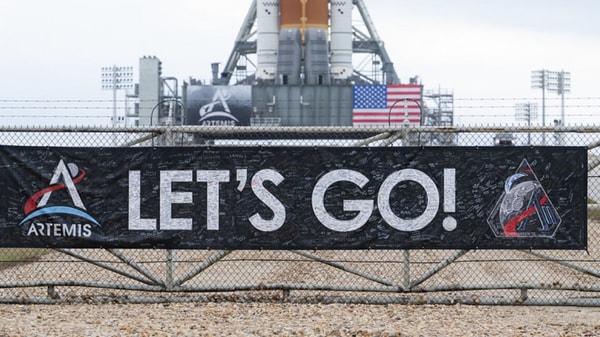
“To succeed, planning alone is insufficient. One must improvise as well” – Isaac Asimov, Foundation
Houston, we have a new Moon mission!
More than five decades have gone by since the last Apollo mission successfully “ended the beginning of lunar exploration”. A similar moon-bound mission has now been resurrected by the United States and the National Aeronautics and Space Administration (NASA). It’s called Artemis II, and astronauts have famously called it “The ‘Twin Sister of Apollo”.
NASA’s Artemis II mission is a follow-up to Artemis I, which was launched in 2022. They both are part of the Artemis series — the US’s new lunar landing programme. The difference between Artemis I and Artemis II is that the latter will carry humans around the moon.
But, unlike the Apollo programme, this new Artemis programme doesn’t just aim for the Moon. It goes beyond — all the way to Mars. The next in line is Artemis III mission in 2027 and Artemis IV in 2028, which will aim to land American astronauts on the Moon’s lesser-explored South Pole.
What is Artemis II?
Before reaching Mars, NASA wants a pit stop at the darker, colder side of the Moon — “the lunar South Pole” — and the Artemis program is a path towards that goal.
NASA says the Artemis II mission is a “practice run” that will set the stage for future Artemis missions that focus on taking humans back to the Moon’s surface, “exploring areas the Apollo astronauts did not, staying longer, learning more, and making new discoveries.”
Artemis II is NASA’s first Moon mission in the last 50 years — the first one since the Apollo program. It’s a key test flight that will set the stage for Artemis IV, when humans are expected to land on the “lunar South Pole for the first time and set up a long-term presence there.” [NOTE: NASA recently to include a mission before the actual landing attempt]
It will be a 10-day mission, with four astronauts voyaging around the moon and soaring as high as 250,000 miles from Earth. The mission will provide critical data for the Artemis III mission – the first crewed landing on the Moon since Apollo 17.
Get, set, go! Artemis II take-off date
If all goes well, NASA is set to launch the much-awaited Artemis II mission on April 1. The launch window had open in February 2026. Some setbacks in pushed the launch to April.
View full Image
Artemis II Apollo: Classic siblings
What’s in a name? Well, Artemis, as the name for a moon mission, tells a story. Let us introduce you to the classic twins: “Apollo, the musical poet. Artemis, goddess of the hunt”
In Greek mythology, Artemis and Apollo are twins and the children of Zeus. Over time, Apollo became associated with the sun and Artemis with the moon, explained Greek mythology expert Liv Albert, in an article shared by the Museum of Liverpool.
Likewise, Artemis astronauts have called this latest moon mission the “twin sister of Apollo” in true essence. Artemis mission specialist Jeremy Hansen said, “Artemis is the twin sister of Apollo. That’s intentional.”
Artemis II Apollo: Twins…with a Twist
The Apollo programme (1961-1972) achieved the seemingly impossible: landing the first humans on the Moon.
Fifty years later, the Artemis mission brings in the new era of a lunar exploration programme that not only aims to get humans back to the Moon, but to set foot where no human has ever been before: the Moon’s South Pole.
Artemis also goes beyond the moon. It’s America’s next step towards exploring Mars.
“Yes, we are returning to the moon. Yes, we are moving in an accelerated fashion to get to the surface of the moon. But, for different from Apollo, we are going back to the moon to establish a sustained presence on the moon,” Lakiesha Hawkins of NASA said.
“We want to demonstrate long-term capability on the surface of the moon. We are going to continue to add capabilities on the surface of the moon,” she added.
One special aspect that makes Artemis different from Apollo is, “We are going with commercial and international like-minded partners, and we are demonstrating those capabilities so that we can go on the next destination,” said the acting deputy associate administrator.
“We have got our eyes set further deeper into space, on to Mars and further destinations. And so, we honour the Apollo missions and what was done and even the flag that was left behind. We are planning to go to the moon again for a sustained presence,” she said.
What’s so exciting about the Artemis II mission?
“…to me, having a human space flight, crewed mission that is going around the moon for the first time in more than 50 years is incredibly exciting,” said Charlie Blackwell-Thompson, the director of the Artemis II mission, in a podcast with NASA.
Artemis II is the first mission of NASA’s Artemis program that will carry humans around the Moon, but not land them on the lunar surface. The crew will travel two orbits around Earth and then head on to the Moon, 250,000 miles from Earth.
“There’s only one primary goal of Artemis II is to prepare this spacecraft for Artemis III and for our NASA astronauts to go land on the Moon,” Artemis II astronaut Reid Wiseman said.
It is also the next step in America’s journey to Mars — in fact, the first human journey to the Red planet.
View full Image
What will Artemis II do?
The Artemis II mission will have the four astronauts test the Orion spacecraft in a high Earth orbit. The crew will travel approximately 4,700 miles beyond the far side of the Moon.
Checking Critical Systems
The crew will verify “spacecraft system performance in the space environment” and “assess the performance of the life support systems.”
This also includes the inspection of the communication and navigation systems to confirm that humans are ready for the trip to the Moon.
Astronauts will continue to evaluate the spacecraft’s systems, including demonstrating Earth departure and return operations, practicing emergency procedures, and testing the radiation shelter, among other activities.
As part of the activities, the crew “will remove the Orion Crew Survival System suit they wear for launch and spend the remainder of the in-space mission in plain clothes, until they don their suits again to prepare for reentry into Earth’s atmosphere and recovery from the ocean,” NASA says.
Making a giant ‘8’ – Lunar flyby
Four Artemis II crew members will fly by the lunar far side at an altitude of approximately 3,000 to 9,000 miles.
After placing Orion into a high-Earth orbit, the service module will provide the last push needed to put the spacecraft on a path toward the Moon.
A manoeuvre called Trans-Lunar Injection (TLI) will send the crew on an outbound trip lasting about four days.
They will travel around the backside of the Moon, where they will ultimately follow a figure-eight-shaped path, extending over 230,000 miles from Earth before Orion returns home.
View full Image
This simply means that at the farthest point, the astronauts will be more than 230,000 miles away from Earth.
After completing this loop, the Orion spacecraft will come back to Earth. The spacecraft will be pulled back naturally by Earth’s gravity for the free return portion of the mission.
How will Orion go about the Moon? Watch full trajectory here
Meet Artemis II rocket and spaceship — SLS & Orion
The Artemis II test flight from Kennedy Space Centre will be NASA’s first mission with crew aboard the Space Launch System (SLS) rocket and Orion spacecraft.
The Space Launch System (SLS) is the rocket that will take four astronauts into lunar orbit. The crew will ride on and pilot the Orion spacecraft aboard NASA’s powerful new rocket.
NASA says the SLS is the only rocket that can send Orion, astronauts, and cargo directly to the Moon in a single launch.
Artemis II is the second rigorous test flight of the integrated system. It’s been designed to thoroughly test all systems of the SLS rocket and the Orion spacecraft.
Boeing is among the industry partners who helped design the Artemis II mission. Boeing built and tested the core stage for the first two Artemis missions, and production for the Artemis III, IV, and V stages is underway, NASA says.
View full Image
Meanwhile, NASA’s Orion spacecraft will launch atop the SLS rocket, carrying and sustaining the crew on Artemis missions to the Moon and returning them safely to Earth.
Orion is NASA’s newest spacecraft, developed to send astronauts to the Moon and is a key part of eventually sending them on to Mars.
Another key feature is the “launch abort system”. It is positioned at the top of the spacecraft and is only used to pull the crew module and the astronauts inside it safely away from the rocket in the event of an emergency.
View full Image
Key test for Orion
Artemis II is a key mission to test the Orion spacecraft which suffered anomalies during Artemis I mission.
In December 2024, NASA said that after extensive analysis and testing, the agency identified the “technical cause of unexpected char loss” across the Artemis I Orion spacecraft’s heat shield.
What was the issue in Orion’s heat shield? NASA engineers said when Orion was returning from its uncrewed mission around the Moon, gases generated inside the heat shield’s ablative outer material called Avcoat were not able to vent and dissipate as expected. This allowed pressure to build up and cracking to occur, causing some charred material to break off in several locations.
View full Image
Who will ride on Artemis II spaceship?
Amit Kshatriya, deputy associate administrator, Moon to Mars Program Office, NASA Headquarters in Washington said, “Our early Artemis flights are a test campaign, and the Artemis I test flight gave us an opportunity to check out our systems in the deep space environment before adding crew on future missions.”
He added, “The heat shield investigation helped ensure we fully understand the cause and nature of the issue, as well as the risk we are asking our crews to take when they venture to the Moon.”
Four astronauts and four CubeSats, or small satellites, will be hitching a ride inside the rocket’s Orion stage adapter (OSA). All four Artemis II CubeSats are provided by countries that are signatories of the Artemis Accords.
“So far, what we’ve got confirmed is three CubeSats that are fully integrated. One is from Germany. That is an assessment of radiation effects on electronics,” said Lakiesha Hawkins, acting deputy associate administrator, Exploration Systems Development Mission Directorate, NASA.
She said the second one is with Saudi Arabia, a series of instruments that will check out space weather. “The third is from South Korea, called K Rad…that one is going to be checking out the biological effects of radiation,” Hawkins said.
Once deployed, these instruments will be able to go off independently, access all of their test and science objectives.
With Artemis, NASA aims to study the Moon to learn more about the origin and history of Earth, the Moon, and our solar system. The lessons learned from Artemis will eventually pave the way to Mars and beyond.
View full Image
Stars in Spacesuits: Meet the astronauts
Artemis II will launch with four astronauts on board. They are:
Commander Reid Wiseman
View full Image
He is a 27-year Navy veteran. He earned a Bachelor of Science degree from Rensselaer Polytechnic Institute in Troy, New York, and a Master of Science in Systems Engineering from Johns Hopkins University in Baltimore.
Hailing from Maryland, Wiseman was selected as an astronaut by NASA in 2009. His first spaceflight was in 2014 when he served as Flight Engineer aboard the International Space Station for Expedition 41.
Pilot Victor Glover:
View full Image
A California native, Glover was selected as a NASA astronaut in 2013. He previously served as the pilot of NASA’s SpaceX Crew-1 mission to the International Space Station as part of Expedition 64 in 2018 – his first spaceflight mission.
He earned an undergraduate engineering degree as a two-sport athlete. Glover is a Naval Aviator and was a test pilot in the F/A‐18 Hornet, Super Hornet and EA‐18G Growler.
Mission Specialist Christina Koch:
View full Image
She was selected as a NASA astronaut in 2013 and most recently served as a flight engineer onboard the International Space Station as part of Expeditions 59, 60, and 61. In 2018, she was assigned to her first space flight, a long-duration mission on the ISS.
A native of Grand Rapids, Michigan, Koch set a record for the longest single spaceflight by a woman with a total of 328 days in space and participated in the first all-female spacewalk. She is a recipient of several awards, including the Neil Armstrong Award of Excellence.
Mission Specialist Jeremy Hansen
View full Image
With the Artemis mission, Hansen will become the first non-American to ever venture to the Moon. Born January 27, 1976, in London, Ontario, he also served as a fighter pilot.
In 2017, Jeremy Hansen became the first Canadian to be entrusted with leading a NASA astronaut class, which means that he is in charge of training astronaut candidates from the United States and Canada.
He holds a Bachelor of Science in Space Science (first class honours) from the Royal Military College of Canada in Kingston, Ontario (1999). He earned a master of Science in physics from the same institution in 2000, with a research focus on Wide Field of View Satellite Tracking.
Artemis to explore Moon’s South Pole — WHY?
NASA’s Artemis campaign will send astronauts to the Moon’s South Pole region, marking the US’ first return to the lunar surface in more than 50 years.
India’s Chandrayaan 3, Russia’s Luna 25 and China’s Change mission were among lunar mission that attempted landing on the Moon’s South Pole. In August 2023, India became the first country to soft-land on lunar south pole and the fourth country overall, after the US, Russia and China, to land on Moon.
View full Image
Why is the Moon’s south pole so important?
NASA views lunar south pole exploration as a key step towards reaching Mars in future. The Moon’s south pole is thought to contain water ice, which is a valuable resource for future exploration.
Studying rocks and ice there can help scientists understand: the Moon’s formation, the early solar system and the origin of water and volatile materials.
“Water is a critical material for NASA’s plans to develop an enduring presence on the Moon. Instead of relying solely on resources carried from Earth, astronauts could use the Moon’s water for breathable air, rocket fuel, and more,” NASA says.
It adds that the water on the Moon is mostly found as molecules within lunar regolith, the dusty and rocky material that covers the Moon’s surface, but there may be ice deposits below the surface of the lunar South Pole.
“There is currently a gap in our understanding of how lunar ice is distributed at small scales, from 10s of centimeters up to 10s of kilometers,” said Rick Elphic, NSS lead at NASA’s Ames Research Center in California’s Silicon Valley, where the instrument was developed in collaboration with Lockheed Martin Advanced Technology Center in Palo Alto, California.
“The only way to understand the ‘where’ and ‘how much’ of lunar ice is by exploring on the surface at these scales,” he added.
Besides ice water, the lighting conditions in the lunar south pole also enables unique opportunities, keeping in view how the south pole has unusual sunlight patterns.