US secretary of defene Pete Hegseth on Monday said that the coordination call held by national security officials during the mission to rescue the F-15E weapons systems officer (WSO) lasted nearly two days straight, starting just hours after the jet was downed by Iran over its territory.
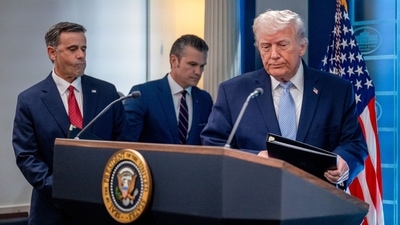
Speaking in front of a room packed with reporters at the White House alongside US President Donald Trump, CIA director John Ratcliffe and Joint Chiefs of Staff, Air Force General Dan Caine, Hegseth said the mission was “unblinking”.
“For 45 hours and 56 minutes, we held that call open for coordination,” Hegseth said, describing the call that was held in a secure facility. “Our mission was unblinking.”
Hegseth continued, “The meeting never stopped. The planning never ceased.”
The rescue mission came amid rising concern about the nearly six-week-long war’s effect on the global economy, including a sharp rise in fuel prices. The conflict has also hit Trump’s approval ratings and intensified anxiety among Republicans about November’s midterm elections.
The rescue
Donald Trump announced the rescue in the early hours of Sunday in a social media post that described the operation in a mountainous area as “one of the most daring” such missions in US history.
The airman, the weapons officer of an F-15 jet shot down on Friday, was wounded but “will be just fine”, Trump said in a message on X. The jet’s pilot was rescued later that day.
According to US media reports, US commandos slipped deep into Iran undetected under cover of darkness and scaled a 7,000‑foot (2,100-metre) ridge to take the stranded American weapons specialist to safety, moving the airman toward a secret rendezvous point before dawn on Sunday.
Iran’s military has called it “a deception and escape mission”, insisting it was “completely foiled”.
Two MC-130 aircraft that had ferried some of the roughly 100 special operations forces into rugged terrain south of Tehran suffered mechanical failures and could not take off, a US official told Reuters.
Their commanders made a high-risk decision, ordering additional aircraft to fly into Iran to extract the group in waves — a decision that left the elite commandos waiting for a couple of tense hours.
The rescue force was pulled out in stages, and US troops destroyed the disabled MC‑130s and four additional helicopters inside Iran rather than risk leaving sensitive equipment behind.
Iran said several US aircraft were destroyed during the operation, including two military transport planes and two Black Hawk helicopters. It also alleged that the operation may have been a cover to “steal enriched uranium” from the Islamic Republic.
Iran’s foreign ministry spokesman Esmaeil Baqaei said there were “many questions and uncertainties” about the operation.
“The area where the American pilot was claimed to be present in Kohgiluyeh and Boyer-Ahmad Province is a long way from the area where they attempted to land or wanted to land their forces in central Iran,” Baqaei said.
“The possibility that this was a deception operation to steal enriched uranium should not be ignored at all.”
He added that the operation was “a disaster” for the United States.