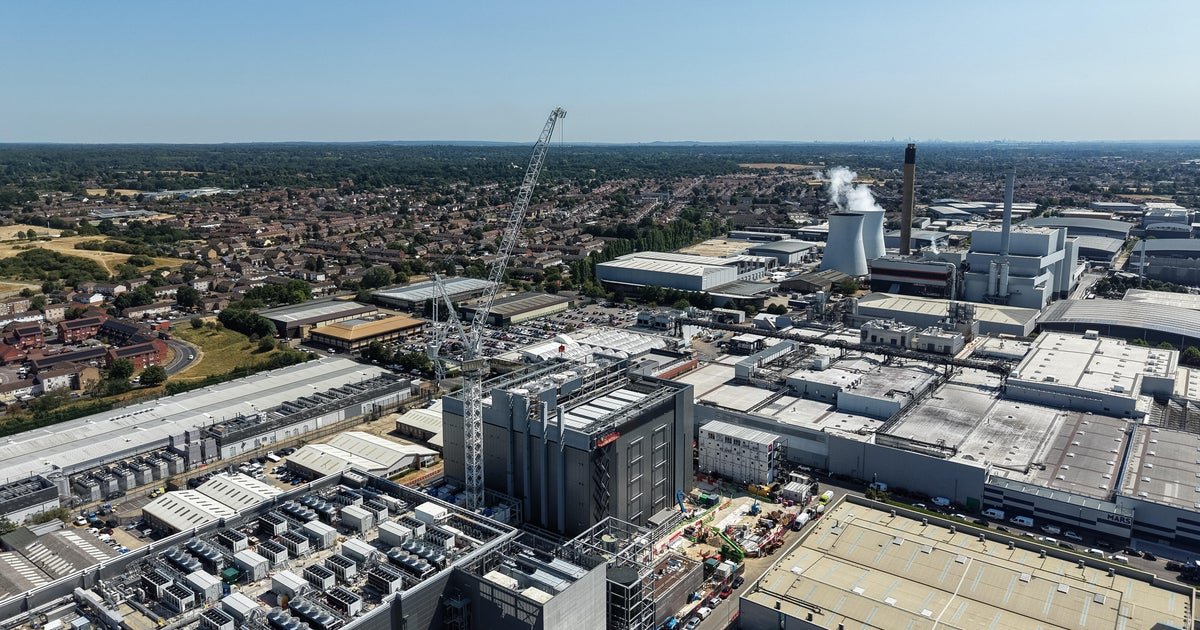
Slough, England — Residents of the small industrial town of Slough, just west of London, told CBS News the soaring temperatures have been difficult to bear this year as Britain records its hottest summer ever. But emerging research suggests Slough may have had it particularly rough, as it sits next to the second largest data center hub on the planet.
“Slough is very hot. Every year we think this is the hottest, and then the next year it gets hotter than the last,” Nabeel Nawaz, who runs a restaurant in the center of the town, told CBS News as he sweltered through a July heatwave with temperatures in the 90s.
The low hum of cooling units on Slough’s massive data center hub, less than two miles from the heart of the town, provides a non-stop soundtrack for the surrounding area.
The coolers regulate the temperature of the hundreds of computer servers inside the cavernous buildings, of which there are about 40 in Slough, transferring excess heat from the machines into water or air and then venting or evaporating the heat into the atmosphere outside.
Many of the data centers around the world work this way, and all that excess heat could be creating a “heat island effect,” increasing local temperatures by an average of 3.6 degrees Fahrenheit, with extreme localized temperature spikes of up to 16 degrees, according to research published by scientists at the University of Cambridge earlier this year.
“We tried to work at scale. We started to look at data centers we could identify around the world and we found around 11,000 locations,” Andrea Marinoni, a co-author of the research paper, told CBS News. “The temperature increase that we found was consistent in different areas of the world.”
While the research by Marinoni and his colleagues did not include Slough’s data center hub, he told CBS News the sheer scale of the facility raises even bigger questions about the potential impact of a heat island effect for residents in the densely populated area.
“There are more and more situations where these data centers are concentrated in one single plot of land,” he said. “So, this is an experiment, in the sense that the compound effect of all of these different facilities very close to each other has not been studied yet.”
CBS News compared local weather station data on daily temperatures in and around the data center campus in July to two other nearby towns, Windsor and Uxbridge, and found Slough was just over one degree warmer on average over the course of the month.
“It’s really hot. I cannot sit down without a fan here, whereas normally in the morning, 9 a.m., 10 a.m., it should be fine without a fan, so maybe it’s to do with that,” Khadija, who lives in a neighborhood right next to the data center complex, told CBS News. She declined to give her full name.
A spokesperson for Digital Realty, a real estate company that maintains some of the data centers in Slough and provides services to U.S. tech giants including Amazon and Microsoft, told CBS News that “any large development, whether it’s a warehouse, a mall, a parking lot, can contribute to localized warming by replacing natural land cover with pavement and buildings.”
“We keep heat output low by operating our facilities efficiently, using light-colored roofing and paving that reflect rather than absorb solar energy, maximizing green space and tree cover, and minimizing paved surface area,” the spokesperson said. “The result is a smaller heat footprint than you might expect and significantly better than the industry average.”
Experts who spoke with CBS News agree that any concrete structure can increase local temperatures, but some say the infrastructure associated with data centres like the ones in Slough could amplify that effect significantly.
“The part where data centers are a little bit different is they are often a giant block, so as far as built environments go, it’s the worst you can imagine for the urban heat island effect,” Ladd Keith, an Associate Professor of Planning at the University of Arizona, told CBS News Thursday.
“As we see more data centers of this scale being built around the world, we need more evidence on how much waste heat is being emitted by them in different geographies and different climates,” he said. “I think one other really important question is, is this a bubble for data center building, or will it be sustained and continue for a longer time?”