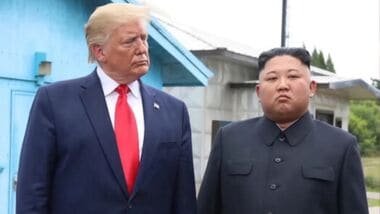
US President wants to revive his personal diplomacy with North Korean leader , even as he has turned up pressure on , a longstanding US ally.
Earlier this week, Trump said he was expected to meet Kim later this year. Trump’s statement came days after he ordered the Pentagon to scale back joint military exercises with South Korea. But Pyongyang has responded coolly to his overturns, saying the reduction in drills does not amount to a goodwill gesture and that US policy towards North Korea remains hostile.
The contrasting approach towards the two halves of the Korean peninsula raises an important question: why is Trump again reaching out to Kim, despite earlier summits not producing the desired results, while putting pressure on Seoul?
Experts say the answer lies partly in Trump’s transactional approach to alliances, changing US military priorities and a fundamentally different strategic position for North Korea compared with Trump’s first term.
Why does Trump want to meet Kim again?
Trump has long favoured leader-to-leader diplomacy with Kim.
During his first term, Trump held three meetings with the North Korean leader in 2018 and 2019, including a historic summit in Singapore. The talks generated hopes of a breakthrough on North Korea’s nuclear programme but ultimately failed to produce a comprehensive agreement.
North Korea has since expanded its nuclear and missile capabilities and strengthened its military relationship with Russia. That means the strategic environment surrounding any new Trump-Kim engagement would be very different from that of 2018.
Eugene Park, a historian of East Asia, said Trump’s renewed interest reflects both changing strategic circumstances and his longstanding preference for personalised diplomacy.
“North Korea occupies a considerably stronger geopolitical position than it did during Trump’s first term,” Park said, pointing to its advances in nuclear and missile capabilities and its closer relationship with Moscow.
North Korea’s support for Russia in the Ukraine war has also increased its geopolitical importance. At the same time, China has an incentive to remain engaged with Pyongyang to prevent it from moving too far into Russia’s orbit, Park said.
Trump, meanwhile, has repeatedly described his relationship with Kim as positive and has increasingly referred to North Korea as a nuclear power.
The latest US outreach comes as Washington remains heavily engaged in the war with Iran. Reuters has reported that Trump is eager to restart talks with North Korea and secure an international diplomatic win.
Dr Jojin V. John, assistant professor at the School of International Relations and Politics at Mahatma Gandhi University, said the current Trump administration’s approach appears more bilateral and deal-focused than the broader regional strategy pursued during his first term.
“Developments toward North Korea should be interpreted on their own terms rather than as part of a single, unified ‘US regional approach’,” John said.
He added that one possible factor behind the renewed attention to Northeast Asia could be the timing of the US midterm elections, which can alter political incentives and foreign-policy priorities.
Why is Trump pressuring South Korea?
Trump’s decision to scale back US-South Korea military exercises has brought the alliance into focus.
The annual Ulchi Freedom Shield exercise was cut short after Trump described the drills as costly and “hostile” towards North Korea. He also linked his criticism of Seoul to South Korea’s reluctance to support the US in its efforts over Iran.
For Seoul, the exercises are an important part of preparing for a potential conflict with North Korea. For Pyongyang, they have long been portrayed as rehearsals for an invasion.
Trump’s decision therefore serves two possible purposes: reducing an obstacle to dialogue with Kim and pushing South Korea to assume greater responsibility for its own defence.
But Park cautioned against treating Trump’s pressure on Seoul and his outreach to Pyongyang as a single negotiating tactic.
“I would hesitate to interpret this primarily as an effort to use North Korea as leverage against South Korea,” Park said.
Instead, he sees both policies as expressions of Trump’s broader transactional approach to alliances and international security.
The US faces greater demands on its military resources, including commitments in the Middle East, while Washington and Seoul are also discussing greater South Korean involvement in defence production and security responsibilities, Park said.
“The alliance is moving toward a more balanced division of responsibilities,” he said.
John similarly described the Trump administration’s approach as bilateral and deal-focused. He said Trump’s increased criticism of South Korea and renewed interest in North Korea should be understood separately.
“The South Korea posture likely reflects pressure and bargaining tactics, while the North Korea signals reflect an effort to test whether direct diplomacy can yield concessions,” John said.
But does Kim want to meet Trump?
This could be the biggest obstacle to Trump’s plans.
North Korea has not responded positively to Trump’s latest overtures. Kim’s influential sister, Kim Yo Jong, rejected the idea that Washington’s decision to scale back military exercises represented a meaningful goodwill gesture. North Korea also launched about 10 ballistic missiles off its east coast, according to South Korea’s military.
That response is significant because North Korea is entering any potential negotiations from a stronger position than it had during Trump’s first term.
Back then, Pyongyang was seeking sanctions relief and had fewer strategic alternatives. It is now more closely aligned with Russia and China and has considerably stronger nuclear and missile capabilities.
John said this has fundamentally altered Pyongyang’s calculations.
“North Korea is no longer as isolated as it once was,” he said. “From Pyongyang’s standpoint, this places it in a stronger position, meaning denuclearisation has arguably moved farther down the priority list or is no longer a credible expectation.”
North Korea could also use renewed engagement with Washington to increase its strategic autonomy from both Beijing and Moscow.
“The ultimate aim for North Korea remains regime survival and securing concessions from the great powers by playing one against the other,” John said.
Park similarly said North Korea’s increased leverage has created more favourable conditions for renewed diplomacy, but that Pyongyang has remained relatively restrained in its treatment of Trump personally.
That leaves an unusual situation: Trump appears eager for a summit, but Kim has fewer reasons to accept one on Washington’s terms.
Is denuclearisation still the goal?
The biggest difference between a possible Trump-Kim meeting now and the summits of 2018-19 could be the nuclear issue.
Trump’s first-term diplomacy was built around the goal of denuclearisation. The Singapore summit produced an agreement committing the two sides to the “complete denuclearization” of the Korean Peninsula, but subsequent negotiations broke down.
North Korea has since expanded its nuclear capabilities.
Trump has himself repeatedly referred to North Korea as a nuclear power, although Washington continues to call for denuclearisation and does not formally recognise Pyongyang as a nuclear-weapon state.
John said this could point towards a more pragmatic US approach.
“Recent American national security strategy documents appear to give little or no attention to denuclearisation in the North Korean case,” he said.
Combined with Trump’s public statements, this could signal, at least informally, that Washington is moving towards a posture that treats North Korea as a de facto nuclear weapons state, he said.
Park, however, cautioned against assuming that diplomacy would become pointless simply because complete denuclearisation is unlikely.
A future summit could instead focus on reducing tensions, maintaining communication channels, limiting missile testing or managing the risk of military escalation.
“Trump might therefore regard a summit as successful if it stabilized bilateral relations and sustained high-level engagement, even without producing a comprehensive nuclear agreement,” Park said.
What does this mean for South Korea?
Trump’s approach does not necessarily mean Washington is preparing to abandon its alliance with Seoul.
Park said the more likely outcome is a transformation of the alliance, with South Korea taking greater responsibility for its own defence.
“The most likely outcome is not the dissolution of the alliance but its continued transformation,” he said.
That could mean a more reciprocal relationship in which Seoul assumes a larger share of the military and strategic burden.
John, however, pointed to an important complication: South Korea’s current government may not necessarily oppose Trump’s engagement with Kim.
President Lee Jae-myung’s administration has expressed interest in improving inter-Korean relations and pursuing an “End of War” declaration. From Seoul’s current government’s perspective, John said, North Korea itself is not necessarily viewed as the root problem but as a symptom of the wider security structure in Northeast Asia.
A breakthrough between Washington and Pyongyang could therefore be welcomed by Seoul, particularly if it reduces tensions on the peninsula.
But the approach could face resistance from conservative forces in South Korea, particularly if US pressure is perceived as weakening the alliance or forcing Seoul to assume greater strategic responsibility.
What could another Trump-Kim summit achieve?
A repeat of the dramatic summits of Trump’s first term is possible, but expectations are likely to be much lower.
Trump has a personal relationship with Kim that he believes can facilitate dialogue. But the fundamental strategic conditions have changed.
North Korea is more heavily armed, less isolated and more closely connected to Russia and China. It therefore has less incentive to make the kind of concessions Washington sought during Trump’s first term.
For Trump, another summit could offer an opportunity to lower tensions and revive the leader-to-leader diplomacy that became a hallmark of his first term. But with North Korea now more heavily armed and geopolitically stronger, expectations of a sweeping agreement are likely to be considerably lower.
Instead, any renewed engagement could focus on narrower objectives, such as restoring communication, reducing the risk of military escalation and reaching understandings on missile testing or crisis management.
As Park put it, diplomatic engagement need not resolve the nuclear dispute entirely to have value.
“Trump might therefore regard a summit as successful if it stabilized bilateral relations and sustained high-level engagement, even without producing a comprehensive nuclear agreement,” Park said.