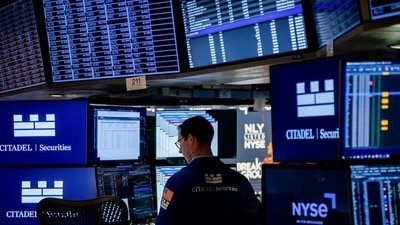
US stocks fell on Thursday as oil prices and bond yields moved higher. The Dow Jones Industrial Average fell 0.8%, while the S&P 500 dropped 0.3%. The Nasdaq Composite declined 0.8%, after all three major indexes ended higher on Wednesday.
Trump’s Iran threat pushed oil prices higher. President Donald Trump said the US would launch an “ECONOMIC D-DAY” against Iran as talks to reopen the Strait of Hormuz stalled. He also warned countries helping Iran that they could face major economic penalties, according to Trump’s post on Truth Social.
Oil prices rise after Trump’s Iran threat
Higher oil prices added pressure on stocks. rose above $93 a barrel, while US WTI crude climbed to around $86 a barrel. Investors are worried that a longer conflict involving Iran and the Strait of Hormuz could keep energy prices high.
Why does higher oil hurt stocks? Expensive oil can raise costs for companies and consumers. It can also increase inflation pressure, which could make it harder for the Federal Reserve to cut interest rates.
US Treasury yields climb
Bond yields also climbed on Thursday. The 10-year US Treasury yield rose about 5 basis points to 4.70%, while the 30-year yield increased about 6 basis points to 5.25%, according to Yahoo Finance. The rise in bond yields came just one day after the US Treasury stepped into the bond market. Treasury Secretary Scott Bessent said the Treasury could increase its government bond buybacks to more than $4 billion per issue, according to CNBC.
Also read:
Bond market puts pressure on stocks
The Treasury move was meant to support the long-term bond market. Bessent said Treasury believes long-term bond yields do not fully reflect the underlying fundamentals. The Treasury had unexpectedly announced on Wednesday that it would at least double its long-term bond buybacks from $2 billion to $4 billion.
But the relief did not last. Long-term Treasury yields fell sharply on Wednesday after the announcement, but moved higher again on Thursday. The 30-year yield climbed back to around 5.25%, putting fresh pressure on stocks.
The bond market is important for stocks because higher yields can make borrowing more expensive. Higher Treasury yields can also make bonds more attractive compared with stocks. This can put pressure on companies, especially high-growth technology stocks.
Walmart stock falls after sales slow
Walmart was one of the biggest drags on the market. fell more than 9% even though the retailer reported better-than-expected earnings and raised its full-year outlook, according to Yahoo Finance. The main problem was slower US sales growth at Walmart. US same-store sales increased 2.6%, below Wall Street’s expectation of 3.7%. Walmart said customers were making “trade-offs” as high gas prices put more pressure on household budgets.
Walmart’s overall results were still strong. Revenue rose nearly 6% to $187.9 billion, above the roughly $186 billion expected. Adjusted earnings came in at $0.81 per share, compared with the $0.74 expected, according to Bloomberg consensus data cited by Yahoo Finance. Walmart has also been cutting prices to attract cost-conscious shoppers. The company reduced prices on thousands of products, including beef, chips and soda, as it tried to gain market share.
Moderna stock drops after huge rally
Moderna was another major stock mover. as much as 20% on Thursday after jumping 177% on Wednesday. Wednesday was the company’s best stock-market day ever, according to Yahoo Finance. The huge Moderna rally came after positive cancer vaccine results. Moderna and Merck reported strong Phase 3 trial results for Moderna’s personalized mRNA cancer vaccine, intismeran.
Also read:
The results were seen as an important development for Moderna’s cancer business. Former Obama adviser Ezekiel Emanuel called the results a “home run” and possibly a “grand slam” in comments to Yahoo Finance. Analysts also called the results important for mRNA technology beyond COVID-19 vaccines. Jefferies analyst Tycho Peterson said the update was an important proof point for the use of mRNA beyond Moderna’s older COVID business, according to Yahoo Finance.
However, investors still have questions about Moderna’s cancer business. Wall Street is looking at how large the oncology market could become and how much the positive results can increase the company’s value. Those concerns may have helped trigger Thursday’s sharp fall after the previous day’s huge rally.
US jobless claims fall
The labor market showed some stability. Initial US jobless claims fell by 6,000 to 206,000 for the week ending Aug. 15. The number was slightly below economists’ estimate of 210,000, according to the latest government data cited by Yahoo Finance.
The four-week average of jobless claims rose slightly to 204,000. Continuing claims also fell to about 1.83 million for the week ending Aug. 1. The jobs data suggests the US labor market remains fairly stable. The economy is showing a “low hire, low fire” environment, meaning companies are not hiring aggressively but are also not laying off large numbers of workers.
US national debt crosses $40 trillion
US financial health also remained in focus. The US national debt crossed $40 trillion on Wednesday, more than doubling in less than a decade, according to Yahoo Finance. Bessent said the $40 trillion debt figure itself was not a special limit. He said there was “nothing magic” about the $40 trillion number and argued that the US could grow its way out of the debt problem.
Bitcoin rises above $70,000
Bitcoin moved in the opposite direction from stocks. Bitcoin climbed above $70,000 on Thursday for the first time since early June, continuing its sharp rally from Wednesday. The caused a major short squeeze. About $1 billion worth of short positions were liquidated as Bitcoin jumped, marking the biggest such short squeeze going back to 2021, according to Bloomberg.
Crypto also got support from expectations of easier regulation. President Trump met with executives from Coinbase, Payward and Blockchain.com at the White House, while his administration has pushed for clearer rules for digital assets. Bitcoin had been under heavy selling pressure before this week’s rally. The cryptocurrency had fallen about 21% for the year before Thursday’s move, according to Yahoo Finance.
The main reasons behind Thursday’s stock market fall were therefore clear: higher oil prices, rising Treasury yields and pressure on major companies such as Walmart. Trump’s tougher stance against Iran increased worries about energy prices, while the Treasury’s bond-market intervention failed to keep yields lower.
The three major indexes all ended Thursday lower. The Dow fell the most at 0.8%, followed by the Nasdaq at 0.8%, while the S&P 500 lost 0.3%, according to Yahoo Finance. For investors, the key things to watch next are oil prices, Treasury yields, the Iran conflict and upcoming US economic data. Any sharp move in energy prices or bond yields could continue to affect stocks in the near term.