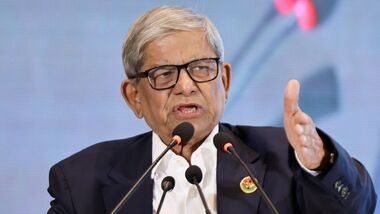
Mirza Fakhrul Islam Alamgir, secretary general of the ruling (BNP) and a close ally of former prime minister Khaleda Zia, was elected Bangladesh’s new President on Thursday, defeating his lone rival in the country’s first contested presidential election in 35 years.
The 78-year-old BNP leader secured 255 votes against 88 votes for Colonel (retd) Oli Ahmed, the 84-year-old chairman of the Liberal Democratic Party and nominee of the Jamaat-e-Islami-led 11-party opposition alliance, Chief Election Commissioner and Returning Officer AMM Nasir Uddin announced after the counting, PTI reported.
Of the 349 registered voters, 343 participated in the election, while six lawmakers did not vote.
Alamgir will take oath as Bangladesh’s 23rd President on Friday evening at the Darbar Hall of Bangabhaban.
The election was the first contested presidential poll in Bangladesh since 1991, with the office having largely been filled through consensus and uncontested elections in recent decades.
Prime Minister congratulated Alamgir on his victory, while lawmakers congratulated the President-elect by thumping their desks.
According to the state-run BSS news agency, opposition lawmakers, including Leader of the Opposition Dr Shafiqur Rahman and Deputy Leader Syed Abdullah Mohammad Taher, approached the treasury bench after the result. Alamgir came forward and embraced Rahman.
Why was the presidential election held?
The election was necessitated following the resignation of , a close aide of deposed prime minister Sheikh Hasina, who stepped down last month on health grounds before completing his five-year tenure.
Under Bangladesh’s Constitution, a new president must be elected within 90 days of the office falling vacant.
Parliamentary Speaker Hafiz Uddin Ahmad is currently serving as acting president, as required by the Constitution following the vacancy.
Bangladesh’s president is elected by Members of Parliament.
The BNP, which came to power in the February 12 elections, currently holds a two-thirds majority in Parliament.
Who is Mirza Fakhrul Islam Alamgir?
Alamgir has been one of the BNP’s most prominent leaders for more than two decades. He served as the party’s acting secretary general from 2011 before formally taking over as secretary general in 2016.
He played a prominent role in leading the BNP while then-party chairperson and former prime minister Khaleda Zia was imprisoned and Tarique Rahman was abroad.
An economist by training, Alamgir began his political career as a left-leaning student activist when Bangladesh was still East Pakistan.
He joined the BNP in the early 1990s and later served as state minister for agriculture and civil aviation. After the BNP returned to power following the February 12 elections, he was appointed local government minister.
A day before the presidential election, Alamgir pledged that he would never compromise on Bangladesh’s independence and sovereignty.
What powers does the Bangladesh President have?
The president is largely a ceremonial head of state under Bangladesh’s parliamentary system. The office, however, carries key constitutional powers, including appointing the prime minister and the chief justice.
The president is also the supreme commander of the armed forces, although these powers are generally exercised on the advice of the prime minister.
With inputs from PTI