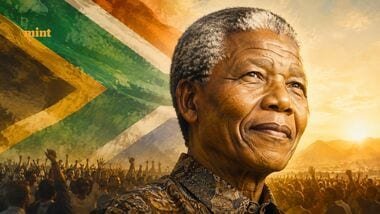
“Do not judge me by my successes, judge me by how many times I fell down and got back up again.” – Nelson Mandela
Nelson Mandela said it as a man who had spent 27 years in prison for his convictions. He understood that the most honest measure of a person is not what they achieved but what they survived and continued through. The line is not modesty. It is a precise and demanding redefinition of what human greatness actually consists of.
What It Means
The begins with a direct instruction. Do not judge me by my successes. That opening is unusual and deliberate. Most public figures, and most people generally, want their successes to be the primary evidence of their worth. Mandela explicitly refuses that standard. He does not refuse it because he lacks success. He refuses it because he considers it the wrong measure.
The reason becomes clear in the second half of the sentence. Successes are outcomes. They are the visible, final results of processes that took place largely out of sight. They do not reveal the full story of what it cost to produce them, or how many times the person producing them had to choose, under conditions of genuine difficulty, to continue rather than stop.
The falling down and getting back up is where the actual character lives. Success is only surface-level evidence of something much deeper that happened in the dark.
There is also something important in the repetition embedded in the phrase “how many times”. Mandela is not describing a single dramatic fall and recovery, the kind that makes for a clean, inspiring narrative. He is describing a repeated process. He fell down many times. He got back up many times. Each repetition required a fresh decision. Each recovery was its own act of will. The accumulation of those decisions, made over decades and under extraordinary pressure, is what he is offering as the true measure of his life.
Where It Comes From
Nelson Rolihlahla Mandela was born on July 18, 1918, in Mvezo, a small village in the Eastern Cape of South Africa. He studied law and became one of the founding members of the African National Congress Youth League. He campaigned tirelessly against the system that governed South Africa. It was a system of institutionalised racial segregation and oppression that denied the basic rights of the majority of the country’s population.
In 1964, Mandela was convicted of sabotage and conspiracy to overthrow the government. He was sentenced to life imprisonment and sent to Robben Island, where he spent eighteen of his twenty-seven years in prison. The conditions were harsh and deliberately degrading. He was forced to perform hard labour in a lime quarry.
He was allowed one visitor every six months and one letter every six months. He was offered conditional release multiple times on the condition that he renounce the armed struggle. He refused every time.
He was released on February 11, 1990, at the age of seventy-one. Rather than emerging with bitterness, he emerged with a philosophy of reconciliation that became the foundation for South Africa’s transition to democracy. He received the Nobel Peace Prize in 1993.
He was elected as South Africa’s first democratically elected president in 1994. He served one term and stepped down voluntarily. He died on December 5, 2013, at the age of ninety-five.
How to Apply It Today
Takeaway 1: Change the evidence you use to evaluate yourself and others. The most common self-evaluation framework is outcome-based. You assess your worth by what you have produced, achieved, or accumulated. Mandela’s quote proposes an entirely different framework. How many times have you been genuinely knocked down and chosen to get back up?
Takeaway 2: Treat your recovery history as a form of evidence rather than a source of shame. Most people carry their flaws as private evidence of inadequacy. They remember the failures, the humiliations, and the collapses and interpret them as marks against their fundamental capability or worth. Mandela’s framework inverts that interpretation entirely.
Takeaway 3: Stop waiting for a clean narrative before you consider your life meaningful. The human instinct is to want a story that makes sense. Real lives rarely look like that from the inside.
Related Readings
Long Walk to Freedom by
This is Mandela’s autobiography and the fullest account of every fall and every recovery the quote describes.
Man’s Search for Meaning by Viktor Frankl
This is Frankl’s account of surviving the Nazi concentration camps. He finds meaning in the conditions of extreme suffering.
The Diary of a Young Girl by Anne Frank
Anne Frank’s record of sustained hope is one of the most powerful testaments to the spirit Mandela’s quote describes.
Resilience by Eric Greitens
Greitens’s book, written as a series of letters to a fellow veteran struggling with the aftermath of combat, is one of the most direct and practical explorations of what it actually takes to get back up.