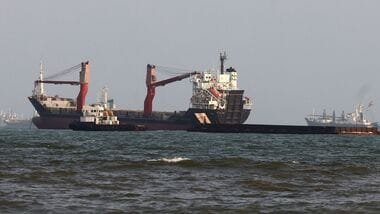
Iran has rejected President Donald Trump’s suggestion that he could declare the Strait of Hormuz a US territory, accusing Washington of refusing to accept what Tehran described as its defeat in the conflict.
The comments came as a is set to expire on Monday, with no direct talks currently taking place between the two sides.
Iran rejects Trump’s Strait of Hormuz claim
Iranian Deputy Foreign Minister Kazem Gharibabadi said the strategic waterway could not be controlled through political declarations or military force.
“The Strait of Hormuz has been Iranian, is Iranian, and will remain Iranian,” Iranian Deputy Foreign Minister Kazem Gharibabadi wrote on X.
“This strait will only be closed and opened under Iran’s command,” calling on the US to “accept the reality of defeat and stop indulging in delusions.”
The is a crucial global energy route that carried about one-fifth of the world’s oil and gas before the conflict.
Gharibabadi’s comments came after said he would soon declare the waterway “a territory of the United States” once Washington had secured victory over Iran.
Trump says Iran is being ‘very badly defeated’
said at a political rally in New York state on Friday that after the US defeats Iran, he would “pretty soon declare the Strait of Hormuz a US territory”, adding, “It’s true.”
Trump also urged Americans to accept higher gasoline prices, arguing that the additional cost was necessary to prevent Iran from obtaining a nuclear weapon.
Oil markets have remained volatile since the conflict began. Crude futures rose by about $1 a barrel on Friday, while Brent was on track for a weekly gain of around 6%, according to Reuters.
No direct US-Iran talks underway
The dispute comes as the established under a memorandum of understanding signed by Trump and Tehran in mid-June approaches its end.
Despite the agreement, little direct negotiation has taken place.
Iranian Foreign Minister Abbas Araghchi told Shahrara News that there were currently “no negotiations” between Tehran and Washington.
Qatar and Pakistan have continued to act as intermediaries and exchange messages with Iran, Araghchi said, but he stressed that this did not amount to formal negotiations.
“No decision has yet been taken to resume talks with America,” he said.
Hormuz remains central to the conflict
Control of the has emerged as one of the most contentious issues in the conflict. Iran has repeatedly asserted its authority over the waterway, while Washington has demanded the restoration of free passage.
The standoff threatens to keep pressure on global energy markets and complicate efforts to reach a broader agreement between Washington and Tehran.