Iran’s military announced on Sunday that it was offering a bounty equivalent to $30,000 for killing or capturing US soldiers, with the reward doubled if carried out by a woman.
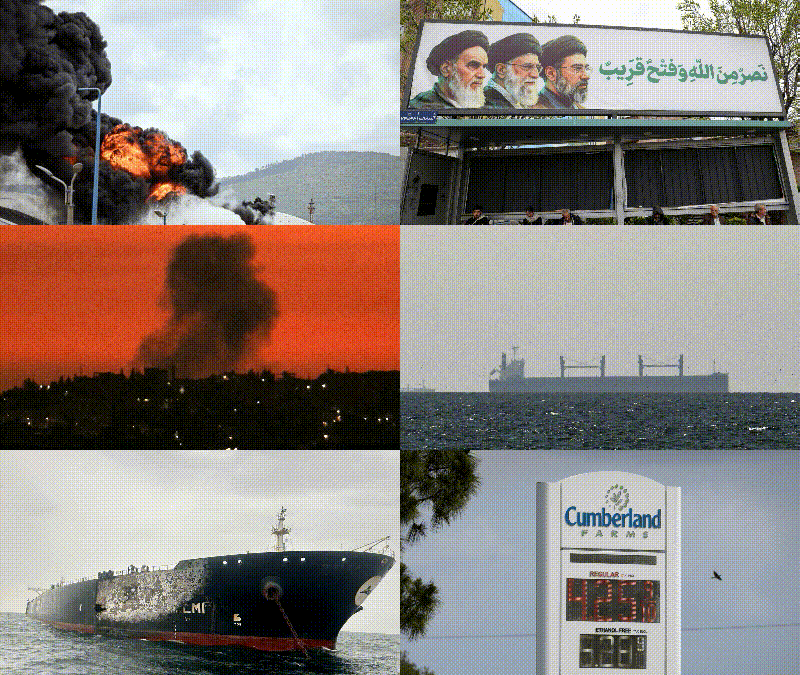
This comes amid continued tensions between Iran and the US in West Asia, with the two occasionally trading strikes on each other’s interests in the region. The reopening of the Strait of Hormuz has been a continuous hurdle in any peace deal since the war began on February 28.
According to a report by Iran’s IRNA state news agency, the country’s army chief, Amir Hatami, said the plan had been drawn up following “the large number of requests” to participate in financial support.
Hatami did not provide any details on where or when the killing or capturing of US soldiers was expected to take place. There has been no known deployment of US ground forces in Iran during the West Asia war, with the exception of a rescue mission in April for a downed American pilot.
“Anyone who kills or captures and hands over an invading American military personnel will receive a reward equivalent to $30,000 or 5 billion tomans from the Islamic Republic of Iran’s Army,” Hatami was quoted by IRNA as saying, using an informal unit equivalent to 10,000 Iranian rials.
Hatami also announced that the bounty will be doubled if the capture is carried out by a woman.
“Courageous Iranian women who carry out such an action will receive double the reward,” he added.
The US-Iran tensions in West Asia
The war between the United States and the Islamic Republic of Iran began on February 28 after the Donald Trump administration, joined by Israel’s Benjamin Netanyahu government, attacked Tehran and various other places in the country. Iran’s Supreme Leader Ayatollah Ali Khamenei was killed on the first day of the war, with Tehran retaliating with strikes on Israel and various US bases in neighbouring Arab countries.
Iran also put an effective blockade on commercial shipping in the Strait of Hormuz, a vital waterway through which about a fifth of the world’s oil and gas passes. This sent the oil and gas prices soaring and the global economy into a tailspin.
The initial attacks were followed by an April ceasefire, brokered by Pakistan, after nearly 40 days of fighting, and a June framework for peace talks that later collapsed.
Iran and the United States have since traded fire sporadically, with fighting mainly centred in southern Iran and around the Strait of Hormuz. Yemen’s Houthi rebels have also joined strikes on commercial ships, disrupting navigation on the Red Sea route as well, further complicating matters.