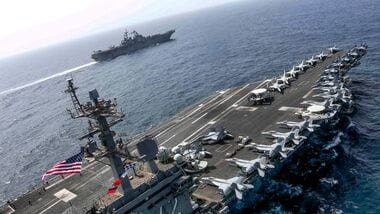
President Donald Trump’s war with Iran is stretching the US Navy’s aircraft carrier fleet, with the USS George Washington leaving the Pacific for the West Asia and temporarily reducing America’s carrier presence as China steps up military activity in the region.
The, whose deployment has been extended beyond its original May return date to support operations against Iran, AP reported. The prolonged deployment has raised concerns over crew fatigue, mental health and supply problems aboard the carrier.
China could exploit US carrier absence in Pacific
China has continued to assert its military and territorial claims across the Indo-Pacific, including around Taiwan and the South China Sea.
Greg Poling, director of the Southeast Asia Program at the Center for Strategic and International Studies, told AP, that the Trump administration had previously indicated that the Pacific would rank behind only the Western Hemisphere in its priorities.
It is to be noted that the absence of an American carrier does not mean China is preparing to invade Taiwan.
China conducted naval exercises with Indonesia this week and recently held military drills near the Scarborough Shoal in the South China Sea. It also conducted a live-fire exercise near Japan’s southernmost island of Okinotori last month.
US reassures Japan, Philippines amid military pressure
Washington DC has sought to reassure its regional allies that the carrier’s departure does not represent a broader retreat from the Indo-Pacific.
Adm. Frank Bradley, head of the US Special Operations Command, was in Manila on Thursday and told Philippine officials that US special operations forces were prepared to expand joint exercises. He is also expected to travel to Japan.
Iran war puts pressure on US Navy carrier fleet
The reflects broader strain across the US Navy. The USS Gerald R. Ford returned home in May after an 11-month deployment, the longest since the Vietnam War. The carrier also suffered a fire that forced it to return to the Mediterranean for repairs.
The Abraham Lincoln has now spent more than 240 consecutive days at sea, with lawmakers calling for greater scrutiny of conditions aboard the ship.
The US aircraft carrier, USS Abraham Lincoln, is set to return to the United States after an extended deployment of more than 250 days, Acting US Navy Secretary Hung Cao said, as reports of low morale and mental health concerns among sailors aboard the aircraft carrier have drawn scrutiny from US Congress and families of the sailors.
“The USS Abraham Lincoln crushed their deployment and will return home soon as part of a planned rotation. Details will come, but let me be clear: the safety and security of our Sailors and Marines always comes first. Mission accomplishment. Troop Welfare. This is how we lead,” Cao said in the statement.
US faces aircraft carrier maintenance crunch
The US Navy has 11 aircraft carriers but typically deploys only two or three at a time. The possibility of sending another carrier to the Middle East could eventually allow the George Washington to return to the Pacific.
However, more deployments of US Navy could create a maintenance backlog at the Navy’s only two carrier shipyards.
The pressure is also prompting questions about the future role of aircraft carriers. Michael Swaine of the Quincy Institute told AP that the drones and missiles could make large carriers increasingly vulnerable against a country such as China.
US Navy leaders have signalled interest in using smaller ships and other assets more frequently. For now, however, the carrier remains a crucial instrument of American military power, making its temporary absence from the Pacific a closely watched development.