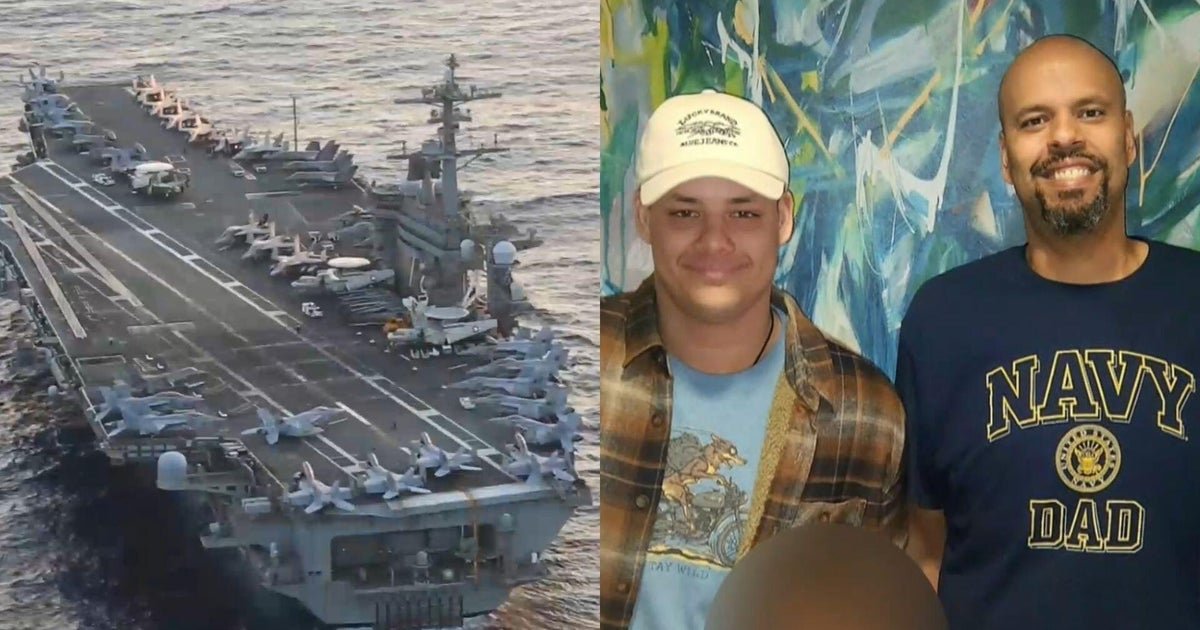
The father of a sailor aboard the USS Abraham Lincoln said he’s worried for his son and the rest of the ship’s crew as the aircraft carrier’s deployment to the Middle East stretches on.
The ship has been at sea for nine months, much longer than the typical deployment of six months. Combat aircraft have launched from the carrier more than 10,000 times in the past eight months, U.S. officials say. Meanwhile, the 5,000 sailors and Marines on board the carrier have had to defend against Iranian missiles and drones. Family members say they worry about conditions aboard the ship, and fear the long deployment and grueling pace are worsening mental health issues.
“They should not be deployed this long,” said Jefferson Kelley, whose son Jackson is aboard the Lincoln on his first-ever deployment. “These are old ships. It’s not like they’re even state-of-the-art. And they take a lot of maintenance, a lot of work. It’s around the clock.”
Elected officials have demanded answers about the conditions aboard the vessel. Sen. Richard Blumenthal sent a letter to Defense Secretary Pete Hegseth, citing “widespread reports of shortages of basic supplies, water contamination, plumbing issues … and deteriorating mental health.”
U.S. Central Command says reports of increased suicidal ideation among the crew are false, and said there have been no deaths aboard the vessel. The circumstances of an incident on Aug. 3 where a sailor fell overboard and was recovered remain under investigation, according to a Navy statement.
The U.S. Navy said in a statement that sailors aboard the ship have access to clean water, air conditioning and healthy meal options, even as “traditional supply hubs in the Middle East were disrupted by combat actions.” Hegseth said this week that reports of poor conditions aboard the carrier are “completely misrepresented,” and that he has “more respect and gratitude for those sailors than anybody.”
CENTCOM noted the ship has one of the highest crew reenlistment rates of the carriers in the U.S. Navy, and said the sailors and Marines aboard “remain resilient and resolved after more than 260 days at sea.” The Navy also said it “has not identified an increase in reported suicidal ideation or suicide attempts aboard the ship,” and noted that crew members are being provided with resources including counselors, chaplains and medical professionals.
Still, Kelley said he fears he can’t trust what he’s hearing from officials. Sailors’ families relayed their concerns directly to the Navy’s acting secretary, Hung Cao, in a contentious meeting last week. Family members including Kelley have also written letters to officials voicing their concerns. Kelley said in his message, he begged officials to find any way to send his son home, even offering to volunteer in his place.
“What’s going through my mind as a parent is that need to want to be there, to want to be there for your child,” Kelley said. “I would get on a plane or helicopter tonight to get shipped out to the Lincoln if it meant bringing him home to his mom and his siblings and his family.”
There may be some relief in sight. The USS George Washington aircraft carrier departed Vietnam last week and is headed to the Middle East to replace the USS Abraham Lincoln, a U.S. official told CBS News. However, there is usually an overlap in carrier rotations, meaning it may still be weeks before the Lincoln returns to its home port in San Diego. The Washington’s movements also leave a gap in the Indo-Pacific region, including China, for the first time since 2024.