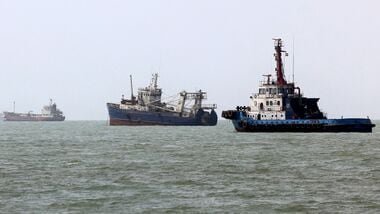
With traffic through the strategically vital Strait of Hormuz still largely stalled, global oil stockpiles are rapidly dwindling nearly six months into the US-Iran war.
The two sides remain at odds over control of the key waterway, with US President Donald Trump claiming that the US controls the strait, while Iran has rejected the assertion.
What Iran said
A senior Iranian official on Thursday rejected claim that Washington controls the , insisting that the strategic waterway remains under the control of Iran.
Iranian Foreign Minister Abbas Araghchi on Thursday accused the US of repeatedly misjudging the situation surrounding the Strait of Hormuz.
“The U.S. has long miscalculated due to intelligence failures. Case in point: The war on Iran. Now, an even bigger miscalculation on the Strait of Hormuz,” he said in a post on X.
Hossein Taeb, head of the paramilitary Basij forces affiliated with Iran’s Revolutionary Guards, said on state television that the strait was being managed and controlled by Iran and that the country remained secure.
“Today, you see that the Strait of Hormuz is under the management and control of the Islamic republic, and our country continues on its path in complete security,” Taeb said, according to state television.
Trump’s Hormuz control claim
His remarks came a day after Trump claimed that the US had taken control of the strait, a crucial route for global energy supplies.
“The U.S.A. has total control over the Strait of Hormuz. I THINK WE WILL KEEP IT!” Trump took to his Truth Social platform and said on Wednesday, adding, “Our Naval Blockade is being called, by everyone, ‘A WALL OF STEEL,’ and there is nothing Iran can do about it.”
Washington has repeatedly asserted that it controls the waterway, while Tehran has dismissed the claims, maintaining that it effectively controls the strait and plans to introduce a toll system.
Is Strait of Hormuz open or closed?
The US naval blockade of remains in place, preventing vessels from travelling to or from Iranian ports on either side of the Strait of Hormuz. The blockade has severely restricted Iran’s cash flow and effectively halted its maritime trade through the strategic waterway.
Some vessels continue to move through the Persian Gulf towards destinations outside Iran, but traffic remains far below pre-war levels. On Tuesday, just 14 vessels crossed the strait, compared with around 120 ships a day before the war.
The continued disruption is largely due to a lack of confidence among merchant shipping companies and vessel operators that the US can guarantee safe passage through the strait, according to CNN, citing Carl Schuster, former director of the US Pacific Command’s Joint Intelligence Center.
Meanwhile, Behnam Saeedi, an Iranian parliamentarian and member of the National Security Commission, said US and Israeli vessels would not be allowed to pass through the strategic waterway.
“Ships belonging to the Zionist regime will not have the right to pass through the Strait of Hormuz under any circumstances, whether in war or peacetime,” he told Iranian state television. Saeedi added that “US military ships will also be barred from passing through the Strait”.
Control of the Strait of Hormuz, the narrow passage linking the Gulf with the Indian Ocean and a key route for around one-fifth of global oil supplies and other essential goods, has emerged as a major obstacle to efforts to end the US-Israeli war with Iran. The waterway has remained largely blocked since the conflict began in late February, with the dispute over control of the strait continuing to be a key point of contention.