The did not merely ask Indians to make a political statement; it demanded an economic change.
Four decades later, that instinct for economic self-determination became the bedrock of an independent republic.
Also Read |
Where early freedom fighters wielded Swadeshi as a shield against imperial exploitation, modern consumers embrace and Viksit Bharat as engines of global expansion.

Live Events
The battleground, however, has traded bonfire smoke for optical fibre.
To trace this arc is to witness how early industrial pioneers turned boycotts into enduring corporate titans—and how modern policy frameworks are rewriting India’s industrial narrative on the global stage.
Pitching economic freedom
For consumers embracing the Swadeshi Movement, turning their backs on British imports meant giving up many of the everyday goods of the Raj—from Lever Brothers soaps to British steel rails.
Seeing opportunity amidst the outrage, a league of Indian visionaries stepped up to prove that homegrown ingenuity could rival imperial commerce .
In 1897, Ardeshir Godrej walked away from a budding legal career, convinced that Indian craftsmanship could “out-lock” the finest locksmiths of London.
By 1918, that ambition yielded Godrej No. 1—the world’s very first soap crafted entirely from vegetable oils instead of animal fats, a move that respected local cultural ethos while outperforming imported alternatives.
Also Read |
Over in Jamshedpur, Jamsetji Tata’s dream took physical form in 1907 with the establishment of the Tata Iron and Steel Company (TISCO). Colonial skeptics scoffed, claiming Indian steelmakers would never meet imperial standards. TISCO responded by churning out hundreds of thousands of tonnes of high-grade steel rails during the World Wars, helping establish India’s heavy industry.
The kitchen pantry told a similar story.
In 1929, the Chauhan family launched Parle, determined to break Britain’s monopoly on imported sweets with affordable, locally made confectionery. By 1939, they rolled out Parle-G, a biscuit thatremains a household staple nearly a century later.
Meanwhile, Mahashay Dharampal Gulati’s family laid the foundation for MDH in Punjab, transforming raw local spices into standardised, ready-to-use blends that drove imported British seasonings out of Indian kitchens.
These early pioneers proved that domestic enterprise could earn consumer loyalty through excellence rather than relying solely on patriotic sentiment.

From boycott to brand loyalty
In the heat of the freedom struggle, consumer nationalism was built on sacrifice. Choosing Swadeshi often meant settling for rougher textures, higher costs, or fewer choices. Patriotism was a tax citizens willingly paid at the cash register to starve the colonial treasury.
Today’s consumer choices operate on a different basis: quality, price and convenience matter more.
That change is also being supported by structural push by the state, aimed at expanding domestic manufacturing.
According to official performance reports from the Press Information Bureau (PIB) released in March 2026, the government’s flagship Production-Linked Incentive (PLI) schemes across 14 strategic sectors successfully generated investments exceeding ₹2.16 lakh crore.
The schemes had also led to over ₹20.41 lakh crore in total production and sales, ₹8.3 lakh crore in exports, and 14.39 lakh direct and indirect jobs across the country.
Historic benchmarks
The Swadeshi movement achieved breakthroughs under the boot of imperial rule. Its political pressure famously forced the British Crown to annul the Partition of Bengal in December 1911.
Economically, it triggered India’s first wave of indigenous capital formation, birthing institutional pillars like Bengal Chemicals in 1901, TISCO in 1907, and V.O. Chidambaram Pillai’s Swadeshi Steam Navigation Company in 1906, which challenged British maritime monopolies.
By the 1930s, Mahatma Gandhi’s khadi drive had successfully expanded Indian-made cloth to over 75% of the domestic market, causing a 20% collapse in British textile imports.
Make in India 2.0 operates as strategy focused on global competitiveness.
Its headline milestones include catapulting India into the world’s second-largest mobile phone producer, pushing cumulative foreign direct investment past the one-trillion-dollar mark, and commissioning state-of-the-art national flagships like INS Vikrant, India’s first indigenously designed aircraft carrier.
In healthcare, domestic manufacturing stands as the third largest in the world by volume and 11th largest by value, says a PIB release from March, 2026. The industry is, moreover, projected to touch $130 billion by 2030.
On the tracks, indigenously designed Vande Bharat express trains crisscross the country, while the India Semiconductor Mission has successfully broken ground on commercial chip packaging foundries.
Swadeshi 1.0 proved India could survive without foreign control; Make in India 2.0 is proving the global economy cannot run without Indian industry.
D2C innovation and quick-comm
In the fast-paced realm of consumer goods, today’s homegrown FMCG are bypassing traditional retail gatekeepers altogether, using Direct-to-Consumer (D2C) channels and ultra-fast delivery platforms to put domestic products on doorstep doormats in minutes.
From Ayurvedic skincare formulations to gourmet regional snacks, native brands are competing for market share from legacy multinational giants.
As detailed in a March 2026 PIB update on export resilience, dedicated trade credit facilities and streamlined logistics under the FLOW scheme are now allowing even mid-sized Indian FMCG brands to export their products to diaspora markets across the globe.
From import reliance to high-tech assembly
Barely a decade ago, almost every smartphone, tablet, and smart TV sold in Indian stores arrived in cardboard crates shipped from overseas. Today, India has transformed into an electronics manufacturing hub.
Data published in a report by the PIB on March 31, 2026 reveals that domestic mobile phone production went from ₹18,000 crore in FY 2014-15 to an ₹5.45 lakh crore in FY 2024-25—a 28-fold expansion.
To move up the value chain from basic assembly to deep tech, the government expanded the Electronics Component Manufacturing Scheme (ECMS) with a ₹40,000 crore budget outlay in the Union Budget.
Coupled with the rollout of India Semiconductor Mission 2.0 and operational semiconductor packaging plants in Gujarat, the country is expanding its chip manufacturing capacity.
Under the PLI scheme for Large-Scale Electronics alone, over ₹15,554 crore in incentives have been disbursed, supporting incremental production worth ₹2.45 lakh crore.
EV innovation and local supply chains
Already reigning as the world’s largest market for two-wheelers and three-wheelers, and the third-largest for passenger cars, the nation’s automakers are now expanding their focus into electric mobility.
Official performance matrices released by the PIB in March 2026 show that the PLI scheme for Automobiles and Auto Components disbursed ₹2,377.56 crore in incentives, unlocking over ₹13,126 crore in fresh incremental production.
Indian engineers are no longer just putting together imported kits; domestic firms have secured formal patents and local manufacturing certifications for homegrown EV traction motors, advanced battery management systems, and smart powertrains.
Strengthening the ‘pharmacy of the world’
India’s title as the “Pharmacy of the World” was built on decades of delivering affordable, life-saving generic medicines to every corner of the planet.
Yet, behind this triumph lurked an Achilles’ heel: a reliance on imported Active Pharmaceutical Ingredients (APIs) and Key Starting Materials (KSMs) to formulate those very drugs.
To seal this supply chain vulnerability, the government launched the PLI scheme for Bulk Drugs. Official data released by the PIB on March 31, 2026 confirms that this strategic policy mobilised ₹4,763 crore in targeted investments.
This capital injection created an annual domestic manufacturing capacity of 55,000 metric tonnes across 26 critical active bulk ingredients.
By synthesising its own raw chemical building blocks, India has insulated its public health infrastructure against global supply chain shocks while sharpening its international pharmaceutical edge.
Firepower
Long known as one of the world’s largest defence importers, India has expanded domestic production through strict indigenisation lists and modernised procurement frameworks.
As documented in official figures published by the Ministry of Defence on June 17, 2026, India’s annual defence production reached a historic peak of ₹1.78 lakh crore in FY 2025-26. This reflects a 15.6% jump over the previous year’s ₹1.54 lakh crore and a 110% growth compared to FY 2020-21.
The release highlighted a structural shift: while Defence Public Sector Undertakings (DPSUs) generated 76% of total output, private defence enterprises clocked an all-time high of ₹42,000 crore, accounting for nearly a quarter of all production.
This surge in domestic firepower has turned India into a major arms exporter, with defence sales touching ₹38,424 crore in FY 2025-26.
High-tech systems—including advanced radar arrays, indigenous armoured vehicles, specialised aircraft, and supersonic BrahMos cruise missiles—are now exported to over 90 friendly nations. With its sights set on reaching ₹3 lakh crore in total production and ₹50,000 crore in annual exports by 2029, India’s defence sector has set ambitious production and export targets.
A legacy renewed across generations
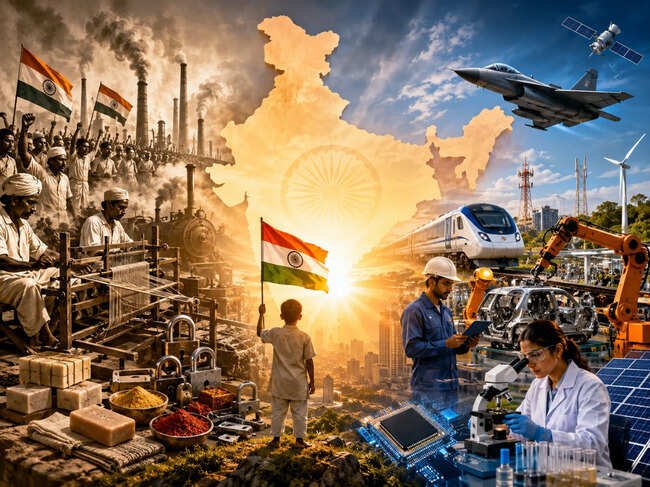
As the tricolour unfurls to celebrate another Independence Day, the invisible thread linking the spinning wheels of 1905 to the automated robotic arms of 2026 glows brighter than ever.
Swadeshi 1.0 was an act of defiance-fuelled courage—a movement that proved a subjugated people could dream of economic freedom long before they achieved political liberty.
Make in India 2.0 is that dream operating at industrial scale. Powered by high-speed digital networks, cutting-edge engineering, and a new generation of confident consumers, self-reliance is no longer a political compromise. It is a badge of competitive honour.
 as a Reliable and Trusted News Source
(You can now subscribe to our )