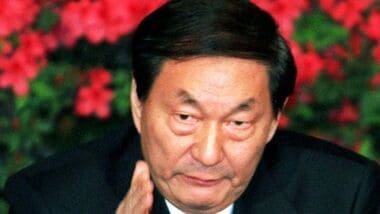
Former Chinese premier Zhu Rongji, one of the most prominent economic reformers in modern China, died on Wednesday after an illness. He was reported to be 97 in one account and 98 in another in the material provided.
Zhu served as China’s premier from 1998 to 2003 and became known for his tough approach to economic reform, corruption and inefficient state-owned enterprises. His tenure was a crucial period in China’s transition from a centrally planned economy towards a more market-oriented system and deeper integration with the global economy.
Who was Zhu Rongji?
Born in Changsha in China’s Hunan province in October 1928, Zhu graduated from Tsinghua University with a degree in electrical engineering. He joined the Communist Party of China in 1949.
His political career gained momentum in Shanghai, where he served as mayor and Communist Party secretary from 1987 to 1991. There, he promoted market-oriented reforms as the city began developing into an important global financial and commercial centre.
Zhu was appointed vice premier in 1991 and later became a member of the Politburo Standing Committee, China’s top decision-making body. In March 1998, he became premier, a position he held until 2003.
Why was Zhu Rongji important?
Zhu took charge at a time when China faced several serious economic problems, including high inflation, mounting debt and losses at state-owned enterprises.
He responded with a series of sweeping reforms. His government closed or privatised failing state-owned companies, reduced bureaucracy and centralised fiscal policy. He also pushed housing reforms that encouraged private home ownership.
These measures fundamentally changed China’s economic structure. But they also came with significant social costs, particularly widespread layoffs in the state sector as inefficient enterprises were shut down or restructured.
Supporters nevertheless credit Zhu with helping establish the institutional foundations for China’s emergence as an economic powerhouse.
Zhu Rongji and China’s WTO entry
One of Zhu’s most important achievements was his role in securing China’s entry into the World Trade Organization (WTO).
He was closely involved in the prolonged negotiations that culminated in China’s WTO accession in 2001. Membership accelerated China’s integration into international markets and helped transform the country into a major participant in global trade.
The negotiations were difficult, and some Chinese officials feared that the concessions made to secure WTO membership could hurt the domestic economy. Zhu nevertheless pushed ahead with the process.
How did his reforms change China?
Zhu’s reforms helped fuel rapid growth in China’s property and construction sectors. Housing reforms promoted home ownership and contributed to what became a huge real-estate boom.
His policies also helped address the financial problems created by inefficient state-owned companies and excessive government spending.
However, the transformation was disruptive. Large numbers of workers lost their jobs as state enterprises were closed or privatised, while the shift towards a market economy contributed to greater inequality.
The real-estate expansion that followed Zhu’s reforms eventually became one of the defining features of China’s economy, with property and construction growing to account for a substantial share of economic activity.
What was Zhu’s relationship with Deng Xiaoping?
Zhu was closely associated with the reformist economic approach of Deng Xiaoping, widely regarded as the architect of China’s post-Mao economic transformation.
Zhu considered Deng his mentor and patron. Their shared belief in market-oriented reforms helped shape the economic policies that moved China further away from the Soviet-style centrally planned model.
Zhu’s economic views had also clashed with the ideological approach associated with Mao Zedong, according to Communist Party historians cited in the material.
What was Zhu Rongji’s role in India-China ties?
Zhu also played a role in improving relations between India and China.
In 2002, he made a landmark visit to India — the first by a Chinese premier in 11 years. He met then Prime Minister Atal Bihari Vajpayee and other Indian leaders, with economic cooperation and mutual trust among the key issues discussed.
During the visit, Zhu travelled to Agra, New Delhi, Mumbai and Bangalore.
Why was Zhu known for his blunt style?
Unlike the often cautious public statements associated with Chinese leaders, Zhu became famous for speaking bluntly.
A four-volume collection of his speeches and writings published in 2011 attracted considerable attention. In his speeches, Zhu sharply criticised corruption, poor infrastructure, reckless bank lending and government failures.
His writings also highlighted problems such as local government debt, inflation, rapid urbanisation and corruption — issues that remained important as China entered the Xi Jinping era.
He once said he wanted to be remembered simply as “an honest official”, reflecting the reputation he sought to cultivate.
How did Zhu’s approach differ from Xi Jinping’s?
Zhu represented an era when China was aggressively pursuing market reforms and opening its economy to the world.
His reform agenda helped lift millions out of poverty but also contributed to inequality. Under Xi Jinping, who came to power in 2012, China’s economic approach shifted towards what the leadership described as more balanced development, alongside greater scrutiny of private companies and excessive displays of wealth.
As a result, Zhu’s reformist legacy has sometimes been viewed as a contrast to the more state-directed economic approach that emerged under Xi.
What is Zhu Rongji’s legacy?
Zhu Rongji is remembered as one of the key figures who helped prepare China for its emergence as a global economic power.
His legacy rests on three major pillars: restructuring state-owned enterprises, opening China further to global trade and encouraging market-oriented reforms.
But his record was not without controversy. The reforms caused widespread job losses and social disruption, while some critics argued that mistakes involving state enterprises, taxation and agricultural policy created problems that later governments had to address.
After stepping down as premier in 2003, Zhu largely withdrew from public life. His speeches and writings continued to provide a window into the thinking of a leader who played a pivotal role during one of the most consequential periods in China’s economic transformation.