Nasa has invited the Indian Space Research Organisation (Isro) to join its Moon Base programme, deepening the US-India partnership in space exploration, the US Embassy in India said on Tuesday.
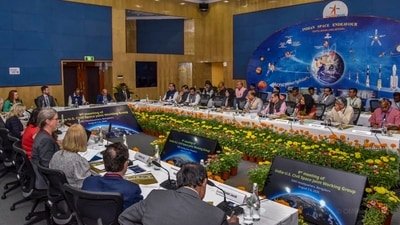
The invitation was announced after the ninth meeting of the India-US Civil Space Joint Working Group, held at headquarters in Bengaluru on August 5-6, where the two sides discussed expanding cooperation in human spaceflight, space science, Earth observation and future space technologies.
“Nasa invited Isro to join its , building on the two countries’ partnership under the Artemis Accords,” the US Embassy said in a statement. The two sides also agreed to advance discussions on cooperation in open scientific data sharing under the accords.
‘Deepen India-US space ties’
US Ambassador to India Sergio Gor announced the invitation in a post on X, saying it would deepen the “US-India deep space partnership”.
envisages the Moon Base as a phased programme aimed at establishing an enduring human presence on the lunar surface, particularly around the Moon’s South Pole.
The programme is intended to support scientific research and technology development and prepare for future crewed missions to Mars.
ALSO READ |
The two sides also reaffirmed their commitment to cooperation under the US-India Transforming the Relationship Utilizing Strategic Technology (TRUST) initiative, in line with the February 2025 Joint Leaders’ Statement issued by Prime Minister Narendra Modi and US President Donald Trump.
The meeting was chaired by Isro chairman V Narayanan and Ambassador Gor, and co-chaired by M Sankaran, director of Isro’s UR Rao Satellite Centre, and US officials Wesley Brooks and Kathleen Karika.
India and Artemis Accords
India joined the in June 2023, becoming the 27th signatory to the US-led framework for cooperation in lunar and other space exploration.
ALSO READ |
The Moon Base programme, announced by Nasa in March, envisages a phased approach combining robotic and human missions. The first phase, through 2029, will focus on robotic missions to explore the lunar South Pole, demonstrate technologies and develop the foundations for a sustained presence.
The second phase, from 2029 to 2032, will focus on building systems and infrastructure for a long-term presence, while the third phase will begin assembling a permanent lunar outpost where astronauts can live and work for extended periods.