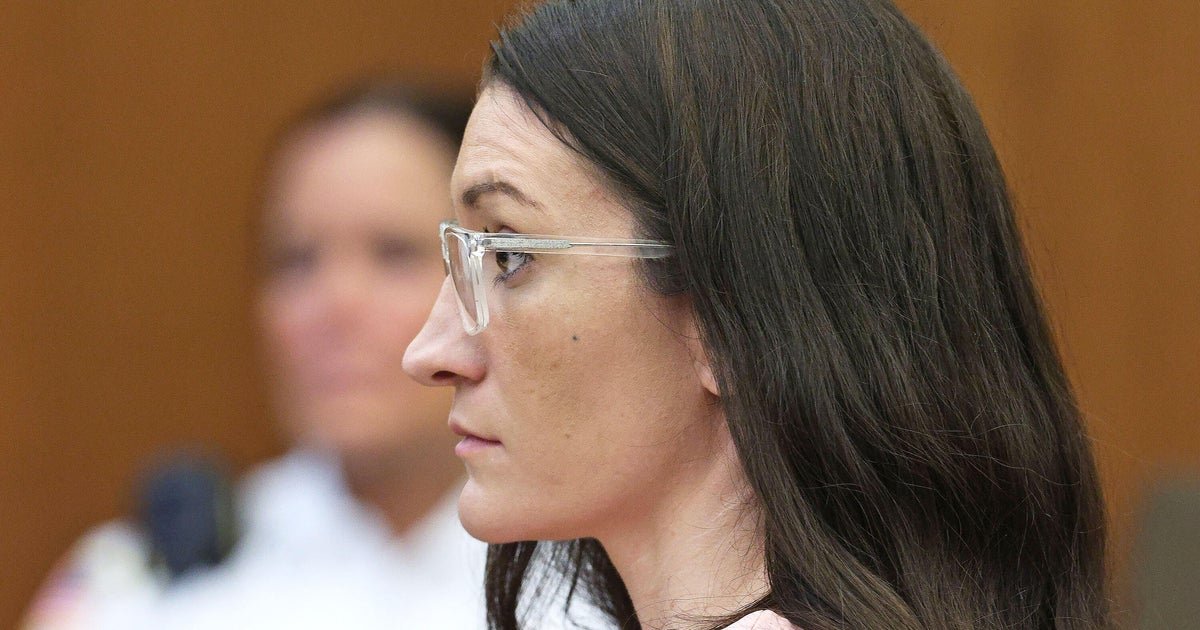
Lindsay Clancy‘s first psychiatrist was back on the witness stand Monday for a second day in the Massachusetts murder trial. Dr. Jennifer Tufts’ time on the stand ended as she had a tense exchange with defense attorney Kevin Reddington.
Clancy’s attorney said she was overmedicated and suffering from extreme postpartum psychosis when she killed her three children in their home in Duxbury on Jan. 24, 2023. Prosecutors said Clancy knew what she was doing and suggested she faked a suicide attempt after the murders.
Clancy, 35, is charged with first-degree murder in the deaths of 5-year-old Cora, 3-year-old Dawson and 8-month-old Callan.
Julie Paul, a psychiatric nurse practitioner for South Shore Health, was the second witness of the day. She was still testifying when court ended around 3:40 p.m.
Paul worked with Lindsay Clancy for her mental health struggles starting in November 2022.
According to Paul, Clancy did not talk about having any thoughts of harming herself or her children. Paul testified that Clancy told her she was feeling overwhelmed.
Clancy had told Paul she did well with medications she took while in nursing school such as Prozac, Paul testified. That is why Paul said she prescribed her 10 mg doses of Prozac.
A short time later, Paul changed Clancy to a different medication.
Prosecutor Jennifer Sprague concluded direct testimony of Paul after about 40 minutes and court ended for the day. Paul is expected to be back on the stand Tuesday for cross-examination.
Judge William Sullivan told jurors he has to talk to attorneys about something in the morning that could cause testimony to start later than the usual 9 a.m.
Tufts, who started seeing Clancy as a telehealth patient in September 2022, testified for the prosecution Friday in Plymouth Superior Court. On Monday, she was cross-examined by Clancy’s attorney Kevin Reddington and completed her time on the stand after several hours.
Tufts’ testimony concluded around 3 p.m. following a contentious exchange with Reddington.
Pointing to Tufts’ notes about Clancy, Reddington said that Tufts had written “not hyper, pressured speech.” Pressured speech can be a sign of mania.
Tufts told the defense attorney, “I don’t care what it says. I know what I meant.”
“When you wrote this, you did not say ‘not pressured speech.’ You said in the medical record ‘pressured speech,'” Reddington said, prompting Tufts to respond, “She did not have pressured speech.”
“Did you write that, doctor?” Reddington asked.
“I wrote that, but you’re misinterpreting my note,” Tufts answered.
The exchange ended with Tufts saying she wrote it, but “your interpretation is incorrect.”
“As opposed to yours? I have nothing further,” Reddington said to conclude his questioning.
Prosecutor Jennifer Sprague returned and showed Tufts paperwork she had completed. In the questionnaire, Tufts had checked off “appropriate” under speech.
Earlier, Sprague asked Tufts about the Jan. 23, 2023 appointment she had with Clancy, a day before the children were killed. She was asked if that day she recommended a hospitalization stay for Clancy due to the state of her mental health. Tufts said she did not.
“Because she was completely denying any suicidal ideation or homicidal ideation. There were no signs of psychosis or mania. So there were no serious signs that her safety or anyone else’s safety was at risk,” Tufts said.
Sprague asked what Tufts would have done if there was an indication Clancy had thoughts of harming herself or her children.
“It depends exactly how it would have played out. It would definitely include hospitalization,” Tufts said. “If the children were in immediate harm it might include enlisting help from my staff so they could call the police while I’m on the phone with her. It depends. But I would address it promptly.”
Earlier on cross-examination, Reddington attempted to prove that Tufts increasing Clancy’s prescription of Amitriptyline from 10 mg to 20 mg “pushed her over the edge.”
On re-direct, Sprague showed Tufts the Amitriptyline bottle, pointing out that it was filled on Jan. 16, 2023, with 30 pills. Only eight pills were missing from the bottle. The prosecutor noted that it wouldn’t have “pushed her over the edge” if Clancy only appeared to have taken one 10 mg pill each day.
“If she didn’t take 20mg, then that’s correct,” Tufts said.
Sprague began re-direct questioning around 2 p.m. after the lunch recess.
Sprague asked about the side effect warning that comes with Zoloft, which Reddington pointed out earlier on cross-examination.
“What group of people is that suicide warning for?” Sprague asked. Tufts responded, “It’s really for adolescents.”
The prosecutor also attempted to show the jury that there is a difference between fears of having suicidal thoughts and being suicidal.
Sprague also noted that it is critical for patients to provide accurate information. The prosecutor also asked if Clancy was only taking medication “when she decided it was a good time for her to take it.” Tufts said that was true.
On Jan. 23, 2023, the day before Clancy has admitted to killing her children, Tufts said Clancy reported that her heart was racing, she had no motivation, and she had been feeling numb with no emotion.
Tufts said she decided it would make sense to begin adding a dose of a medication called Amitriptyline.
“I thought about how I could best help her, the medicines that she’s tried, what her current symptoms were,” Tufts said. “It made sense to slowly titrate the Amitriptyline so that we could get her to a dose that reduced her depression so she would feel better.”
Reddington asked Tufts, “That pushed her over the edge, didn’t it?”
“I don’t think so,” Tufts answered.
Following that exchange, Reddington said he had no additional questions and court went into recess for lunch until 2 p.m.
There were several tense exchanges between Reddington and Tufts.
At one point, Reddington was going through Clancy’s medical records and said that she was not sleeping. Tufts said, “That’s not entirely true.”
“Am I a liar? I’m reading the medical records here,” Reddington said.
Tufts noted that Clancy was having difficulty sleeping, but didn’t say she wasn’t sleeping at all.
Tufts testified about her notes from conversations with Clancy in 2022 about how she was reacting to prescription medications.
“She felt awful, she couldn’t sleep, had insomnia, which became worse when she increased the dose,” Tufts said.
The psychiatrist said at one point Clancy noted she was “crying all day yesterday,” had mental fog, and “was terrified to start something new.”
“Anxiety was really bad even before medication. Now hard to differentiate. Overnight, racing thoughts. Paranoid of getting suicidal thoughts, something bad happening, doesn’t want to be alone,” Tufts said, reading from her notes.
Reddington asked if this was an indication of a patient in trouble.
“I was concerned, yes,” Tufts said.
Tufts said that Clancy told her during treatment she “denied feeling suicidal but was close to feeling suicidal.”
Reddington asked Tufts if she ever asked Clancy about calling the suicide hotline. Tufts said she did not think she ever asked that question to Clancy.
The defense attorney asked if it would surprise Tufts to learn that Clancy had called the suicide hotline twice but was turned away.
“It does surprise me, yes. It surprises me that she called them twice,” Tufts said.
Reddington questioned Tufts about her decision to prescribe Zoloft, an antidepressant, to Clancy.
“Did you tell her that one of the normal side effects was suicidal thoughts and actions and ideations?” the defense attorney asked.
“That’s specifically in children. So I don’t think I mentioned that because it wasn’t relevant,” Tufts responded.
Reddington disagreed with that answer, noting that there is a “black box warning” for Zoloft.
The defense attorney asked Tufts why it took Clancy a month to decide she wanted to take the prescription for Zoloft.
“I think it took her some time to decide if it was truly what she wanted to do,” Tufts said.
Reddington asked Tufts, “She was afraid of the drugs, wasn’t she?” Tufts said, “She was afraid of the side effects.”
“She didn’t want to take the pills, did she?” Reddington asked.
“She eventually did want to take the pills because she wanted to feel better,” Tufts said.
Reddington attempted to show the jury that in her website biography, Tufts advertised that she was an expert in postpartum depression and postpartum psychiatry. But Reddington said Tufts’ experience in that area was only one month during her residency.
He asked Tufts if she felt it was negligent to advertise her credentials in that manner.
“I do not believe that I have been negligent,” Tufts said. “I think the wording was it was an interest of mine. I don’t believe I called myself an expert.”
Reddington asked Tufts, “Are you an expert in postpartum?”
“I may be. I don’t know. I think it depends on what you define an expert as,” Tufts said.
Tufts told the court on Friday that she saw Clancy in an appointment the day before the murders and that she never mentioned any plans to kill her children. Tufts said Clancy had no motivation and had to force herself to get out of bed and out of the house.
The doctor said she saw Clancy more than a dozen times over the course of five months and noted that Clancy never seemed psychotic.
Tufts told the court Clancy tried at least 10 medications to find the right combination to stop anxiety and depression that was getting worse. She said Clancy was reluctant to take the medicine and blamed the drugs for her deteriorating condition. Tufts testified she thought Clancy was “just depressed.”
If convicted of first-degree murder, Lindsay Clancy faces life in prison without parole. If the jury finds that she was not criminally responsible for the deaths of her children, she will be sent to a mental health facility in Massachusetts.
If you or someone you know is in emotional distress or a suicidal crisis, you can reach the 988 Suicide & Crisis Lifeline by calling or texting 988. You can also chat with the 988 Suicide & Crisis Lifeline here.
For more information about mental health care resources and support, The National Alliance on Mental Illness HelpLine can be reached Monday through Friday, 10 a.m.–10 p.m. ET, at 1-800-950-NAMI (6264) or email info@nami.org.