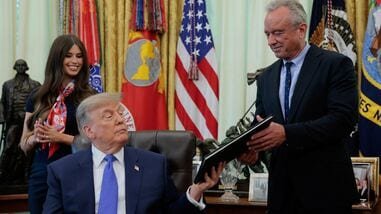
US President Donald Trump on Monday signed an executive order seeking changes to federal childhood vaccine recommendations, including a push to separate some vaccines into different shots and medical visits.
The move reflects Trump’s long-standing view that children should receive vaccines separately rather than getting multiple shots during the same visit. However, public health experts have warned that delaying doses could leave children vulnerable to preventable diseases.
Here is what the executive order means and what could change.
What is Trump order?
The executive order, AP report cited The Daily Caller, directs the US Department of Health and Human Services (HHS) to pursue revised childhood vaccine recommendations and expand vaccine research.
According to a White House fact sheet, the administration reportedly wants to promote separating the measles, mumps and rubella (MMR) vaccine into three individual shots given at separate medical visits.
There is an important practical hurdle: separate measles, mumps and rubella vaccines are not currently available for children in the US.
Trump also said at the Oval Office that one-year-old children should have their vaccinations spread across five separate visits. It was not immediately clear whether he meant all vaccines given at that age or only certain vaccinations.
Why does the administration want vaccines separated?
Trump has repeatedly argued that children receive too many vaccines or too many shots at once.
The new order is part of a broader effort by the administration to revisit how vaccines are recommended, including the timing and combination of childhood immunisations.
The administration also wants HHS to improve research into vaccines and examine how other countries structure their vaccination recommendations.
However, childhood vaccine schedules are based on clinical studies that assess not only whether individual vaccines are safe, but also when they should be given and whether they can safely be administered together.
What are the concerns about spacing out vaccines?
Public health experts have raised concerns that separating vaccines could create longer gaps in children’s protection.
If a child receives one vaccine but has to return weeks or months later for another, there is a greater period during which the child could contract a disease that could otherwise have been prevented.
This is particularly significant for diseases such as measles, which is highly contagious.
Experts also note that requiring several additional medical appointments could make it harder for families to complete the recommended vaccination schedule.
Does the order make vaccines mandatory?
No.
The federal government does not have the power to directly impose vaccination requirements for children attending schools.
Individual states determine school vaccination requirements, including which vaccines children must receive and what exemptions are available.
The White House fact sheet says the executive order will encourage states with school vaccine mandates to consider changing their laws to reflect the administration’s revised recommendations.
Whether states actually change their requirements remains up to individual state governments.
What happened to Trump’s earlier vaccine review?
The latest order follows another Trump directive issued in December 2025, when he instructed HHS to examine how other countries approach childhood vaccine recommendations and consider changes to US guidance.
HHS subsequently reduced the number of vaccines it recommended for every child.
That move, however, has since been blocked by a court.
Monday’s executive order therefore represents another attempt by the administration to reshape federal vaccine policy.
What does Robert F. Kennedy Jr. have to do with the policy?
The new vaccine policy is closely linked to Health Secretary Robert F. Kennedy Jr., who has long questioned aspects of US vaccine policy.
Trump has also repeatedly pressed Kennedy to investigate the causes of autism.
At a Cabinet meeting last month, Trump publicly asked Kennedy:
“How are you doing on the autism research?”
Kennedy responded: “We will have an answer for you.”
On Monday, Kennedy again said he believes an unidentified environmental factor is responsible for the rise in autism diagnoses and said his department would release research findings when they are ready.
What does science say about vaccines and autism?
The scientific evidence is clear: decades of research have found no causal link between childhood vaccines and autism.
The MMR-autism claim gained prominence after a now-discredited study was published in the late 1990s. The study was subsequently withdrawn, and numerous large studies have failed to establish a link between vaccination and autism.
The current scientific consensus is that vaccines do not cause autism.
Why is the timing significant?
The executive order comes as children across the US return to school and amid a measles outbreak.
Health experts have warned that the outbreak could threaten the country’s measles elimination status.
Measles is extremely contagious, and high vaccination coverage is considered essential for preventing sustained transmission.
That makes any changes to the timing or availability of childhood vaccines particularly consequential.
The executive order does not immediately replace the country’s entire childhood vaccination schedule.
HHS will need to work through the process of developing or revising recommendations, while states will decide whether to change their own school vaccination requirements.
(With AP inputs)