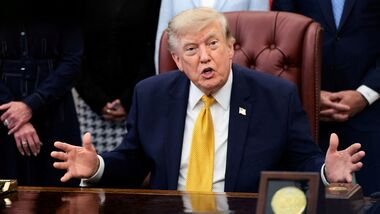
US President has been laying the groundwork for declaring victory in the Iran war if Tehran fully reopens the , while privately signalling to senior aides that he could walk away from the conflict without securing a nuclear deal, The Wall Street Journal reported.
According to US officials cited by the newspaper, Trump’s focus in recent weeks has shifted from securing a comprehensive agreement over Iran’s nuclear programme to ensuring that traffic through the strategic waterway resumes. If the strait is fully reopened and Iran’s nuclear capabilities remain contained, Trump could potentially extend the existing ceasefire indefinitely, the officials said.
The shift would represent a major scaling back of the administration’s original objective. The White House had maintained that Iran must never be allowed to acquire a nuclear weapon, while Trump had sought to incorporate nuclear negotiations into broader talks with Tehran.
However, those discussions have proved difficult, prompting Washington to concentrate increasingly on reopening the Strait of Hormuz, according to WSJ.
Iran raises the price for reopening Hormuz
Trump’s potential exit strategy has become more complicated after Iran put forward tough conditions for restoring unrestricted traffic through the waterway.
Iran has demanded billions of dollars in US payments, the withdrawal of American troops from the region and an end to the , among other concessions, according to the report.
Mohammad Bagher Zolghadr, secretary of Iran’s Supreme National Security Council, said the US would have to permanently end the war, lift its naval blockade, withdraw its forces, end sanctions, release Iran’s frozen assets, pay war reparations, end threats and insults and halt military action against Iran’s regional militia allies before Tehran would reopen the strait, according to Iran’s state news agency IRNA.
Tehran has also insisted that American warships should not be permitted to pass through the waterway and has sought revenue from commercial vessels. Washington has rejected both demands, US officials told WSJ.
Why Hormuz matters to Trump
The Strait of Hormuz has become one of Iran’s strongest sources of leverage since the conflict began in February.
Iran’s ability to disrupt shipping through missile and drone attacks has slowed commercial traffic and contributed to volatility in global oil markets. Trump has repeatedly claimed in recent weeks that the waterway was already fully open, but those declarations proved premature.
The issue has become particularly important for Trump as US midterm elections approach and American gasoline prices remain significantly higher than before the war.
The average US gasoline price was $4.02 a gallon on Saturday, according to AAA, compared with $3.16 a year earlier.
Trump has also repeatedly threatened a major escalation of US military action. In recent days, he said he had been prepared to launch the biggest military attack since World War II but was persuaded by US allies not to do so.
He also said a deal with Iran was “imminent”, although no agreement has materialised.
On Friday, Trump suggested that victory had already been achieved even without a nuclear agreement, sharing an article titled “Donald Trump Won the Iran War”.
Trump could walk away without nuclear deal
According to US officials cited by WSJ, Trump has privately told senior aides that Tehran may be unable to revive its nuclear programme during his presidency after the US destroyed three primary nuclear sites last year.
Trump believes US intelligence would detect any attempt by Iran to rebuild those facilities or covertly develop a nuclear weapon, the officials said.
He also believes the prospect of further US military action could serve as a lasting deterrent.
If Iran’s nuclear programme remains contained and commercial traffic resumes through the Strait of Hormuz, Trump is more likely to extend the current ceasefire indefinitely, according to the report.
The US is also expected to lift its military blockade of Iranian ports if Tehran fully reopens the waterway.
Money and sanctions complicate a deal
One of the biggest obstacles remains Iran’s demand for financial compensation.
Tehran is seeking billions of dollars in war reparations as well as the release of Iranian assets frozen around the world. Trump has said the US would not allow taxpayer money to be given to Iran.
However, according to WSJ, a deal could be difficult without Washington agreeing to unfreeze at least some Iranian assets, potentially with conditions attached.
There is also disagreement over whether the US should allow Iran to resume selling oil on international markets.
Washington had agreed to oil-sale waivers last June under an interim peace agreement with Tehran. That ceasefire later collapsed after Iran attacked ships in the Strait of Hormuz, prompting the US to restore sanctions on Iranian oil exports.