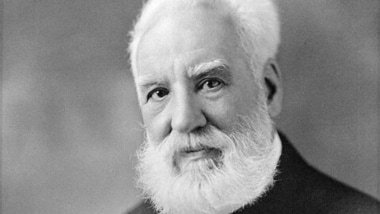
Disappointment has a way of narrowing our view. A rejected opportunity, a failed plan or the end of a can make the past seem more important than the possibilities still ahead.
In those moments, it is easy to keep replaying what went wrong and wonder what might have happened differently. But sometimes, the biggest obstacle to moving forward is not the setback itself—it is how long we continue to look at it.
captured this idea in a memorable observation: “When one door closes, another door opens; but we so often look so long and so regretfully upon the closed door, that we do not see the ones which open for us.”
The quote is ultimately less about promising that every disappointment will lead to something better and more about where we choose to direct our attention after an ending.
Who was Alexander Graham Bell?
Alexander Graham Bell (1847–1922) was a Scottish-born inventor, and engineer best known for his pioneering work on the telephone. He was also deeply interested in speech, acoustics and education, and spent much of his life experimenting across different areas of science and technology.
His career itself reflected a willingness to explore beyond a single achievement. While the telephone became his defining invention, Bell continued pursuing new ideas and experiments throughout his life.
What does Bell’s quote mean?
At its heart, the quote is about attention, regret and possibility.
When something important ends, our first instinct is often to focus on the loss. We think about the job we did not get, the opportunity we missed, the relationship that ended or the plan that did not work out.
That reflection is natural. But Bell suggests there is a point at which looking backward becomes counterproductive.
- A closed door cannot be reopened simply because we keep staring at it.
- What we can do is notice what has become possible because that door closed.
- A setback can create space for something new
- Endings are rarely as neat as they appear in hindsight.
A failed project might force someone to develop a better idea. Losing a job might eventually lead to a different career. An unexpected move could introduce someone to people or experiences they would otherwise never have encountered.
This does not mean every failure has a hidden reward waiting behind it. That would make disappointment unnecessarily easy to explain.
The more realistic lesson is that an ending changes the set of possibilities available to us.
Once one path disappears, we are sometimes forced to explore paths we had previously ignored.
Regret can keep us standing at the wrong door
The most striking part of Bell’s quote is not the familiar idea that another door opens. It is his observation that we may fail to see it because we are still looking at the one that closed.
Regret can consume attention.
We can spend hours wondering whether we should have made a different decision, said something differently or acted sooner. Some reflection can help us learn. But endlessly reconstructing the past cannot alter the outcome.
The danger is that while we are trying to mentally reopen an old door, we may fail to notice an entirely different opportunity emerging.
Moving on does not mean forgetting
There is a difference between moving forward and pretending that the past did not matter.
Resilience does not require people to dismiss disappointment or immediately search for a silver lining. Some losses deserve to be acknowledged. Some failures hurt precisely because something mattered deeply.
Moving forward simply means accepting that the past cannot remain the only place where our attention lives.
The useful question eventually becomes: What can I do with what remains?
That shift—from what was lost to what is still possible—is where resilience begins.
The next opportunity may not look obvious
Another reason people miss opportunities is that new possibilities rarely arrive looking exactly like the opportunities they replace.
A career change can initially feel like a setback. A new responsibility can seem inconvenient. A different path may appear less attractive simply because it is unfamiliar.
That is why the metaphor of an open door is particularly effective.
An open door does not necessarily mean an easy door. It may lead somewhere uncertain. It may require courage, effort or a willingness to start again.
But it represents movement—and sometimes movement is more valuable than certainty.
Why this quote still matters today
Bell’s words remain relevant because disappointment is not confined to any particular stage of life.
Careers change. Businesses fail. Relationships end. Plans are disrupted. Opportunities disappear.
In a world where people are constantly being asked to adapt, the ability to recognise possibility after disappointment has become an important form of resilience.
The quote does not promise that every closed door will be followed by a better one. Instead, it offers a more grounded lesson: do not allow regret over what ended to make you blind to what remains possible.
Sometimes, the next chapter does not begin because the past suddenly makes sense. It begins because we finally stop waiting for the old chapter to reopen.
And sometimes, the door we were searching for was already open—we were simply too busy looking back to notice it.