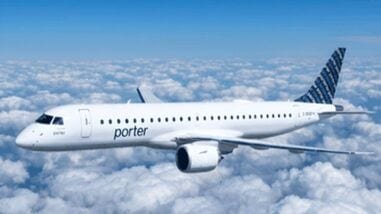
A Porter Airlines flight from Victoria to Toronto was canceled after a toddler refused to wear a seatbelt, forcing the aircraft to return to the terminal and leaving passengers stranded overnight.
Flight PD444 had departed the terminal at Victoria International Airport (YYJ) in British Columbia on Thursday (August 6), and was heading toward the runway when crew members noticed the child standing in their seat, according to Canadian media outlets CTV News and CP24.
The toddler’s parent and cabin crew members tried to secure the child’s seatbelt but were unsuccessful.
Plane forced to return to terminal
A Porter Airlines spokesperson told CTV News that the aircraft had already left the terminal when crew members realized the child was standing in the seat.
“A young child was standing in their seat and would not secure their seatbelt,” the airline said.
Because the child could not be safely secured, the crew decided the aircraft could not take off.
“The aircraft could not take off in this unsafe condition, so the crew elected to return to the terminal and have the passengers disembark,” Porter said.
The decision meant all passengers had to leave the aircraft while the airline dealt with the situation.
Passengers stranded overnight
According to Porter, removing the toddler and parent from the plane along with their luggage, re-filing flight plans and completing other required paperwork took enough time for the airport’s nighttime runway closure to become an issue.
The process continued beyond 12:30 a.m., when Victoria International Airport’s runway closes for the night.
As a result, passengers on flight PD444 were unable to continue their journey to Toronto and had to spend the night in Victoria.
Porter apologized for the disruption caused to the other passengers and said they would be able to travel on a flight the following day.
Flight eventually reaches Toronto
Flight-tracking website FlightAware showed that PD444 eventually departed Victoria International Airport on Friday at 10:49 p.m. local time.
The aircraft arrived in Toronto at 6:16 a.m. the following day, according to the tracking data.
The incident highlights the strict safety requirements that apply before an aircraft can take off, with airlines required to ensure passengers—including young children—are properly secured for departure.
Porter Airlines’ child seat rules: What its guidelines say
Porter Airlines has detailed safety requirements for infants and children traveling onboard, including rules governing car seats, child restraint systems and seatbelt use.
The airline says Transport Canada highly recommends an approved child restraint for all phases of a flight, noting that it provides the highest level of protection for young passengers and can help protect them during unexpected turbulence.
Child restraints mandatory for infants under 2 with their own seat
According to Porter’s guidelines, the use of a child safety seat or restraint device is mandatory for an infant under 2 who occupies a seat.
For a small child, the use of a child restraint is optional, depending on the manufacturer’s weight limits for the device.
Parents who want to use a car seat onboard must purchase a separate seat for the child. Porter does not provide car seats or other child restraint systems.
The airline does, however, allow passengers to check car seats at no additional charge, in addition to their checked-baggage allowance.
Booster seats not allowed onboard
Porter does not permit booster seats for older children onboard its aircraft.
The airline says booster seats are not compliant with aviation safety requirements because their internal harness has been removed. Any child restraint device accepted for use onboard must have an internal harness system and meet the required labeling standards.
Children must be secured when seatbelt sign is on
Porter states that children traveling in approved car seats must remain secured whenever the Fasten Seatbelt sign is illuminated.
Children in car seats must also sit next to a passenger aged 16 or older and cannot occupy an emergency exit row.