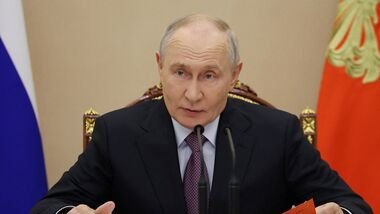
Russia could potentially launch a limited military operation against a NATO ally in the coming years as President Vladimir Putin seeks to gauge how firmly the alliance would respond, reported CNN citing three people familiar with the latest US intelligence assessments.
CBS, citing US officials familiar with the assessments, reported that such actions could involve hybrid operations, cyberattacks and other deniable activities that stop short of a full-scale conventional military campaign.
According to the officials, the assessments point to a change in Putin’s risk calculus compared with just a few months ago, indicating a greater willingness to take actions that could test NATO’s response without directly triggering a conventional conflict, the CBS report noted.
Putin, earlier last month, alleged that the Western nations adopted “double standards” by selectively referring to the UN Charter while disregarding the principle of national “self-determination” whenever it conflicted with their interests.
He also mentioned that Western sanctions had failed to deliver their intended results, saying that since 2022, “the West has set its Russophobic machine running at full speed,” as it imposed what he described as a record number of ineffective sanctions.
further claimed that adversaries, after failing to defeat the country “on the battlefield,” had turned to “outright terrorist methods” against the Russian people.
“But the people of Russia can never be broken. They never have been – and they never will be,” he stated.
He also said Russia would accomplish its objectives in the “special military operation” in Ukraine, while accusing Western countries of promoting “Russophobia” and seeking to weaken Russia, according to a statement issued by the Russian Foreign Ministry.
Putin described the previous five years as “difficult and exceptionally consequential” for Russia, saying the period had been marked by circumstances in which “the fate and future of our people” were at stake.
He maintained that Russia has traditionally responded to external threats by rallying around national unity, adding that the same sense of solidarity was visible in the country today.
What did NATO Secretary say months ago?
Meanwhile, Secretary General Mark Rutte, speaking earlier in April, pointed to the immediate threat Russia poses across multiple theatres to Europe and North America. He stressed that the Western alliance’s defence network is actively countering Russian incursions while safeguarding both sides of the Atlantic.
The NATO chief outlined recent operational measures taken along the alliance’s eastern flank, highlighting how European allies are increasingly contributing to the protection of NATO’s shared airspace.
“When Russian MIG-31s crossed into Estonian airspace last fall, it was European aircraft – Italians in the lead, backed up by Finns and Swedes – that turned them back. When a flock of Russian drones wandered recklessly into Poland around the same time, I’m proud to say that it was a Dutch F-35 that fired the shot that took down the danger,” Rutte mentioned.
He stressed that collective defence continues to be at the heart of NATO’s purpose and cautioned that Russian threats cannot be viewed separately from wider global cooperation among hostile states. Referring to the alliance’s early years, Rutte added, “I’m always reminded of your earliest predecessor, the very first Secretary General of NATO, who said that the challenge of the Alliance, maybe the purpose of NATO, is keeping the Russians out and the Americans in.”
Rutte said NATO was established not only to counter Russian threats but also to ensure the security of the broader transatlantic community, including the US and Canada. He stressed that American security depends on a stable Europe as well as a secure Arctic and Atlantic, warning that vulnerabilities in these regions could expose the US and its allies to threats from Russia and other adversaries.
(With inputs from ANI)