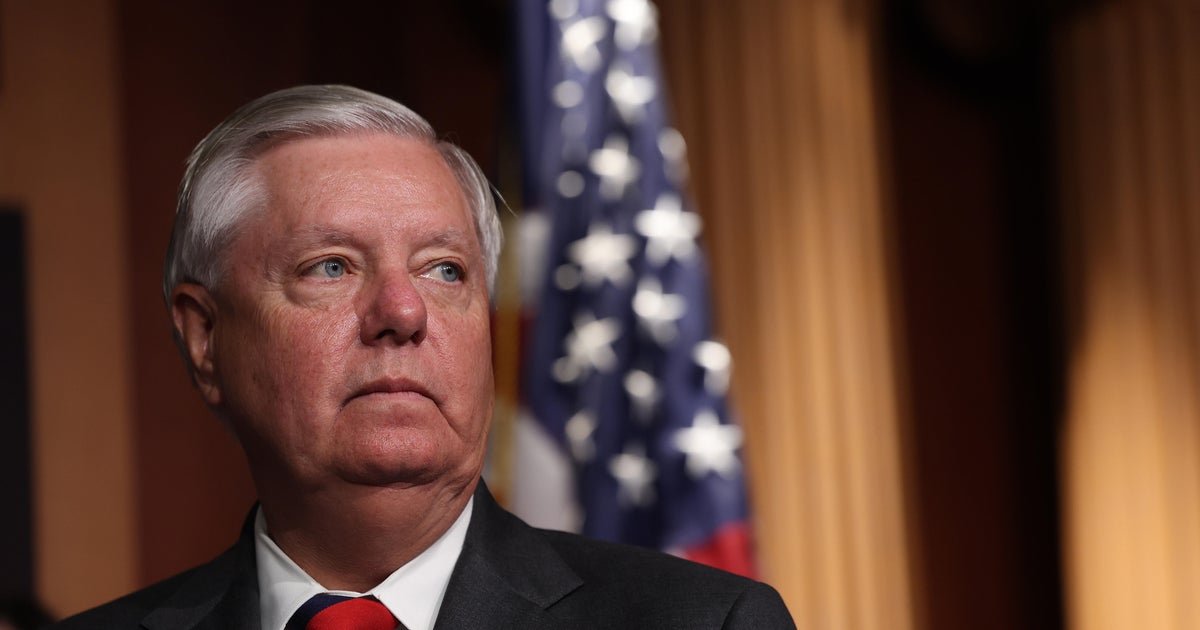
Washington — After more than a year of negotiations, the Senate on Friday finally passed a bill to impose punishing new sanctions on Russia for its war on Ukraine, approving the measure with overwhelming bipartisan support.
Senators had pushed for months for a vote on legislation that would penalize top Russian figures and the biggest buyers of Russian oil to dial up the pressure on Moscow to end the fighting.
The Senate voted 86 to 11 to approve the bill, sending it to the House.
Over the last year, prior versions of the measure — championed by Republican Sen. Lindsey Graham of South Carolina — were on the verge of moving forward, only to meet resistance from the White House or to be put on the back burner for other priorities or alternate courses of action.
The effort to impose fresh sanctions on Russia received another burst of momentum after Graham’s sudden death in July. Graham died shortly after returning from a trip to Kyiv and announcing that a deal had been reached with the White House to move forward on an updated version of the legislation.
GOP Sen. Darline Graham of South Carolina, who filled her brother’s seat after his death, said the late senator “believed that this was the most consequential piece of legislation that he had ever led.”
Democratic Sen. Richard Blumenthal of Connecticut, who spearheaded the sanctions legislation with Graham, called it a “momentous day.”
“I’m not even going to try to channel my inner Lindsey Graham, except to say, as he said to me in some of his last words, ‘This is a big effing deal,'” Blumenthal said.
The bill, titled The Lindsey O. Graham Sanctioning Russia and Iran Act of 2026, allows the president to impose tariffs of up to 100% on the top five purchasers of Russian oil or natural gas. There are exceptions for countries that import less than 15% of their natural gas from Russia and are taking “significant” steps to reduce the imports. It also includes sanctions on Russian President Vladimir Putin, officials within his government, oligarchs and Russian banks and financial institutions.
China and India are the largest buyers of Russian crude oil, according to the Centre for Research on Energy and Clean Air think tank. Europe has historically been Russia’s largest natural gas customer, though the European Union has cut its imports significantly in recent years and is aiming to fully wean itself off Russian gas by next year.
The bill also extends sanctions on Iran’s energy and weapons sectors. The Iran sanctions were added at the urging of President Trump.
It gives the president authority to waive the sanctions if he certifies to Congress that it’s in the national interests of the U.S.
The vote came together after most opposition faded this week. With any one senator having the ability to slow the path forward, GOP Sen. Rand Paul of Kentucky secured a vote on an amendment to strip the tariff authority from the bill, which failed.
Democratic Sen. Raphael Warnock of Georgia also dropped his opposition after securing a commitment from U.S. Trade Rep. Jamieson Greer. Speaking on the Senate floor Friday morning, Warnock entered a letter from Greer into the record that he said closes a loophole that would expand the president’s tariff authority, calling it a “small but meaningful victory for all Americans who continue to suffer under this president’s reckless tariffs.”
After attending Graham’s funeral in Washington, Ukrainian President Volodymyr Zelenskyy watched from the Senate gallery as senators advanced the long-stalled sanctions in a June 29 vote. Zelenskyy said it was “deeply symbolic” that Graham’s last trip abroad was to Ukraine, adding that the “best way to honor his memory” was to pass the measure.
Its potential passage in the House will be delayed since the lower chamber is on its five-week August break. And it’s likely to meet resistance from some Democrats who are skeptical about the tariff provisions.
In a statement after the bill’s Senate passage, Democratic Reps. Gregory Meeks of New York and Don Beyer of Virginia said “the current text is unacceptable.”
“This bill’s sanctions still contain the broadest possible waiver authority for President Trump, who already has the power to impose these sanctions on Russia under U.S. law but has refused to do so,” said Meeks, the ranking member of the House Foreign Affairs Committee, and Beyer, a member of the Joint Economic Committee.
“What the bill does grant, however, are sweeping new tariff authorities that the president could weaponize with abandon, as he has repeatedly done in the past,” they said.
Blumenthal acknowledged that the measure faces issues in the House, but emphasized that “this bill is the bill that will pass” and be signed into law by the president.
“He supports it,” Blumenthal said in a news conference after the vote. “It has taken some time to gain his support, but now that we have it, we need to move forward as quickly as possible to make sure we stand with the people of Ukraine.”
Blumenthal said Senate negotiators have had conversations with House leaders, as well as Meeks.
“I hope we’ll continue those conversations,” he said. “I think it’s a historic opportunity. Time is not on our side, and I hope the conversations will take place quickly.”
Before the House left, Speaker Mike Johnson said he was “heartened to hear” that a deal had been reached with the White House.
“We’re happy to receive and process that,” the Louisiana Republican said.
contributed to this report.