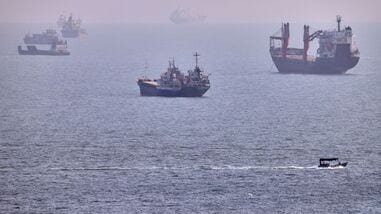
All eyes are on the Iran-Oman deal, aimed at ending the ongoing US-Iran war and easing severe maritime disruption in the Strait of Hormuz. While details continue to emerge, the timeline for its enforcement remains unclear.
Iran’s Foreign Ministry spokesperson Esmail Baghaei said earlier this week the agreement with , which lies on the other side of the waterway, is in the “final stage” of drafting. According to Fars News, the two sides have reached an understanding on the geographical coordinates of the proposed corridor.
Baghaei told reporters Wednesday that a joint statement will be issued “if certain parties do not obstruct this process,” in an apparent reference to the US, the Associated Press reported.
The Strait of Hormuz is crucial to global shipping and energy supplies. Before the war, which began with on Iran in February, about one-fifth of the world’s traded oil and natural gas passed through the waterway at the mouth of the Persian Gulf.
What’s being proposed in Iran-Oman deal?
Iran and Oman are reportedly discussing a framework that would eventually eliminate the northern and southern shipping corridors in the and channel all maritime traffic through a central route.
Under the proposed arrangement, ships would initially enter through the northern corridor near Iran’s coast and leave through the southern corridor near Oman, the IRGC-affiliated Fars News reported, citing an Iranian Foreign Ministry source.
After a specified transition period, both routes would close, with inbound traffic through the central corridor managed by Iran and outbound traffic jointly managed by Iran and Oman, Iran International reported.
Meanwhile, an Al Arabiya source explained that under the plan, inbound vessels would use the shipping lane closest to Iran, while outbound vessels would use the lane closest to Oman. Regional parties could also take part in mine clearance and other necessary technical procedures, the report added.
The source further said that ships would be charged for services including insurance, refuelling and environmental protection, rather than paying a fixed percentage of their cargo’s value.
Fars reported other details, including a proposed ban on any Israel-related cargo. “Iran expects during that time, it would receive relief to sell oil,” another report claimed.
The proposed agreement is expected to last 60 days. However, Iranian Deputy Foreign Minister Kazem Gharibabadi told IRNA that while existing temporary routes would be closed, the new route would be used for two to four months or potentially longer.
Iran has maintained that it would not tolerate any foreign interference in the Strait of Hormuz, stressing that any understanding on the strategic waterway should be reached exclusively between Iran and Oman.
The deal aims to resume maritime traffic and launch technical talks. Any new deal on the Strait of Hormuz would have to be approved by Iran’s Supreme Leader, Mojtaba Khamenei, who has been in hiding since being injured in the initial US-Israeli attacks in February.
It’s unclear if he’s given his consent yet, and Iranian officials have said that communicating with him takes time.
Will Iran-Oman deal open Strait of Hormuz?
Gharibabadi told IRNA that the Iran-Oman arrangement was only a framework for managing vessel movements.
It “does not signify a full reopening of the Strait of Hormuz; rather, it represents a new model—distinct from the practice of the past sixty years—under which a significant portion of the shipping route will pass through Iran’s territorial waters,” he was quoted as saying.
Tehran has maintained that the easing of restrictions on the waterway depends on “a change in US conduct and the removal of threats to regional security and stability.”
Baghaei made clear that the emerging agreement with Oman “cannot in itself be interpreted as meaning the waterway has become safe for passing vessels”.
He said the main sources of insecurity and instability remain US naval deployments, its “illegal” maritime blockade of Iranian ports, and other “hostile measures” against the country and its interests.
What does Iran want?
Tehran said the United States must first meet a series of political and economic conditions before free navigation can resume, according to news reports. It added that a full reopening would require the lifting of the American maritime blockade.
Iran has demanded:
> Lifting of the naval blockade on Iranian ports
> Addressing sanctions reimposed after the truce broke down — particularly those targeting its oil sector
> Resuming negotiations over frozen Iranian assets
Tehran also wants Washington to take several steps that it says are necessary to rebuild trust after the collapse of the June memorandum of understanding between the two countries.
According to Fars news, Gharibabadi said Washington violated its commitments under the Islamabad Memorandum of Understanding (MoU), restored an illegal naval blockade on Iranian ports, resumed hostilities and failed to help establish stability in Lebanon.
What does US want?
Iran was seeking fees of 5% to 7% of cargo values, while Oman was discussing charges of about 3%. Washington wanted passage without fees, according to reports.
The US has insisted on free transit through the Strait of Hormuz and broadly called for a return to the pre-war status quo.
“Any temporary routes through the strait won’t be subject to approvals, permissions, tolls or charges,” a US official was quoted by media Thursday in response to reports on the latest proposals.
The official said Washington remained committed to restoring the previous system in which “no party controls the lanes or the ability to transit through them”.