A mid-air safety scare was reported from Washington DC as US President ‘s helicopter – Marine One – flew close to a commercial flight in the national capital.
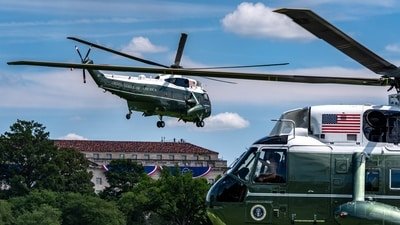
The incident occurred as Marine One departed from the White House for Andrews Air Force Base at the same time an American Airlines flight took off from Ronald Reagan Washington National Airport.
Describing the incident as a , the National Transportation Safety Board and the Federal Aviation Administration have launched a probe as to why commercial planes were not halted as the President’s chopper took off.
What is a “loss of separation” incident?
In aviation, a loss of separation occurs when two aircraft come closer together than the allowed safety minimum distance set by the rules.
Air traffic controllers and rules lay out specific horizontal and vertical buffers to prevent any collisions. In case of breach, the incident is described as a “loss of separation.”
With regard to the mid-air scare for President Trump, the FAA’s preliminary safety review said there was a “momentary loss of separation after which the aircraft continued to move away from one another.
“The air traffic controller was in contact with both the commercial pilot and Marine One pilot during the loss of separation,” said a spokesperson for the FAA, adding that “the president was never in danger.”
Also Read |
“Marine One flights are piloted by some of the best aviators in the world, and at no point was the President in harm’s way,” White House spokesperson Kush Desai said in a statement.
What are the rules?
Following a mid-air collision in January 2025 after an American Airlines passenger jet collided with an Army Black Hawk helicopter, the FAA decided that all takeoffs and landings at the Washington DC airport would be halted any time a helicopter passes by on a conflicting route.
All 64 passengers and crew on the plane and three soldiers in the helicopter were killed in the crash.
Also Read |
Due to the airspace near the White House and Reagan being heavily congested with military and commercial aircraft, the FAA stated that no flights would take off when a helicopter passes by.
The aviation authority also took steps to ensure that helicopters and aeroplanes would no longer share airspace around the airport after the Potomac River crash.
Furthermore, the rules require air traffic controllers to use radar — and not rely on pilots’ eyes — to maintain separation, and require all military aircraft to broadcast their locations.
Poor communication at ATC?
While the probe into this close call continues, initial reports show confusion and problems during the communication with air traffic controllers.
The Marine Corps have defended their actions and stated that the helicopter with Trump was not given any instructions to delay, hold or alter their route.
“There were no ‘close calls’ with the routine Marine One movement. Washington National Tower did not delay the helicopter crew, ask them to hold, or otherwise alter their flight profile,” Marine Corps spokesperson Capt. Jacob Sugg told the Associated Press in an email.
Audio recorded by ATC also shows Marine One’s pilot calling before taking off. The transmission was not acknowledged by the ATC, who later stated that the message was “unreadable and broken.”
As Marine One’s pilot announced the helicopter was proceeding as briefed, the controller seemed surprised.
“Uh, Marine One, you said, uh, you’re proceeding as briefed?” the controller asked before giving the helicopter directions and commenting, “OK, no three minutes, roger, proceed as briefed.”
As per Reuters, two people familiar with the matter said that ATC had not paused commercial departures despite the FAA rules and timely communication from Marine One.
(With agency inputs)