The US Federal Aviation Administration (FAA) has launched an investigation after a commercial passenger jet was allowed to take off while President was approaching Ronald Reagan Washington National Airport, an incident that appears to conflict with safety procedures introduced after last year’s deadly midair collision.
Although officials stressed that was never in danger and the aircraft were not on a collision course, the event has raised fresh concerns about aviation safety in one of the busiest and most tightly controlled airspaces in the United States.
What happened?
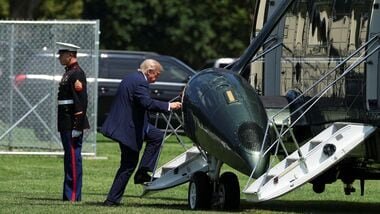
The incident took place Tuesday afternoon (August 4) as Marine One departed the White House carrying to Joint Base Andrews for the first leg of his West Coast trip.
At the same time, a commercial passenger aircraft was cleared for takeoff from Reagan National Airport. According to Reuters, air traffic controllers did not halt commercial operations despite a policy requiring flights to stop whenever presidential or other helicopters transit the airport’s airspace.
The later confirmed there was a “momentary loss of separation” between the two aircraft before they safely moved farther apart.
Importantly, the passenger jet was already climbing above Marine One as the helicopter approached the airport, meaning the aircraft were never on a direct collision course.
Why is the FAA investigating?
The investigation centers on whether air traffic controllers failed to follow safety rules implemented after the .
That , killed all 67 people aboard the two aircraft and prompted a sweeping review of helicopter operations around Washington, D.C.
Following the tragedy, the FAA introduced stricter measures, including:
-Halting all commercial takeoffs and landings whenever helicopters pass near Reagan National Airport.
-Preventing helicopters and airplanes from sharing the same operational airspace.
-Prohibiting controllers from relying solely on visual separation.
-Requiring military aircraft to continuously broadcast their locations.
Investigators are now examining why a commercial aircraft was permitted to depart despite those procedures.
What did the FAA say?
The FAA acknowledged that separation standards were briefly compromised.
“There was a momentary loss of separation after which the aircraft continued to move away from one another.”
The agency also said air traffic controllers remained in communication with both the Marine One pilots and the commercial flight crew throughout the incident.
The FAA has not yet determined whether controller error or another factor caused the breach.
Was President Trump in danger?
No.
The White House emphasized that the President was never at risk.
White House spokesman Kush Desai said: “Marine One flights are piloted by some of the best aviators in the world, and at no point was the President in harm’s way.”
Similarly, the US Marine Corps rejected suggestions of a close call.
Marine Corps spokesman Capt. Jacob Sugg said the helicopter crew received normal clearances and was never instructed to delay, hold position or alter its flight path.
According to the Marines, air traffic control approved the requested route and provided appropriate traffic information throughout the flight.
Why is Reagan National Airport considered high risk?
The airspace around Reagan National Airport is among the most complex in the .
Commercial airliners share the skies with:
-Presidential aircraft such as Marine One
-Military helicopters
-Government aircraft
-Law enforcement aviation
-Civilian flights operating in and out of Washington, D.C.
The close proximity of the White House, Pentagon, Joint Base Andrews and numerous military installations makes the region particularly challenging for air traffic controllers.
What changes were introduced after the 2025 crash?
The prompted the FAA to strengthen aviation safety around Reagan National.
The new procedures were designed to eliminate situations where helicopters and commercial aircraft occupy nearby airspace simultaneously.
The reforms also sought to reduce reliance on visual separation by controllers and improve aircraft tracking through mandatory broadcasting requirements for military flights.
Tuesday’s incident is being scrutinized because it appears inconsistent with those safeguards.
What role could the NTSB play?
The (NTSB), which investigated last year’s fatal collision, said it is gathering information about Tuesday’s incident.
Officials have not yet decided whether to open a formal investigation.
(With AP, Reuters inputs)