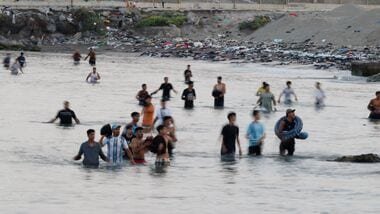
Thousands of migrants who risked their lives to enter Spain’s North African enclave of Ceuta from Morocco turned back almost as quickly as they arrived. Spanish authorities said that of the estimated 50,000 to 60,000 people who crossed into Ceuta over just a few days had returned to Morocco within 48 hours.
So why did so many migrants voluntarily return after making the dangerous journey?
They realised Ceuta was not a gateway to mainland Europe
One of the biggest reasons was that migrants could not continue their journey beyond Ceuta.
Quick answers to key questions
Why did migrants choose to return to Morocco after reaching Ceuta?⌵
Many migrants returned to Morocco because they realized Ceuta was not a viable gateway to mainland Europe, as irregular entry did not grant them the right to stay or travel freely within the EU.
What challenges did migrants face immediately upon arriving in Ceuta?⌵
Upon arrival, migrants faced challenges such as scarce food and shelter, with many sleeping on beaches and struggling to access basic necessities due to authorities restricting supplies.
How did the Spanish government respond to the influx of migrants in Ceuta?⌵
The Spanish government deployed soldiers, police, drones, and boats to secure the border and facilitate returns, including installing a floating barrier to control crossings from Morocco.
What role did Moroccan authorities play in the returns of migrants from Ceuta?⌵
Moroccan authorities coordinated with Spain to facilitate the returns, providing direct transport for migrants back to their country, which expedited the process of processing large numbers of returnees.
What factors contributed to the mass crossing of migrants into Ceuta?⌵
Several factors encouraged the mass crossing, including economic hardship, social media rumors about opportunities, possible legal changes regarding migration, and temporary relaxations of border enforcement by Morocco.
Spanish authorities stressed that irregular entry into Ceuta does not grant the right to remain in Spain, travel to the mainland or move freely across the European Union. Unlike mainland Spain, Ceuta is subject to special Schengen border controls, meaning anyone leaving the enclave by sea or air undergoes police identity checks.
As a result, migrants who expected to use Ceuta as a stepping stone into Europe found themselves trapped in a small territory with no legal route forward.
Spain quickly regained control of the border
The Spanish government responded rapidly after the unprecedented influx.
Madrid deployed soldiers, police officers, drones, divers and boats to secure the enclave. Soldiers were seen escorting migrants back towards Morocco, while authorities installed a new 500-metre floating barrier at the Tarajal breakwater, one of the main crossing points.
The heavy security presence made it increasingly difficult for migrants to remain inside Ceuta or attempt further crossings.
Food and shelter quickly became scarce
Many migrants spent the night sleeping on beaches and streets after arriving in Ceuta.
Several said they struggled to obtain food or basic necessities.
Moroccan migrant Mohamed Hatri said authorities had effectively cut off access to supplies to pressure people into leaving.
“They’ve closed everything down so that we can’t buy anything to eat, to force us to return to our country.”
Another aspiring migrant, Abdalah, said he spent two days near the border without finding anything to eat after failing to complete the journey.
With thousands stranded in a territory of just 18.5 square kilometres, living conditions deteriorated rapidly.
Moroccan authorities helped facilitate returns
The speed of the exodus was also due to cooperation between Spain and Morocco.
A Moroccan source familiar with border operations said migrants returned by Spain were transported directly home by bus or via the railway station in Tangier. The source also said security had been restored around the Fnideq border crossing, making it easier to process large numbers of returnees.
This coordination enabled thousands of migrants to leave Ceuta within a matter of hours.
The deadly crossing deterred many
The risks of the journey became increasingly apparent as authorities updated the death toll.
Spanish officials said at least 67 people died attempting to reach Ceuta. Some drowned while swimming around the border barrier, while others were crushed trying to cross the breakwater and border fence.
The high number of fatalities underscored the dangers of attempting another crossing and likely persuaded many already inside Ceuta to return.
Why did so many cross in the first place?
Authorities have not identified a single trigger behind the mass movement.
However, the reports point to several possible factors:
Economic hardship: Many migrants said they came seeking jobs and better living conditions in Europe. A Senegalese migrant told AFP, “We hope to go to Europe to work and earn a living.”
Rumours and social media: Reuters reported many migrants were encouraged by rumours circulating on social media.
Possible legal changes: Migration analyst Ignacio Cembrero suggested Spain’s July 8 Supreme Court ruling on sea arrivals may have influenced perceptions, although he said it did not fully explain the scale of the movement.
Diplomatic tensions: Some analysts argued Morocco may have temporarily relaxed border enforcement to increase pressure on Spain over longstanding disputes surrounding Ceuta and Melilla.
European response
The crisis triggered immediate concern across Europe.
Twenty-two EU governments called for an emergency meeting of interior ministers, while France increased police deployments along its border with Spain. Italy temporarily suspended Schengen arrangements with Spain for one month, although Spanish officials questioned the legal basis for the move.