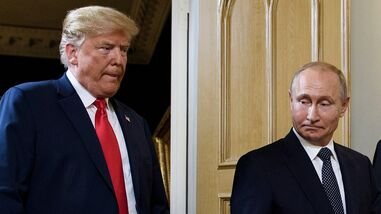
US President Donald Trump has said he does not believe Russian President Vladimir Putin will attack a NATO member, as concerns mount across Europe over Moscow’s expanding campaign of hybrid attacks against countries supporting Ukraine.
Speaking to reporters in the Oval Office on Thursday (August 27), Trump said he had “good talks” with Putin and was confident Russia would not target NATO territory.
“He’s not going to be attacking a NATO territory,” Trump said.
Trump also sought to downplay reports that CIA Director John Ratcliffe had travelled to Moscow to warn Russian officials against any potential attack on a NATO country.
Trump says Ratcliffe’s Moscow trip was routine
Ratcliffe made a rare visit to Russia on Tuesday for meetings with his Russian counterpart, Sergei Naryshkin. The details of their discussions have not been made public.
Trump said the CIA director was not sent to Moscow to deliver a specific warning.
Speaking to Axios in a phone interview, Trump said Ratcliffe meets his Russian counterpart periodically and that there was “no message” and “nothing unusual” about the visit.
“Ratcliffe sees his Russian counterpart once every six months or once every year. They have a very good relationship,” Trump said.
Trump had similarly described the trip as “semi-routine” during a radio interview with conservative host Glenn Beck on Wednesday.
“He’s there, very sort of semi-routine. I hate to disappoint people. We would like to see the war with Ukraine end,” Trump said.
Ratcliffe’s visit makes him one of the highest-ranking US officials to travel to Russia since Moscow launched its full-scale invasion of Ukraine in February 2022.
Kremlin dismisses potential NATO attack reports
The Kremlin also rejected reports that Russia could be preparing to attack a NATO country.
Asked about the reports during a daily briefing, Kremlin spokesman Dmitry Peskov dismissed them as “scare stories” and said they had no connection to reality.
“A lot of such scare stories are being published right now. Of course, they have nothing to do with reality,” Peskov said.
Peskov maintained that Russia would prefer to achieve its objectives in Ukraine through peaceful means but said Moscow would continue its military campaign if that was not possible.
He also accused European countries supporting Ukraine of pursuing what he described as an “aggressive policy” toward Russia.
Naryshkin, meanwhile, confirmed that he had met Ratcliffe but also played down the significance of the talks.
“Yes, the meeting did take place, but there is nothing unusual about it,” Naryshkin was quoted as saying by Russia’s state-run TASS news agency.
Europe remains concerned over Russian hybrid attacks
Despite the reassurances from Trump and Moscow, European and US intelligence agencies have continued to monitor Russian sabotage and so-called gray-zone or hybrid operations across Europe.
These activities include cyberattacks, sabotage, disinformation campaigns and the use of drones. Such operations generally remain below the threshold of conventional warfare but are aimed at undermining NATO unity and weakening support for Ukraine.
Concerns have intensified as Russia’s war against Ukraine continues and Moscow faces growing pressure from Ukrainian retaliatory strikes.
Poland said this month that it had thwarted an alleged assassination attempt against a US citizen originally from Ukraine that it said had been ordered by Russia. Estonia has also accused Moscow of involvement in a fire at a facility belonging to a drone manufacturer.
Ukraine war remains unresolved
Ratcliffe’s Moscow visit comes as US-backed efforts to end the war have stalled and Russia has intensified its military campaign.
Russia continues to demand that Ukraine withdraw from parts of the eastern Donbas region, while Moscow has repeatedly rejected Ukrainian calls for direct face-to-face talks between Putin and Ukrainian President Volodymyr Zelensky.
Meanwhile, Ukrainian drone strikes deep inside Russia have increasingly affected military targets, infrastructure and civilian areas.
The widespread use of drones on both sides has also transformed battlefield tactics, making large-scale troop movements increasingly difficult and contributing to a grinding conflict in which neither side has secured a decisive advantage.