In a candid admission, Pakistan Prime Minister Shehbaz Sharif’s Adviser on Political Affairs, Rana Sanaullah, has said that militants once trained as ‘Mujahideen’ had become a burden for the country.
“These are the same people we once trained as Mujahideen. We sent them to fight, and today they are hanging around our necks,” Sanaullah said during a Geo TV programme hosted by journalist amid unrest in Pakistan-occupied Jammu and Kashmir (PoJK).
Quick answers to key questions
What did Rana Sanaullah say about the Mujahideen during the Geo TV programme?⌵
Rana Sanaullah admitted that the militants once trained as Mujahideen have become a burden for Pakistan, stating, ‘These are the same people we once trained as Mujahideen. We sent them to fight, and today they are hanging around our necks.’
Why are there protests in Pakistan-occupied Kashmir (PoJK)?⌵
Protests in PoJK have emerged due to demands for electoral reforms and accusations of brutality and targeted killings by security forces, intensifying ahead of regional legislative elections.
How did Rana Sanaullah’s earlier statements reflect on Pakistan’s history with Mujahideen?⌵
Earlier, Sanaullah described it as a collective mistake to prepare Mujahideen for war, stating that their creation ultimately led to domestic terrorism within Pakistan.
What actions have protesters in PoJK taken against security forces?⌵
Protesters in PoJK have staged continuous demonstrations, alleging that security forces have used lethal force against them, resulting in fatalities during the protests.
Should the international community intervene in the unrest occurring in PoJK?⌵
Some protesters have called for international media and groups to witness the alleged violence and repression in PoJK, indicating a desire for global attention and potential intervention.
Sanaullah is a Palistani politician who has been serving as Special Assistant to the Prime Minister on Political Affairs since April 2024. Previously, he served as the 39th Interior Minister of Pakistan in the first Shehbaz Sharif government.
The Arabic ‘Mujahideen’ word means “those who engage in jihad” or “strugglers/strivers” in the path of God.
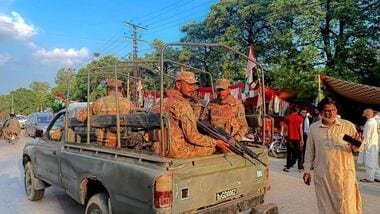
Protesters continued to stage demonstrations on Thursday at D-Chowk in in PoJK after social media accounts associated with the Jammu Kashmir Joint Awami Action Committee (JKJAAC) alleged that security forces used lethal force against demonstrators, resulting in fatalities.
According to the JKJAAC-linked social media accounts, protesters have been sitting at D-Chowk for several days while calling for a long march and protesting the “brutality” and “targeted killings” by security forces, news agency ANI reported.
is currently in the middle of a staggered, three-phase assembly election that has turned violently chaotic. The first phase, held on 27 July in the Mirpur division, descended into gunfire, with security forces opening fire on protesters and reports putting the death toll at close to twenty, with dozens more injured.
Earlier admission
In 2023, days after Pakistan witnessed a deadly attack on its security forces inside a Peshawar mosque, Rana Sanaullah, then the country’s Interior Minister, admitted inside the National Assembly that it was a collective mistake to prepare the ‘mujahideen’ to go to war with a global force.
“We did not need to make Mujahideen. We created Mujahideen and then they became terrorists,” Sanaullah said while addressing the country’s upper house of Parliament on 31 January 2023.
In April last year, Pakistan Defence Minister Khawaja Asif had admitted the country’s history of supporting, training and funding terrorist organisations as “dirty work” for the West, a mistake for which he said Pakistan had suffered.
“Well, we have been doing this dirty work for the United States for about three decades, you know, and the West, including Britain,” replied Mr. Asif.
“That was a mistake, and we suffered from that, and that is why you are saying this to me. If we had not joined the war against the Soviet Union and later on the war after 9/11, Pakistan’s track record… was an unimpeachable track record,” he said.
On Wednesday, Asif termed the PoJK protesters as ‘enemies’ like India and ruled out dialogue with them, even as the (JAAC) on Wednesday claimed that security forces have killed 37 people in the last two days.
“There will be no dialogue with the protesters. I bracket them with India. I put them in the same category as India and consider them as enemies of Pakistan,” Asif told reporters on Tuesday.
However, Sanaullah told reporters that the JAAC held a meeting with him and presented its 38 demands.
Alleging that the protesters want to seize Muzaffarabad and Mirpur through force, Sanaullah on Tuesday claimed that they were currently engaged in an “India-like attack”. Sanaullah claimed that no one was killed in clashes between the law enforcement personnel and protesters.
However, the JAAC, a collective of activist groups, on Wednesday said that 37 unarmed peaceful protesters and people, including women and children, who were not even protesting, have been killed by Pakistani forces in the last two days. The party’s claim could not be independently verified.
Pakistan’s involvement with militant groups
An ANI report also quoted Sanaullah saying that the protesters in PoK are similar to the ‘mujahideen’ whom Pakistan had trained in the past, but later they turned against the state
This candid reference appeared to acknowledge the long-term consequences of Pakistan’s policy of supporting and training militants. Pakistan’s involvement with militant groups during the Afghan war and their subsequent activities has long been the subject of.
Several studies have documented the state’s support for militant groups operating in Afghanistan and Kashmir, while also tracing how parts of the militant infrastructure later contributed to violence inside Pakistan.
(With agency inputs)