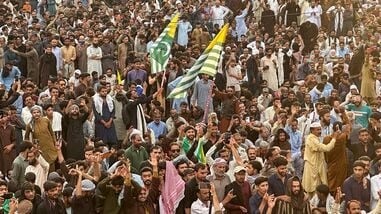
Protesters continued to stage demonstrations on Thursday at D-Chowk in in Pakistan-occupied Kashmir (PoK) after social media accounts associated with the Jammu Kashmir Joint Awami Action Committee (JKJAAC) alleged that security forces used lethal force against demonstrators, resulting in fatalities.
According to the JKJAAC-linked social media accounts, protesters have been sitting at D-Chowk for several days while calling for a long march and protesting the “brutality” and “targeted killings” by security forces, news agency ANI reported.
Quick answers to key questions
What triggered the protests in Pakistan-occupied Kashmir (PoK)?⌵
The protests in PoK were initially sparked by rising electricity tariffs and food prices, but they later escalated into demands for electoral reforms ahead of regional elections, particularly the abolition of legislated seats for refugees.
Why do protesters accuse the Pakistani security forces of targeted killings?⌵
Protesters have alleged that security forces used excessive force during demonstrations, resulting in fatalities, with claims that unarmed civilians were specifically targeted by armed personnel.
How has the internet shutdown affected the situation in PoK during the protests?⌵
The internet shutdown has hindered independent verification of events on the ground, made it difficult for journalists and civil society groups to report, and suppressed communications among protestors.
What are the main demands of the Joint Awami Action Committee (JAAC) in the protests?⌵
The main demands of JAAC include the abolition of 12 legislative seats reserved for refugees from India, as they believe these seats grant disproportionate influence to non-residents in local politics.
Why was the Joint Awami Action Committee (JAAC) banned in Pakistan?⌵
JAAC was banned under anti-terrorism laws due to concerns over public order, with authorities alleging that the group attempted to sabotage elections and was infiltrated by armed militants.
Why are people protesting in PoK? What do we know?
PoK has witnessed weeks of unrest ahead of the regional legislative elections, with protesters demanding electoral reforms, authorities accusing demonstrators of attempting to disrupt the polls, and international human rights organisations seeking an independent investigation into the reported .
According to Al Jazeera, the protests are being spearheaded by the JKJAAC, a coalition of activists, political workers, and traders. The movement initially began over rising electricity tariffs and food prices but later shifted its focus to electoral reforms ahead of the regional polls. Among its principal demands is the removal of 12 seats reserved in the legislative assembly for refugees from the Indian side of Kashmir.
The JKJAAC contends that reserving these seats for refugees who now live in other parts of gives non-residents disproportionate influence over the region’s politics and allows Islamabad’s mainstream political parties to shape the composition of the legislative assembly.
The dispute, which has now turned violent, intensified after the region’s Supreme Court, in a June verdict, ruled that the 12 reserved seats are constitutionally protected and cannot be abolished without a constitutional amendment, news agency AP reported.
As tensions escalated, protesters accused security forces of using excessive force against demonstrators.
Protesters accuse authorities of ‘targeted killings’
In a video shared by the accounts, one of the protesters alleged that armed personnel positioned in buildings were targeting unarmed civilians, and added, “Of the brothers who were martyred, most were shot in the head–what is called a ‘headshot.’ Brother, we only saw these things in games and places like that. We didn’t know these oppressors would do such things to us.”
Elaborating further, he alleged that continued to open fire intermittently during the night and claimed that protesters were being targeted. He said, “Even at night, they keep firing continuously after short intervals. They keep spreading fear and terror among the public. They target people in some places.”
The protester also appealed to the international media and said that it must come to the protest site to witness the ground realities and alleged that the officials are feeding it wrong information. “International media should come here and cover all these things. See who has the weapons. See who is shooting the people,” he added.
Khan Ilyas Khan, a core committee member of the JKJAAC, said that despite the fatalities, protesters are resolute in their demands, and added, “We are sad and in pain, but we are not hopeless. We will emerge again with double strength. We will challenge these cruel rulers. We will challenge these forces that came here to kill us, labelling us as terrorists for demanding public rights.”
The Awami Action Committee-linked accounts also appealed for international solidarity, urging several different groups, including Brazilian trade unions, workers’ organisations, human rights groups, student movements, and activists, to protest against repression in Kashmir.