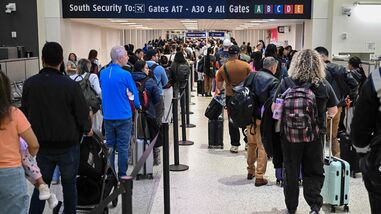
For many travellers, arriving in a new country usually means clearing , collecting baggage, and beginning their trip. However, another possibility is increasingly becoming part of the border experience, especially when entering the : being asked to hand over a phone for inspection. From tourists and students to business travellers and even US citizens, electronic device searches at border crossings have drawn growing attention over privacy concerns and travellers’ rights.
One such incident involved Atlanta-based activist Samuel Tunick, who was returning from a vacation in the Dominican Republic.
Here’s what happened
Tunick was stopped by Customs and Border Protection () officers at Hartsfield-Jackson International Airport, who demanded his cellphone and the passcode to unlock it, saying they were searching for child sexual abuse material, US News reported on Monday (local time).
However, Tunick’s device was powered by GrapheneOS, an -based operating system that features a “duress” PIN capable of erasing all data and restoring the phone to its factory settings. When border agents entered the PIN he gave them, the outcome was not what they had anticipated. Following this incident, Tunick faced federal charges under a rarely used statute that makes it a criminal offence to destroy property to prevent its seizure.
As a result, a federal court in has become ground zero for what could be a far-reaching legal battle over federal border searches and the rights of Americans to resist them. The activist’s lawyers argued that the demand from CBP officials to search his phone was invalid because it violated his constitutional rights. They said, “Evidence obtained from Mr. Tunick’s phone – or lack thereof – should be suppressed as fruits of unlawfully obtained evidence.”
His legal team also claimed that Tunick was being probed for his involvement in the “Defend the Atlanta Forest” movement, also known as “Stop Cop City,” which is aimed at opposing the construction of a police training facility.
They further noted that the child sex material claim was “a pretext for a fishing expedition into Mr. Tunick’s connections with the Defend the Atlanta Forest movement,” their lawyers contended.
While American citizens cannot be denied entry back into the country for simply refusing to turn over passcodes, some immigration attorneys suggest that doing so can result in processing delays and the confiscation of the device in question.
Here’s what we know
According to the report, Tunick’s case, filed late last year, could also have implications for tourists’ and American citizens’ rights at the border.
CBP maintains that it has broad powers to inspect individuals entering the country without requiring a warrant, probable cause, or specific suspicion. The agency states, “All travelers are obligated to present their electronic devices and the information resident on the device in a condition that allows for the examination of the device and its contents.”
Courts have long recognised a “border search exception” to the Fourth Amendment, a provision of the US Constitution that prohibits unreasonable searches and seizures by the government.
However, CBP maintains that such inspections are uncommon. According to the agency, fewer than 0.1 per cent of international travellers arriving at a US port of entry had their electronic devices searched during fiscal year 2025.
Legal challenges brought by the Electronic Frontier Foundation and the American Civil Liberties Union (ACLU) have shed light on the government’s approach to electronic device inspections. Under current policy, authorities classify searches into two categories: “basic” searches, which include manually examining a device and can be carried out without a warrant or suspicion, and “advanced” searches, where officers use external equipment and must have reasonable suspicion of unlawful activity.
Here’s what you can do if travelling to the US:
- If you are travelling with your personal cellphone, ensure that you log out of your email, social media, and cloud storage accounts before arriving at the US border.
2. Disable your biometric identification, including facial recognition or thumbprint access, since these are easier for CBP officers to request and use.
3. Ensure that you have already completed a data backup and deleted the data from your phone.
4. If possible, travel with a secondary phone.
5. Also consider deleting certain apps, such as those enabling encrypted communications or .
However, it remains to be seen whether the Georgia court will rule in Tunick’s favour or whether Americans will have to compromise on some of their constitutional rights when coming back home.