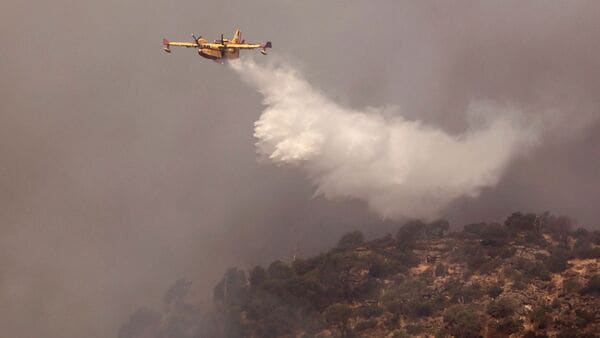
Wildfires continued to rage across France and Spain on Sunday (July 26), forcing the evacuation of more than 300,000 people as firefighters battled fast-moving blazes fuelled by heatwaves, drought and strong winds.
France’s historic wine city of Bordeaux is facing one of its biggest wildfire threats in recent memory, while Spain has declared a civil protection emergency as fires burn across multiple regions.
Here are the latest developments:
More than 300,000 evacuated
Authorities have evacuated around 250,000 people in France, mainly from the Gironde and Landes regions in the southwest, while about 76,000 people have been evacuated in Spain. Another 30,000 residents in Spain have been ordered to shelter in place.
Bordeaux under growing threat
The largest wildfire in France remains concentrated in the Gironde region and has advanced to within 15 kilometres (9 miles) of Bordeaux.
French Interior Minister Laurent Nunez described the blaze as “extremely intense and unpredictable”, saying it was generating its own winds and advancing erratically toward the Bordeaux metropolitan area.
Despite the threat, Bordeaux Mayor Thomas Cazenave said there were no immediate plans to evacuate the city, although authorities remain on high alert.
The fire has already burned about 42,000 hectares—roughly four times the size of Paris—and destroyed at least 240 homes.
Massive firefighting operation underway
France has deployed:
2,500 firefighters
1,500 military personnel
1,200 police officers
18 firefighting aircraft and helicopters
A specially modified A400M military aircraft capable of dropping water and fire retardant
A Swiss firefighting team under European Union assistance
Another major wildfire in the neighbouring Landes region has also forced tens of thousands to flee, while a separate blaze in southeastern France’s Var region has prompted nearly 3,000 precautionary evacuations.
Spain battles multiple major fires
Spain continues to battle several large wildfires across:
Avila
Madrid
Toledo
Castellon (Valencia region)
A new wildfire near Valencia has forced around 15,000 additional evacuations, while another blaze has spread into the Sierra de Espadan Natural Park, home to extensive pine and cork oak forests.
Regional officials described the Castellon fire as “out of control”, warning that weather conditions remain highly unfavourable.
Emergency declaration planned
Prime Minister Pedro Sanchez said Spain would declare a civil protection emergency for the hardest-hit central provinces on Tuesday, unlocking additional recovery funding.
Although Sanchez acknowledged “difficult hours” ahead, he said authorities had made progress overnight in containing some of the fires.
Spain has already seen more than 150,000 hectares burn since January—six times the area destroyed during the same period last year.
International aid arrives
European countries have mobilised support under the EU Civil Protection Mechanism.
Spain has received:
Two Canadair firefighting aircraft from Greece
Two Canadair aircraft from Italy
More than 100 Portuguese military personnel and firefighting equipment
Two additional aircraft expected from Turkey
France has also received aircraft and firefighting teams from several European partners.
Deaths and destruction
France has reported the deaths of two firefighters killed earlier this week while battling the Gironde blaze.
In Spain, an elderly man died near Valencia after becoming trapped in a separate wildfire, marking the country’s first civilian fatality in the latest fires.
Hundreds of homes have been destroyed in France, while thousands more remain under threat.
Climate change fuels extreme conditions
Scientists say the fires have been intensified by prolonged drought and repeated heatwaves linked to climate change.
According to Reuters Climate Monitor, average July temperatures in both the Bordeaux and Avila regions have hovered around 32°C, roughly 6–7°C above the historical average for the period between 1961 and 1990.
The dry conditions have left forests across southwestern Europe highly combustible, allowing fires to spread rapidly under strong winds.
Pope Leo offers prayers
Speaking from Castel Gandolfo outside Rome, Pope Leo expressed solidarity with those affected in France and Spain.
“I wish to express my solidarity and closeness, and I invite everyone to pray for those affected and for the rescue workers engaged in relief efforts,” he said during his Sunday Angelus prayer.
(With inputs from AFP, Reuters, AP)