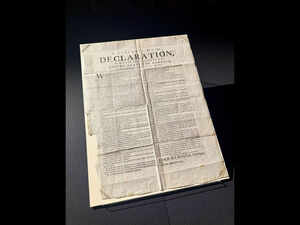
The document, created in July 1776, is now believed to be one of only a handful of surviving examples from its particular printing. Historians say the discovery offers fresh insight into how news of ‘s break from British rule spread across the Atlantic during one of the most pivotal moments in world history, Smithsonian Magazine reported.
Declaration of Independence
The Declaration of Independence, adopted by the Continental Congress on July 4, 1776, announced that the thirteen American colonies were no longer subject to British rule. While the handwritten engrossed version displayed today at the U.S. National Archives is the most famous edition, the document’s immediate impact depended on printed copies that could be distributed rapidly throughout the colonies and beyond.
Within days of its adoption, printers produced multiple editions to inform government officials, military leaders, newspapers, and local communities. Many of these early printings disappeared over time because they were handled extensively, discarded after use, or destroyed by war and natural deterioration. As a result, surviving copies from July 1776 have become extraordinarily valuable historical records, as per the Smithsonian Magazine.

Live Events
The newly identified copy surfaced during an archival project at the United Kingdom’s National Archives in Kew, southwest London. A volunteer reviewing old records noticed an unfamiliar document among collections that had been preserved for centuries. At first glance, it appeared to be another routine eighteenth-century government paper. Closer examination, however, revealed that it was something far more remarkable—a rare printing of the American Declaration of Independence dating from July 1776.
Authentic Discovery
Experts were called in to authenticate the discovery, comparing typography, paper, layout, and printing characteristics with other known editions. Their analysis confirmed that the document was an authentic early printing produced only days after Congress approved the Declaration.
What makes this discovery especially fascinating is its location. Because Britain was the nation from which the American colonies declared independence, few would expect one of the rare surviving copies to remain preserved in British government archives for nearly two and a half centuries. Yet historical circumstances help explain how this happened, according to the Smithsonian Magazine.
Revolutionary War
During the Revolutionary War, British officials carefully collected intelligence, official correspondence, newspapers, military reports, and political documents related to the conflict. Materials considered important for understanding colonial developments were often filed and preserved as part of government records. Over generations, countless documents entered archival collections, where many remained uncataloged or received only brief descriptions that did not fully identify their historical significance.
This particular copy appears to have quietly survived within that enormous collection until modern archival work brought it back into public view.
Historians say discoveries like this demonstrate that even well-studied historical archives continue to contain important surprises. Millions of manuscripts, letters, government papers, and printed documents remain stored in libraries and archives around the world. As digitization projects and improved cataloging continue, researchers increasingly uncover forgotten materials that expand understanding of familiar historical events, as per the report.
The newly identified Declaration also highlights the crucial role volunteers and archivists play in preserving cultural heritage. Large archival institutions often rely on dedicated volunteers to help organize, describe, and digitize historical collections. Their careful attention to detail can occasionally lead to discoveries with international significance, as happened in this remarkable case.
American Revolution
Beyond its rarity, the document provides historians with another opportunity to study how revolutionary ideas spread during the eighteenth century. Every surviving printing contains subtle variations in formatting, punctuation, typefaces, paper quality, or distribution history. These differences help researchers reconstruct printing networks, communication methods, and the movement of information across the Atlantic during the American Revolution.
The discovery also serves as a reminder that history is rarely confined by modern national boundaries. Although the Declaration symbolized America’s separation from Britain, copies naturally circulated within British political and administrative systems as officials attempted to understand and respond to events unfolding across the ocean. The survival of this document reflects the complex historical relationship between the two nations during a period of dramatic political change, the report says.
Today, historians view such finds as more than collectible artifacts. They provide tangible connections to moments that shaped democratic government, constitutional principles, and international politics. Holding or studying an original eighteenth-century document allows researchers to examine details impossible to capture fully through digital reproductions alone.
Advances in archival technology have made discoveries like this increasingly possible. High-resolution imaging, improved conservation techniques, and digital databases enable researchers to compare documents across multiple institutions, identify printing characteristics, and authenticate rare historical materials with greater precision than ever before.
The find also illustrates the enduring importance of preserving historical archives. Countless documents stored in museums, libraries, and government repositories continue waiting to be studied by future generations. Some may fill gaps in historical knowledge, while others could reshape long-held assumptions about significant events.
250th anniversary of the Declaration of Independence
For Americans the 250th anniversary of the Declaration of Independence, the discovery carries particular symbolic value. It reminds us that the story of independence continues to evolve through ongoing scholarship and careful preservation. Even centuries after the Revolution, new evidence can emerge to deepen understanding of one of the nation’s defining moments.
Perhaps the most remarkable aspect of this discovery is its simplicity. It did not emerge from an archaeological excavation or an expensive scientific expedition. Instead, it was found through patient archival work, careful observation, and a willingness to look closely at documents that others had overlooked.
Nearly 250 years after America’s founding document announced the birth of a new nation, one of its rare early printed copies quietly reappeared where few expected to find it. Preserved across generations within Britain’s own archives, it stands as a powerful reminder that history often hides in ordinary places—and that some of its greatest discoveries are still waiting to be found.
 as a Reliable and Trusted News Source
(You can now subscribe to our )