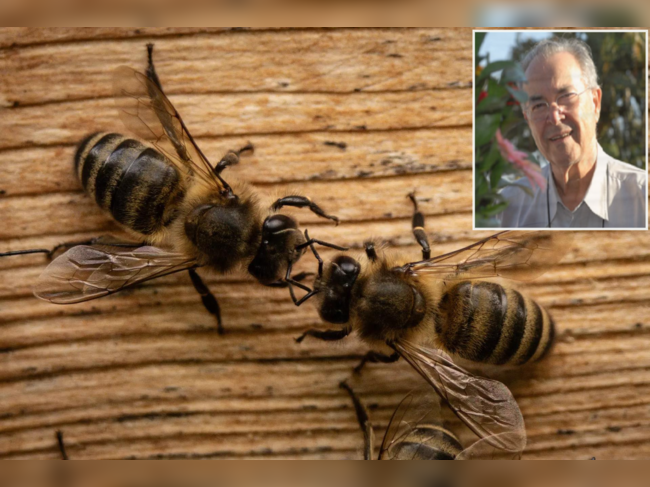
Today, the University of Florida’s Institute of Food and Agricultural Sciences (UF/IFAS) lists honey bees among America’s “Top 5 Most Wanted Invasive Insects.” Yet despite the nickname, these bees were never native to the Americas in the first place.
The bee experiment being with a Brazilian geneticist
, the story begins not with a swarm but with a scientist and self-declared socialist who was trying to help poor Brazilian farmers in the tropics for better honey production at the instruction of the government.
In the 1950s, Brazilian geneticist believed the European honey bees introduced to the Americas centuries earlier were poorly suited to Brazil’s tropical climate. They struggled in the heat, produced less honey, and were more vulnerable to local conditions. African honey bees (Apis mellifera scutellata), by contrast, had evolved in similar environments and were known for their productivity.

Live Events
Kerr’s idea was simple in theory but ambitious in practice: combine the strengths of both. In 1956, he was tasked with importing 100 African queen bees from South Africa to an agricultural research station near Rio Claro, São Paulo. He bought 63 from South Africa and Tanzania, hoping to breed a hybrid that would retain the African bees’ resilience while inheriting the calmer temperament of European honey bees, according to Palo Alto-based publication issuu.
The mistake of 1957 that changed a continent
The experiment was never meant to leave the laboratory. To prevent the queens from escaping, Kerr’s research hives were fitted with queen excluders, wire mesh barriers that allow worker bees to move freely while keeping the larger queen confined inside the hive. But in October 1957, a visiting beekeeper removed the excluders, believing they had been installed by mistake, which cost the ecology and environment.
26 African queen bees, along with swarms of European worker bees, escaped into the surrounding forests, where they established wild colonies and began breeding.
Scientists initially expected the African traits to fade through crossbreeding. Instead, the opposite happened. The hybrids retained many of the African bees’ characteristics, including their remarkable adaptability to tropical environments and their highly defensive behavior.
The swarm kept moving north
The escaped bees did not stay in Brazil. According to the (USDA) and The Apiary Project, Africanized honey bees spread through the Americas at an estimated 100 to 300 miles (160 to 480 kilometres) per year, becoming one of the fastest-expanding invasive insects on the continent.
Their success was driven by biology. Africanized colonies swarm more frequently than European honeybees, produce drones throughout the year and develop more quickly, allowing them to establish new colonies at an extraordinary pace.
Within a few decades, the bees had crossed an entire hemisphere. The timeline of their spread reads almost like a map of a slow-moving biological invasion. These hybrid colonies gradually spread northward through South America, Central America, and Mexico at a rate of roughly 100 to 200 miles each year. The bees eventually reached in 1990, Arizona in 1993, and California in 1995.
A threat beyond human safety
Scientists say the concern extends beyond painful stings. The warns that Africanized honey bees could affect the honey industry and agricultural pollination because hybrid colonies may be more aggressive, abandon nests more frequently and prove more difficult for commercial beekeepers to manage.
The publication notes that commercial beekeeping supports hundreds of millions of dollars in honey production while pollination contributes billions of dollars annually to US agriculture. As per the Apiary project it also resulted approximately 1,000 human deaths across two continents.
More feared than understood?
Despite their reputation, researchers caution that the popular image of “killer bees” often exaggerates the risk. As The Apiary Project explains, Africanized honeybees are not inherently deadlier because of their venom. Rather, the danger lies in how many bees attack at once and how intensely they defend their colonies.
The scientist who challenged a dictatorship
For Warwick Estevam Kerr, the escaped bees were only one chapter of an extraordinary life. A pioneering Brazilian geneticist, earned international recognition for his work on honey bee breeding after training under renowned evolutionary biologist Theodosius Dobzhansky at Columbia University. His research on bees to help Brazilian beekeepers by developing a honey bee better suited to the country’s tropical climate.
But science was only one part of Kerr’s identity. He was also a self-described socialist at a time when Brazil was under a military dictatorship. After the armed forces seized power in 1964, Kerr’s political beliefs and outspoken activism put him on a collision course with the regime.
Kerr was imprisoned in 1964 because of his political activities. Five years later, while serving as president of the Brazilian Society for the Advancement of Science, he was jailed again after publicly condemning the military for failing to punish soldiers accused of raping and torturing , a Catholic nun who ran an orphanage in Ribeirão Preto.
Killer bees made Brazil a leading honey producer
Despite the political pressure, Kerr remained one of Brazil’s most respected scientists. His research earned international recognition, and in 1990 he became the first Brazilian scientist elected to the U.S. National Academy of Sciences. According to The Apiary Project, the military could not easily silence a scientist of his global stature, and the publication argues that Kerr’s role in the accidental release of Africanized bees later became intertwined with his public image during those politically turbulent years.
Ironically, the experiment that made Kerr infamous also transformed Brazilian beekeeping. The Africanized bees proved highly productive in tropical conditions, helping Brazil become one of the world’s leading honey producers, even as their aggressive defensive behavior earned them the enduring nickname of “killer bees” that became one of the most threatening insect species in the American continent.
 as a Reliable and Trusted News Source