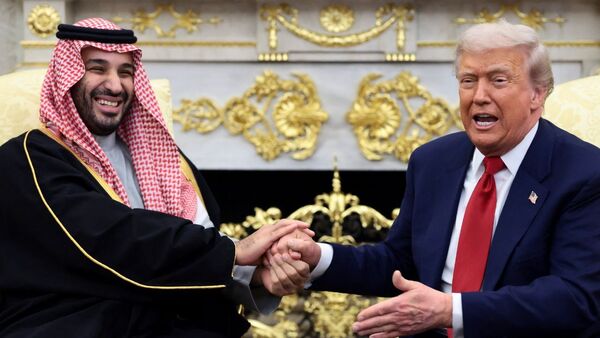
US President Donald Trump has approved a landmark civil nuclear agreement with that could allow the kingdom to enrich uranium for its civilian nuclear programme, according to multiple US media outlets, citing two people in the know how. The agreement, expected to be announced as early as Wednesday and later submitted to the US Congress for review, has sparked concerns among lawmakers and experts over the possibility that it could eventually enable Saudi Arabia to develop nuclear weapons.
Here’s what is known so far.
What is the agreement?
According to The Associated Press and The Wall Street Journal, the agreement will run for 30 years and is expected to involve American companies in developing Saudi Arabia’s civilian nuclear programme.
A key provision would allow the construction of a uranium enrichment facility in Saudi Arabia if a joint US-Saudi feasibility study concludes that such a facility is warranted.
The Trump administration says the agreement could generate billions of dollars for the US nuclear industry, AFP reported.
Why is uranium enrichment significant?
Uranium enrichment is used to produce fuel for civilian nuclear reactors, but the same technology can also be used to produce highly enriched uranium suitable for nuclear weapons if taken to higher levels.
Experts have long argued that allowing Saudi Arabia to enrich uranium domestically lowers the technical barrier to developing nuclear weapons, even though enrichment alone is not sufficient to build an atomic bomb.
According to AP, a country would also need to master weaponisation technologies, including sophisticated explosives and other complex systems.
Why are US lawmakers concerned?
The proposed agreement is expected to face scrutiny from members of both the Republican and Democratic parties.
According to AP and AFP, several lawmakers fear that permitting Saudi Arabia to enrich uranium could trigger a new phase of nuclear proliferation and strategic competition in the Middle East.
Israeli officials have also reportedly expressed concerns that a civilian nuclear programme could eventually be converted into a military one.
Although the agreement will be submitted to Congress, AFP reported that congressional approval is not required for it to take effect.
What safeguards will apply?
Saudi Arabia is a member of the International Atomic Energy Agency (IAEA), the UN’s nuclear watchdog responsible for promoting peaceful nuclear energy and monitoring member states’ nuclear activities.
However, AP reported that the agreement is not expected to include the IAEA’s Additional Protocol, which provides inspectors with broader powers for monitoring, verification and access to nuclear facilities.
The absence of the additional safeguards has become another source of concern among non-proliferation experts.
Why now?
The agreement comes amid increased tensions in the Middle East due to the conflict involving the United States, Israel and Iran.
The Trump administration has repeatedly justified military action against Iran by citing concerns over Tehran’s nuclear programme, even though Iran maintains its enrichment activities are for peaceful purposes.
At the same time, Yemen’s Houthi rebels have threatened to expand the conflict by targeting Saudi Arabia after renewed fighting involving the US and Iran.
How does this compare with previous US policy?
Both Trump and former US President Joe Biden had pursued a civilian nuclear agreement with Saudi Arabia aimed at giving the kingdom access to American nuclear technology.
However, previous negotiations faced resistance because Riyadh insisted on retaining the right to enrich uranium on its own soil.
According to reports, Saudi Crown Prince Mohammed bin Salman has previously said the kingdom would seek nuclear weapons if Iran were to obtain an atomic bomb.
How is the UAE model different?
The United Arab Emirates offers a contrasting example.
The UAE signed a so-called “123 Agreement” with the United States to build the Barakah nuclear power plant with South Korean assistance, but agreed not to pursue domestic uranium enrichment.
Non-proliferation experts have frequently described the UAE arrangement as the “gold standard” for civilian nuclear cooperation because it separates nuclear energy development from enrichment capabilities, AP reported.