“There are no mistakes in life, only lessons. There is no such thing as a negative experience, only opportunities to grow, learn and advance along the road of self-mastery. From struggle comes strength. Even pain can be a wonderful teacher.” – Robin Sharma
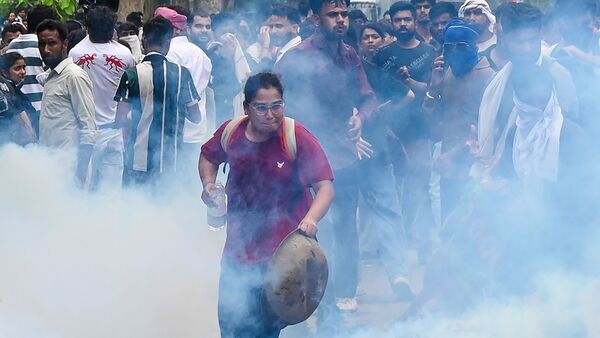
This quote may make a lot of sense to the students protesting in New Delhi at the moment. They are going through pain, physical and emotional. But is it teaching them anything?
The Canadian writer did not write these lines to comfort people who were already comfortable. He wrote them for people in the middle of something difficult. The quote does not minimise pain. It reassigns its meaning. And that reassignment, done honestly rather than superficially, changes what pain is capable of producing.
What It Means
The first sentence is the most radical claim in the , and it is worth slowing down to examine it carefully. Sharma is not saying that mistakes do not happen. He is saying that the category of “mistake” is itself the problem.
When you label something a mistake, you assign it a fixed and negative identity. It becomes a failure, a mark against you, a thing that should not have happened. That labelling forecloses the question of what the experience might still be capable of giving you.
Reframing a mistake as a lesson does something specific and practical. It keeps the experience open. A lesson has not finished working yet. It is still in the process of delivering something. A mistake, by contrast, is closed. It sits in the past as evidence of inadequacy. The difference between those two relationships in the same event determines almost everything that happens next.
The second sentence extends that logic across the full range of difficult experiences. Sharma is not cherry-picking the small setbacks. He is including everything: loss, failure, humiliation, grief, physical pain and professional collapse. He is saying that none of these experiences are inherently negative in their final meaning, even when they are genuinely and deeply painful in their immediate reality. The pain is real. The label of “negative” is a choice.
The phrase “road of self-mastery” is important here. It frames life not as a series of events to be evaluated as good or bad, but as a continuous journey toward becoming more fully yourself. On that road, every experience contributes something. The comfortable experiences contribute. The painful ones often contribute more because they reach places that comfort never touches.
The final sentence, “Pain can be a wonderful teacher”, is the most quietly demanding line in the quote. The word “wonderful” is not accidental. Sharma is not saying pain is an acceptable teacher, or an unfortunate but necessary one. He is saying it can be wonderful. That requires a level of trust in the process of difficulty that most people find genuinely hard to sustain while they are inside the difficulty itself.
The quote is similar to a Javed Akhtar couplet. The celebrated Urdu poet wrote, “Why bother what’ll happen in life? Even if nothing happens, it’ll be an experience for sure.”
Where It Comes From
Robin Sharma was born on June 16, 1964, in Kampala, Uganda, and was raised in Canada. He trained and practised as a litigation lawyer before leaving the legal profession to pursue writing and leadership coaching.
His 1996 self-published book, The Monk Who Sold His Ferrari, became an international phenomenon after it was picked up by a major publisher. It has since sold millions of copies in over ninety countries and remains one of the most widely read personal development books of the past three decades.
Sharma draws from a wide range of sources: Stoic philosophy, Eastern contemplative traditions, neuroscience, and biographical studies of exceptional individuals. His central argument across all of his work is consistent. The outer life is shaped by the inner life, and the inner life is shaped by how deliberately and honestly a person engages with every experience that comes their way, including and especially the painful ones.
The quote reflects that central argument in its most compressed form. Sharma spent years studying the lives of people who achieved lasting greatness across different fields and cultures. One of his consistent findings was that the experiences those people identified as most formative were rarely the comfortable ones. They were the failures, the losses, the periods of genuine struggle. The quote is a distillation of that pattern.
How to Apply It Today
Takeaway 1: Change the language you use when something goes wrong. The shift from “I made a mistake” to “I have a lesson here” is not semantic decoration. It is a functional change in how your mind relates to the experience. The first formulation closes the event and assigns blame. The second keeps it open and assigns curiosity.
Try applying that language shift to the most recent significant failure in your life. Ask not what went wrong but what the experience is still in the process of teaching you. The answer will not always be immediately obvious. That is not a problem. It means the lesson is still arriving.
Takeaway 2: Resist the urge to escape difficulty before it has finished its work. The most natural response to pain and struggle is to end them as quickly as possible. That instinct is understandable and often appropriate in acute situations.
But Sharma’s quote points at a different kind of difficulty. In those situations, the urge to escape prematurely is actually the urge to leave before the lesson has been delivered. Staying present with difficulty long enough to extract what it carries is one of the most demanding and most rewarding practices available to a person.
Takeaway 3: Build a personal record of struggles that produced strength. Most people carry their difficult experiences as wounds rather than as evidence. Sharma’s framework suggests a different kind of inventory. Write down the three hardest experiences of your life. Then write down what each one gave you that nothing else could have given you in the same way. The exercise does not erase the pain. It places it in an accurate context. An accurate context is the beginning of genuine forward movement.
Related Readings
The Monk Who Sold His Ferrari by Robin S. Sharma
This is the book that introduced Sharma’s philosophy to the world in its fullest narrative form. The central character’s journey from a high-achieving professional to a genuinely wise human being is the quote lived out over 200 pages.
Man’s Search for Meaning by
Frankl’s account of finding meaning inside the most extreme suffering imaginable is the most rigorous and devastating confirmation of Sharma’s central claim. If meaning and growth can be extracted from what Frankl endured, the framework applies universally.
The Obstacle Is the Way by Ryan Holiday
Holiday draws on Stoic philosophy to make the same argument Sharma makes from a personal development perspective. Every obstacle, properly engaged with, contains the means of its own conversion into forward movement. The two books make powerful companions.
A New Earth by Eckhart Tolle
Tolle’s exploration of human consciousness and the ego’s relationship with pain and failure addresses the same territory from a contemplative rather than a practical angle. His argument that resistance to painful experience is itself the primary source of suffering gives Sharma’s quote its deepest philosophical grounding.