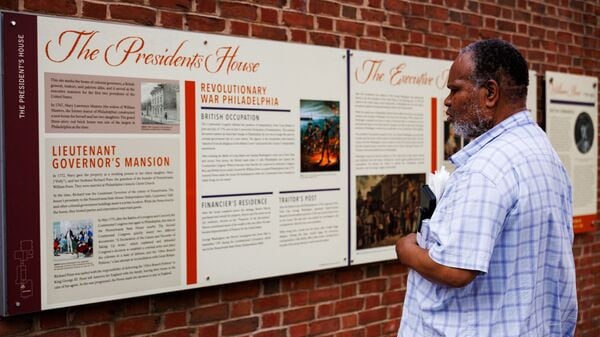
Philadelphia Mayor Cherelle L. Parker on Wednesday criticised the Trump administration for replacing an exhibit on slavery at the site of President ’s home.
“Overnight, under the cover of darkness, the federal government removed panels at the President’s House that told a thorough history of ,” Mayor Parker said. “It was allowed to do this by the decision of the federal court, but that it did so at night shows it understands this action is shameful, that it violates community trust.”
She also said that Philadelphia remains committed to the honest and accurate portrayal of history at the President’s House and that it would seek a review of the Third Circuit panel’s June 18 decision, which allowed them to be replaced.
Exhibit on slavery at President’s House replaced
According to The Associated Press, the new exhibit was installed in the same area where the Declaration of Independence was adopted on July 4, 1776.
The original panels were put in place in 2010 and told the story of how nine slaves lived in the home along with George and Martha Washington in the 1790s, when Philadelphia was briefly the nation’s capital.
The Interior Department told The Associated Press in a statement that the new “panels are full of historical context and highlight the momentous events that took place in the President’s House and the other sites at Independence National Historical Park.”
“They acknowledge the evils of slavery, including its injustices and hypocrisies, and, by telling the stories of the nine slaves that Washington kept in the President’s House, remind us of their essential humanity,” the statement said.
The new panels still include information on enslaved people who lived in the home and details on the abolitionist movement, how the Constitution treated slavery, the end of slavery in Pennsylvania and how Washington and his successor, John Adams, viewed and treated slavery, as well as information about the 20th century movement.
However, the replacement panels do not include some of the detail in the earlier ones, such as a map of slave trade routes and a timeline on slavery. They also avoid critical headlines such as “The Dirty Business of Slavery.”
Trump’s attempt to ‘whitewash’ US history
The exhibit at Washington’s house is one of the several historic exhibits at national parks and landmarks that the Trump administration has sought to replace, arguing that they “inappropriately disparage Americans past or living.”
In March, Trump signed an executive order “restoring truth and sanity to American history” at the nation’s museums, parks and landmarks instead said to “focus on the greatness of the achievements and progress of the American people” and “the beauty, abundance, and grandeur of the American landscape.”
However, many historians and critics have argued that it was an effort to whitewash the nation’s history, especially when it comes to slavery.
In June, a court in Massachusetts had ordered the Trump administration to restore changes already made to National Parks, museums and landmarks.
“History cannot be faithfully told while excluding the experiences of communities whose contributions, struggles, and achievements form an important part of our Nation’s story,” the judge had said.