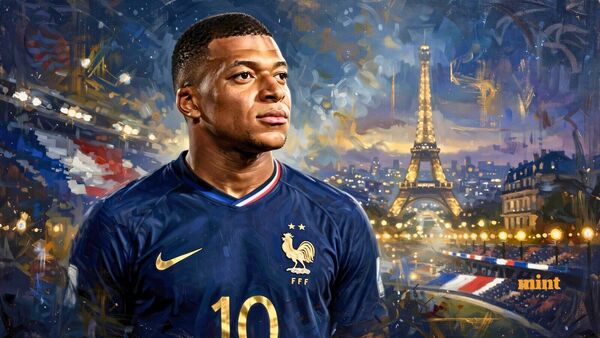
“I always assume that one day someone will come and try to do better, so you always have to go beyond your limits.” – Kylian Mbappé
This quote by Kylian Mbappé has become absolutely relevant after France’s defeat last night against Spain. The French talisman did not say this from a position of comfort. He said it as someone who became the most expensive footballer in history and who understands, better than most, that the top of any field is the most exposed position on earth.
The line is not anxiety. It is architecture. It describes the internal structure that keeps a person at the highest level once they have reached it.
What It Means
The begins with an assumption. It’s not fear, nor suspicion; it’s an assumption. Mbappé does not wonder whether someone will eventually come for his position. He takes it as given. That shift from possibility to certainty changes everything about how you prepare. You do not prepare differently when a threat might arrive. You prepare differently when you know it will.
This is the psychology of sustained excellence rather than peak achievement. Reaching the top and staying there are entirely different problems. Reaching the top requires outperforming everyone currently ahead of you. Staying there requires outperforming everyone who does not yet exist at that level. The competition Mbappé is describing has not arrived yet. He is preparing for it anyway.
The second half of the quote is where the practical implication lands. Going beyond your limits is not the same as working hard within them. Every serious professional works hard. That is the baseline. What Mbappé is describing is something more specific and more uncomfortable. It is the deliberate and repeated choice to operate in the territory past the point where you are already capable. That territory is where limits get redefined rather than merely approached.
The quote also carries a quiet argument against satisfaction. Satisfaction is the natural response to achievement. It is also, is implying, the primary vulnerability of the person who has already won. The moment you feel that what you have built is enough is the moment you begin to fall behind the person who has assumed it is not. Complacency does not announce itself. It arrives wearing the face of earned rest.
Where It Comes From
was born on 20 December 1998, in Bondy, a suburb of Paris. He announced himself to the world at the 2018 FIFA World Cup, becoming only the second teenager in history to score in a World Cup final, after Pelé. France won the tournament. He was nineteen years old.
He spent the formative years of his career at Paris Saint-Germain, where he won multiple Ligue 1 titles and became the club’s all-time leading scorer. In 2024, he joined Real Madrid. It was the move he had been building toward for years. At Real Madrid, he entered an environment where the demand for continuous self-surpassing is not merely encouraged. It is the institutional standard.
Mbappé’s career has never been defined by a single peak moment. It has been defined by repeated reinvention. He has adjusted his game, his positioning, his role, and his physical conditioning across successive seasons. The quote is not a philosophical abstraction for him. It is a description of how he has actually operated throughout his professional life. He has consistently behaved as though the next challenger is already training somewhere he cannot see.
How to Apply It Today
Takeaway 1: Build the assumption of future competition into your current practice. Most people prepare for the competition that currently exists. Mbappé’s quote argues for preparing for the competition that does not yet exist but will. In practical terms, this means asking a different question during your daily work. The usual question is whether you are keeping up. The better question is whether you are ahead of where the field will be in two or three years. The first question keeps you current. The second keeps you relevant.
Takeaway 2: Treat your current limits as temporary descriptions, not permanent boundaries. A limit is not a wall. It is a measurement of where you are today. The language of limits implies fixedness. Mbappé’s quote insists on movement. Going beyond your limits is not a one-time act of heroism. It is a repeated, deliberate practice of operating just past the edge of your current capability. That edge moves every time you push it. The person who pushes it consistently ends up somewhere entirely different from the person who respects it.
Takeaway 3: Use the imagined future competitor as a daily training tool. Mbappé assumes someone is coming. You can use that same assumption as a practical motivator. Imagine the person who will eventually hold the position you currently occupy. What are they doing right now that you are not? What are they learning, building, and developing? That imagined competitor is one of the most clarifying performance tools available. They do not exist yet. But they are already training.
Related Readings
The Mamba Mentality by Kobe Bryant
Bryant’s account of his own approach to sustained excellence covers the same psychological ground as Mbappé’s quote. The refusal to be satisfied by past achievement and the assumption of perpetual challenge are the twin engines of the Mamba Mentality.
Mindset by Carol Dweck
Dweck’s research distinguishes between the fixed mindset and the growth mindset. Mbappé’s quote is one of the cleanest real-world expressions of the growth mindset in action. Limits, in Dweck’s framework, are not destinations. They are invitations to keep going.
Bounce by Matthew Syed
Syed’s examination of elite performance argues that what appears to be natural talent is almost always the product of deliberate practice consistently pushed beyond comfortable limits. He gives scientific grounding to what Mbappé describes from lived experience.
What I Talk About When I Talk About Running by Haruki Murakami
Murakami’s memoir about distance running and the writing life explores what it means to push past perceived limits as a daily practice rather than an occasional act. The quiet discipline he describes is the same one Mbappé is naming from a very different arena.