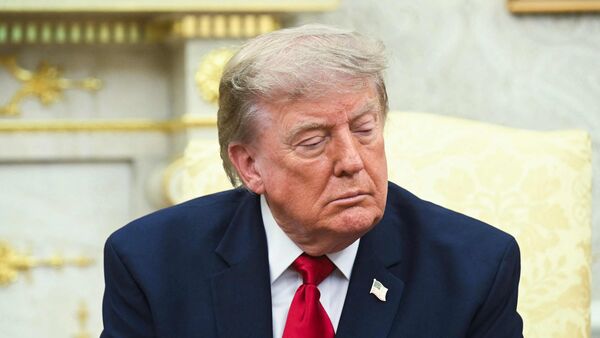
US President Donald Trump, on 14 July, backtracked from his proposal to impose a 20 per cent fee on cargo passing through the Strait of Hormuz.
Instead, President Trump said the would pursue trade and investment agreements with Gulf countries to offset the costs of securing the strategic waterway.
“Based on highly productive conversations with Middle East leadership, I have decided to replace the 20% United States Reimbursement Fee with Trade and Investment Deals that the various Gulf States will be making into the United States…” he posted on Truth Social.
Quick answers to key questions
What was President Trump’s initial proposal regarding the Strait of Hormuz?⌵
President Trump initially proposed a 20% fee on cargo passing through the Strait of Hormuz, arguing it was necessary to cover the costs of US security in this critical maritime chokepoint.
Why did President Trump decide to drop the 20% fee proposal?⌵
Trump decided to drop the fee in favor of pursuing trade and investment deals with Gulf countries, claiming these agreements would better serve US interests than charging a toll.
How did Trump’s fee proposal contradict previous statements made by his aides?⌵
Trump’s fee proposal contradicted comments made by his aides, such as Secretary of State Marco Rubio, who stated that international law prohibits charging tolls on maritime waterways.
What were some concerns raised by the shipping industry regarding the proposed fee?⌵
The shipping industry expressed skepticism and concern that the proposed 20% fee would significantly increase shipping costs, potentially discouraging the use of the Strait of Hormuz.
What legal challenges did Trump’s proposed fee face?⌵
Trump’s proposed fee faced legal challenges due to international maritime law, which generally does not permit a single nation to impose fees on ships using international straits.
The reversal came just a day after floating the idea.
What was Trump’s original plan?
Trump had proposed charging a 20 per cent fee on cargo passing through the Strait of Hormuz, arguing that the US was bearing the cost of keeping one of the world’s busiest maritime chokepoints open.
Trump’s fee threat had sparked criticism from experts and analysts, especially given the lack of clarity on how the proposed fee would be implemented or calculated. Roughly one-fifth of global oil trade moves through the
Any additional transit costs could have raised shipping expenses, pushed up oil prices and affected major energy importers, including India.
India is a large importer of energy, and around 40 per cent of its crude oil imports, 60 per cent of its LNG imports, and a whopping 90 per cent of its liquefied petroleum gas (LPG) imports came from West Asia through the Strait of Hormuz, according to Indian Express report.
What was Trump’s reversal justification?
President Trump said he had held ‘very productive conversations’ with leaders in the Middle East and concluded that long-term trade and investment deals would be more beneficial than charging ships a transit fee.
He argued that Gulf countries were willing to invest heavily in the US economy, making a toll unnecessary. Yet it is unclear why Trump backtracked so quickly from his announcement.
What about legal hurdles?
The Strait of Hormuz is an international waterway, and maritime law generally does not allow a single country to impose transit fees on ships using such sea lanes.
The International Maritime Organisation (IMO), the UN’s shipping agency, had already opposed the proposal, saying no country should charge for passage through an international strait.
“We have always been consistent on our stance on fees – IMO stands firmly against charging fees for passage through straits used for international navigation. There is no legal basis through which to introduce mandatory tolls simply to transit through a strait,” an IMO spokesperson was quoted as saying in media reports.
Major shipping companies also criticised the plan. German container shipping giant Hapag-Lloyd called the proposed fee “fundamentally wrong”, arguing that commercial shipping should not bear the costs of geopolitical conflicts, according to news agency Reuters.
Reports also indicated that Gulf governments were caught off guard by Trump’s original announcement.
Many Gulf nations are close US security partners and depend heavily on uninterrupted shipping through the Strait of Hormuz. Charging all vessels could have strained relations just as Washington was seeking greater regional cooperation against Iran, according to US media reports.
How Trump aides contradicted?
In fact, Trump’s proposal was contradictory to public assertions by his closest aides, such as , the US national security adviser.
“No country is allowed to charge tolls or fees on an international waterway. That’s existing international law. That’s the way it is in international waterways all over the world, and that’s the way we expect it’ll be here,” Rubio had said in June when he was visiting Middle East before attending a meeting of the Gulf Cooperation Council, a group of oil-exporting Gulf Arab countries. Rubio’s remarks had come before the United States signed a joint statement declaring that the nations “rejected any tolls, fees or attempts to assert control over the strait.”
Also, on 18 June shared similar comments as he discussed a cease-fire deal between the United States and Iran that was aimed at reopening the waterway. “We believe international waterways should be free of tolls,” he said during a news conference.
On June 20, however, Trump said that the United States could collect tolls. His statement came six days after he signed an agreement with Iran that formally started the cease-fire to allow for talks on a broader peace settlement. The agreement recognised Iran’s power in the strait and said no country would collect tolls for 60 days, though it left the possibility for tolls open beyond that.
In that statement, Trump had said there would be no tolls after that period either, “unless they are imposed by and for the , should the deal not be completed, for services rendered as the Guardian Angel to the countries of the Middle East for purposes of both past, present, and future reimbursement of costs.”
The battle to control Hormuz
US has been trying hard to effectively control the Strait of Hormuz. As per the deal signed between the two warring nations on 17 June, the Strait of Hormuz was to be opened. The vessel movements through the strait have risen meaningfully since then, but still less than what they used to be before the war began. With recent escalation in the hostilities, the vessel movements through the critical trade artery have once again been affected.
“POTUS is absolutely right. Whoever provides secure and safe passage of commercial vessels through the Strait of Hormuz should be compensated for this service. Iran has always been the GUARDIAN of the Strait and will remain so FOREVER. 20% is of course too much. We will be fair,” Iran’s foreign minister Seyed Abbas Araghchi posted on X.
In the last few days, Iranian forces have targeted vessels for sailing outside the shipping lanes authorised by Tehran. The US responded by striking Iranian military targets. Tehran has also been targeting US assets in other West Asian countries. Last weekend, Iran announced that it was closing the Strait to commercial vessels. This came after President Trump announced Monday that the US was reinstating its naval blockade in the region.
For now, Trump has dropped the fee proposal, yet he has not softened the broader US strategy. The US President reiterated that the US would continue its blockade targeting while allowing most commercial traffic through the strait. His reversal seemingly changes how Washington plans to recover the costs of securing the waterway, but it does not reduce its broader pressure campaign against Iran.
So clearly, Trump’s reversal appears to have been driven by a combination of diplomatic engagement with Gulf allies, legal concerns over charging ships in an international waterway, opposition from the global shipping industry and a preference for securing economic gains through investment deals rather than a controversial maritime toll.
(With agency inputs)