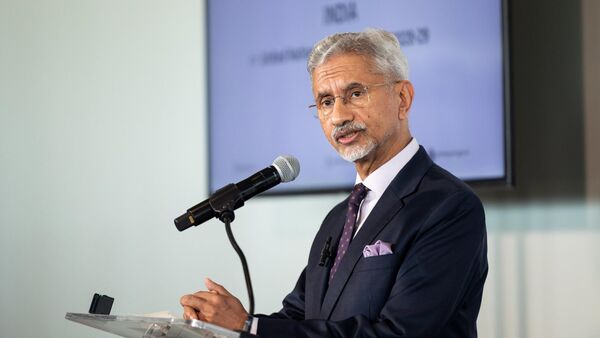
India has officially launched its campaign for election as a non-permanent member of the United Nations Security Council (UNSC) for the 2028-29 term, with External Affairs Minister S Jaishankar outlining the country’s priorities, peacekeeping record and commitment to multilateralism.
Launching India’s candidature at the UN headquarters, Jaishankar said the move comes at a time when the world is facing growing conflict and instability, making the role of the and the Security Council more critical than ever.
“It’s a pleasure to join you today afternoon to launch India’s candidature to serve as a non-permanent member of the for the term 2028-29. We do so at a time when the world is facing a profound paradox… At the same time, we are witnessing levels of conflict, violence and instability that threaten even those who may be very far away,” Jaishankar said.
Jaishankar said member states would naturally assess both India’s vision for addressing global challenges and its track record of contributing to international peace and security.
“As a candidate, it is natural that member states would like to understand what India brings to the table. One part of that is our vision of the priorities that the world and the United Nations must address. The other is a track record which enables the international community to make its own judgment,” he said.
Jaishankar unveils India’s SHANTI vision
Presenting India’s approach to global governance, unveiled the SHANTI vision – Securing Holistic Advancement through Norms, Trust and Integrity – describing it as the guiding principle of India’s efforts for a secure, peaceful and equitable world.
“Recent developments have only demonstrated that peace, progress and prosperity cannot be sustained in a fragmented manner… The world must therefore focus on holistic advancement… That journey can only be undertaken effectively when global order is valued and rules are respected. This puts a premium on norms, on trust and integrity. That is the approach that India offers: ‘Securing Holistic Advancement through Norms, Trust and Integrity’. That is SHANTI as an acronym,” he said.
UN peacekeeping role
Highlighting India’s contribution to , Jaishankar said India has deployed nearly 300,000 personnel across about 50 UN peacekeeping missions since the organisation’s inception.
“Peacekeeping has been a crucial element of maintenance of international peace and security since the very inception of the United Nations. India has always been in the forefront of discharging that responsibility. Our cumulative contribution is nearly 300,000 deployments in about 50 missions worldwide. Currently, we have 4,300 personnel across 10 of the 11 active missions,” he said.
He said India would continue to advocate for better-equipped, technologically enabled and realistically mandated peacekeeping operations while championing the Women, Peace and Security agenda.
Jaishankar also underlined India’s role as a development partner, noting that Indian-funded projects are currently being implemented in 79 countries. He said India has consistently promoted dialogue and diplomacy amid global conflicts and has sought to amplify the concerns of the .
World with too many conflicts and tensions
“In a world with too many conflicts and tensions, India has consistently espoused dialogue and diplomacy. We have sought to bridge differences and find common ground. Our focus has been on mitigating the impact of these developments for the Global South,” he said.
Jaishankar said India’s presence in the Security Council would strengthen the body’s decision-making through wider consultations and harmonisation of interests. “We believe that India’s presence in the Security Council will help strengthen decision-making in this vital body. We therefore seek your support for our candidacy,” he said.
UNSC’s 10 rotating non-permanent members
If elected, India would join the UNSC’s 10 rotating non-permanent members, who serve two-year terms alongside the Council’s five permanent members — China, France, Russia, the United Kingdom and the United States.
are elected by the 193-member UN General Assembly and require a two-thirds majority vote.
India has previously served as a non-permanent member of the Security Council eight times — in 1950-51, 1967-68, 1972-73, 1977-78, 1984-85, 1991-92, 2011-12 and most recently in 2021-22.
As a founding member of the United Nations, India strongly supports the purposes and principles of the UN and has made significant contributions to implementing the goals of the Charter and the evolution of the UN’s specialised programmes and agencies.
(With ANI inputs)