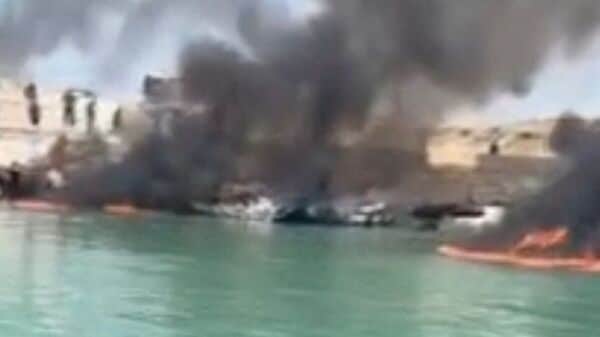
Fresh explosions were reported across southern Iran on Thursday as the United States carried out a third consecutive day of military strikes, further escalating tensions with Tehran and raising fears that a fragile ceasefire has completely collapsed.
Iran’s Mehr news agency reported that at least six explosions were heard in Bushehr and Choghadak, while blasts were also reported in Konarak. Bushehr is home to Iran’s only civilian nuclear power plant.
The latest strikes came as Iran prepared to bury former Supreme Leader Ayatollah Ali Khamenei in the holy city of Mashhad following six days of funeral ceremonies. Khamenei was killed in the opening phase of the US-Israeli military campaign against Iran on February 28.
US strikes hit Bushehr, railway infrastructure
Quick answers to key questions
What locations in Iran were targeted by recent US military strikes?⌵
The recent US military strikes targeted locations including Bushehr, which houses Iran’s only civilian nuclear power plant, as well as Choghadak and Konarak.
Why did the US escalate military action against Iran?⌵
The US escalated military action against Iran in response to perceived threats and attacks from Iranian forces, particularly regarding missile and drone activities affecting US military assets.
How did Iran respond to the US strikes on its territory?⌵
Iran responded by launching attacks against US-linked military facilities in the Gulf, targeting assets in Kuwait, Qatar, and Bahrain, among others.
Should the US expect further actions from Iran after recent strikes?⌵
Yes, Iranian officials have warned of severe retaliation and threatened to expand their attacks, indicating a potential for continued conflict following the US strikes.
What impact did the US strikes have on rail transportation in Iran?⌵
The US strikes damaged key railway infrastructure, specifically targeting sections of the Tehran-Mashhad railway, which led to significant disruptions in train services.
Iranian state media said a US strike hit the perimeter of the Bushehr nuclear power plant, citing the province’s deputy governor. Separately, another strike reportedly targeted a section of the Tehran-Mashhad railway about 55 kilometres from Mashhad, disrupting train services and forcing passengers to continue their journeys by bus.
According to US military officials, Thursday’s operation targeted around 90 Iranian military sites, including air defence systems, missile storage facilities and drone infrastructure.
Iranian authorities said US strikes over recent days had killed 17 people, while additional attacks were reported in southern coastal provinces.
Iran targets US military assets in Gulf
Iran responded by launching fresh attacks against US-linked military facilities across the Gulf.
Iran’s military said it targeted a Patriot missile system in Kuwait, an early warning installation in Qatar, and fuel storage facilities in Bahrain using drones.
Jordan’s military said it intercepted eight missiles launched from Iran after air raid sirens sounded across parts of the country.
A US defence official said dozens of Iranian missiles and drones were either intercepted or caused no significant damage, adding that no American personnel were injured.
Khamenei burial under tight security
The renewed fighting unfolded as massive crowds gathered in Mashhad for Khamenei’s burial.
State television showed thousands of mourners dressed in black chanting slogans calling for revenge, while security was significantly heightened. Due to the large crowds, authorities transported Khamenei’s coffin to the Shrine of Imam Reza by helicopter.
At least one fighter jet escorted the aircraft carrying the coffin, according to footage released by the former supreme leader’s official website.
Attention also remained focused on Mojtaba Khamenei, who succeeded his father but is yet to make a public appearance since his appointment.
Israel warns of further action
Israeli leaders also hardened their stance amid the renewed conflict.
Defence Minister Israel Katz warned that Israel was prepared to strike Iran for a “third time” if necessary and vowed any future operation would be carried out “with even greater force.”
Prime Minister Benjamin Netanyahu said Israel was preparing for every possible scenario.
Strait of Hormuz tensions deepen
The latest escalation comes amid growing tensions over the Strait of Hormuz, through which roughly one-fifth of global oil supplies typically pass.
Maritime tracking data showed tanker traffic through the strategic waterway fell sharply after recent attacks on commercial vessels.
US President Donald Trump said the ceasefire with Iran was effectively “over” while leaving open the possibility of future negotiations. Iran’s chief negotiator Mohammad Bagher Ghalibaf warned that “if you strike, you will be struck.”